Why movement matters more than coffee at your desk
You are two hours into your workday and your eyelids feel heavy. A third coffee will not fix what sitting still for eight hours creates. Your body is starving for movement, not more stimulation.
The Institute of Medicine reports that caffeine peaks within 15 to 120 minutes after consumption and has a mean half-life of approximately 5 hours [1]. Caffeine lingers long after the alertness fades. The problem is not that you are tired. Prolonged sitting disrupts your natural energy rhythms, and no amount of stimulation corrects what only movement can restore.
Desk exercises for office workers are short movement routines timed to specific energy dips throughout the workday. Matching the right exercise to the right energy crash – morning fog, pre-lunch drag, afternoon slump, or end-of-day fatigue – produces a measurable shift in alertness within minutes, without equipment, floor space, or attention from coworkers.
Desk exercises are movement routines a person can do in an office chair or standing at a desk without equipment, without floor space, and without attracting attention from coworkers. They are not a replacement for fitness. They are a tactical intervention for the specific energy dips that happen throughout a workday.
The best desk exercises for office workers are seated marching with arm drives, chair squats, desk push-ups, arm circles, and torso twists. These dynamic movements increase heart rate and cerebral blood flow within 2-3 minutes, producing measurable alertness shifts without equipment, floor space, or attention from coworkers. The Energy Slump System below matches each exercise to the specific energy crash it targets best.
Circadian rhythm is the body’s internal 24-hour cycle that regulates sleep, energy levels, hormone production, and metabolism. Throughout a workday, circadian rhythm creates predictable energy dips at specific times – morning fog (7-9am), pre-lunch drag (10am-12pm), afternoon slump (1-3pm), and end-of-day fatigue (4-6pm).
What you will learn
- The Energy Slump System: how to match exercises to daily energy crashes
- How movement boosts alertness better than stretching alone
- Five-minute routines for morning fog, pre-lunch drag, and afternoon crashes
- Discreet movements for open offices and back-to-back meetings
- How to build the consistency that makes desk exercises stick
Key takeaways
- Desk exercises work best when timed to specific energy dips, not just “when you remember.” Targeting the worst crash (usually 2-3pm) produces the highest return.
- Energizing exercises are dynamic and rhythmic, not passive stretches. Seated marching, desk push-ups, and arm circles work. Static hamstring stretches do not.
- A few minutes is enough to shift energy noticeably. Radwan et al. (2022) found that active microbreaks of 2 to 3 minutes every 30 minutes improve both physical and mental well-being without reducing productivity [2].
- Discreet desk movements let a person exercise without announcing it to the open office. Seated exercises blend into the workday without awkwardness.
- The Energy Slump System organizes exercises by time-of-day, so the right movements match each daily crash.
Desk exercises for office workers: the science behind movement and energy
Before jumping into specific routines, it helps to understand why some movements energize and others relax. The difference is timing and intensity, not duration.
Sympathetic nervous system activation refers to the body’s “fight-or-flight” response that increases heart rate, sharpens mental focus, and triggers endorphin release. Ogoh and Ainslie (2009) documented that cerebral blood flow increases during moderate dynamic exercise, improving oxygen delivery to the prefrontal cortex [3]. These energizing desk movements – seated marching with arm drives, chair squats, desk push-ups, and arm circles – activate this system when performed with speed and intention.
Parasympathetic nervous system activation, by contrast, is the body’s “rest-and-digest” response that calms the nervous system and triggers relaxation. Passive stretches, gentle neck rolls, and slow deep breathing activate this system. These movements are valuable for recovery and evening wind-down, but they are the wrong choice during a 2pm energy crash when stimulation is needed, not sedation.
Desk exercises occupy a unique niche among energy interventions. Caffeine provides stimulation but disrupts sleep and creates dependency. Napping restores energy but requires time and privacy most offices do not offer. Passive stretching relieves tension but activates the relaxation response. Dynamic desk exercises increase circulation, trigger endorphin release, and sharpen focus in 2-3 minutes – without side effects, special equipment, or schedule disruption.
“During dynamic exercise, increases in cardiac output and mean arterial pressure result in increased cerebral blood flow… These changes in cerebral blood flow are closely related to changes in cerebral metabolism.” – Ogoh and Ainslie (2009) [3]
We call this the Energy Slump System. It is our framework for matching exercises to energy timing. It organizes the day into four distinct windows, each with a different fatigue driver and a different best-response movement pattern.
The Energy Slump System works not by adding more effort to the workday, but by placing the right kind of effort at the right moment. For a deeper look at the science connecting movement and cognition, that research supports the same principle.
The Energy Slump System: four daily energy dips and how to target them
Energy does not crash randomly. It follows predictable patterns tied to circadian rhythm, digestion, meeting load, and sitting duration. Each pattern responds to different movement. The breaks and movement productivity guide covers the broader framework, and this article delivers the specific desk exercise routines for each window.
Morning fog (6am-9am)
The body has been still for 8 hours. Blood is pooling, oxygen delivery to the brain is sluggish, and the nervous system is still in sleep mode. Mental grogginess persists even after coffee.
Best movement: Activation exercises that increase circulation without requiring high energy. Seated or standing marching with coordinated arm swings, arm circles, and gentle torso rotations. The goal is to get blood flowing and oxygen moving upward to the brain.
Routine: 2-3 minutes of seated high-knee marching (lift knees up and down in rhythm, pumping arms), followed by 1 minute of arm circles (large, controlled circles, 10 forward and 10 backward). Do this before the first meeting or during the first coffee brew.
Pre-lunch drag (10am-12pm)
By mid-morning, mental fatigue from sustained focus compounds physical sluggishness from three hours of sitting. The result is a diffuse unfocus and restlessness.
Best movement: Moderate-intensity exercises that break the monotony and reset focus. Chair squats (standing up and sitting down repeatedly), desk push-ups (hands on desk edge, body at an angle), and toe raises (standing, rising onto toes repeatedly). These strengthen and energize without being a full workout.
Routine: 10 chair squats, 10 desk push-ups, 20 toe raises (two sets). Takes 2-3 minutes. Do this around 11am, before hunger and fatigue compound. For related desk stretches between meetings, those pair well with these strength moves.
Afternoon slump (1pm-3pm)
The post-lunch circadian dip hits hardest around 2pm. Monk (2005) documented the “post-lunch dip” as a measurable decline in alertness and cognitive performance that occurs in the early afternoon, driven by circadian sleep propensity rather than food intake [4]. This is the most dangerous energy valley – the one that stalls productivity and tempts a third or fourth coffee.
The afternoon crash is circadian, not personal. The afternoon crash routine helps combat fatigue at desk without leaving your chair or drawing attention from coworkers.
Best movement: Sustained rhythmic movement vigorous enough to fight the circadian dip. Sustained seated marching (2-3 minutes straight), alternating knee lifts (standing or seated, lifting one knee high then the other), or stair climbs if the office has accessible stairs. The key is sustained rhythm, not intensity.
Routine: 3-minute sustained seated marching with arm drives (knees pumping, arms swinging in rhythm), or 1 minute of alternating knee lifts for those who can stand. This is the anchor routine. Do it at 2pm, just before the crash hits hardest. For a broader look at afternoon energy crash solutions beyond movement, that guide covers nutrition and timing strategies too.
A 3-minute seated marching routine at 2pm produces more alertness improvement than a 5-minute passive stretch at any time of day.
End-of-day fatigue (4pm-5:30pm)
Tiredness has set in, attention span has fractured, and the countdown to leaving has begun. Movement at this window is about fighting the urge to power down before the workday ends.
Best movement: Short, intense bursts that feel like a reset rather than another task. Desk push-ups, chair squats, or rapid arm circles done with intention (not leisurely). Something that can be done in 2-3 minutes that feels energizing, not obligatory.
Routine: 15 rapid arm circles (both directions), 5-10 desk push-ups, 10 chair squats. Total time: under 3 minutes. Do this around 4:30pm when attention dips hardest.
Energy Slump System: quick reference
| Energy Window | Time | Best Exercise | Energy Mechanism | Difficulty |
|---|---|---|---|---|
| Morning Fog | 6-9am | Seated marching + arm circles | Increases circulation and oxygen to brain | Low |
| Pre-Lunch Drag | 10am-12pm | Chair squats + desk push-ups + toe raises | Engages large muscle groups, triggers endorphins | Moderate |
| Afternoon Slump | 1-3pm | Sustained seated marching with arm drives | Fights circadian dip through sustained rhythm | Low-Moderate |
| End-of-Day Fatigue | 4-5:30pm | Rapid arm circles + chair squats + desk push-ups | Short intense bursts reset fading attention | Moderate |
Five-minute desk exercise routines
Here is what it looks like to actually do this. These routines are office-safe, equipment-free, and produce real energy shifts. The best routine is the one that matches the crash, not the one that feels hardest.
The 2pm afternoon crash routine (3 minutes)
This is the routine for the hardest energy window. Do this seated, so it looks like focused work to anyone walking past.
- Seated high-knee marching (90 seconds): Sit upright in the chair. Lift one knee up toward the chest, then lower it, then lift the other knee. Do this in steady rhythm – aim for a pace like jogging in place, but sitting down. Arms should pump in coordination (right arm forward when right knee lifts). Keep torso upright. After 90 seconds, heart rate will rise and mental fog will begin to clear.
- Seated torso twist (45 seconds): Still seated. Cross arms over the chest so the right hand touches the left shoulder and vice versa. Twist the torso to the right, then left, in rhythm with the marching pace. This engages the core, improves digestion from lunch, and adds variety to the movement.
- Seated or standing arm circles (45 seconds): Do 10 large circles forward (both arms together), then 10 large circles backward. Go slow and controlled. A slight stretch in the shoulders and chest should be noticeable.
“Active microbreaks (2-3 minutes of light intensity activity for every 30 minutes of sedentary work) may have the potential to decrease musculoskeletal discomfort, improve cardiometabolic markers, and help provide relief from fatigue and stress experienced throughout the workday without posing detrimental effects to employee productivity.” – Radwan et al. (2022) [2]
Total time: Under 3 minutes. Energy will noticeably shift. Fischetti et al. (2024) found that ten-minute physical activity breaks produce a statistically significant increase in alertness and selective attention [5]. Even shorter movement breaks of 2-3 minutes produce noticeable energy shifts. Movement changes the brain faster than willpower does.
The morning fog routine (2 minutes)
Do this during the coffee brew or before the first meeting.
- Seated marching (60 seconds): Same as above – high-knee marching in steady rhythm, arms pumping. The goal is to wake the system up, not to exhaust it. One minute is enough.
- Arm circles and shoulder rolls (60 seconds): 10 forward circles, 10 backward. Then 10 shoulder rolls forward, 10 backward. Slow and intentional. This resets posture and opens the chest after sleeping in a curled position.
Total time: 2 minutes. Do this immediately after sitting down at the desk, before checking email.
The pre-lunch strength routine (3 minutes)
Do this around 11am to ward off the late-morning drag.
- Chair squats (60 seconds): Stand in front of the chair. Lower toward the seat until lightly touching, then immediately stand back up. Do not sit all the way down – the goal is a squat motion, not sitting. Do this in rhythm for 60 seconds. This engages the largest muscle groups (quads, glutes), which requires energy and triggers endorphin release.
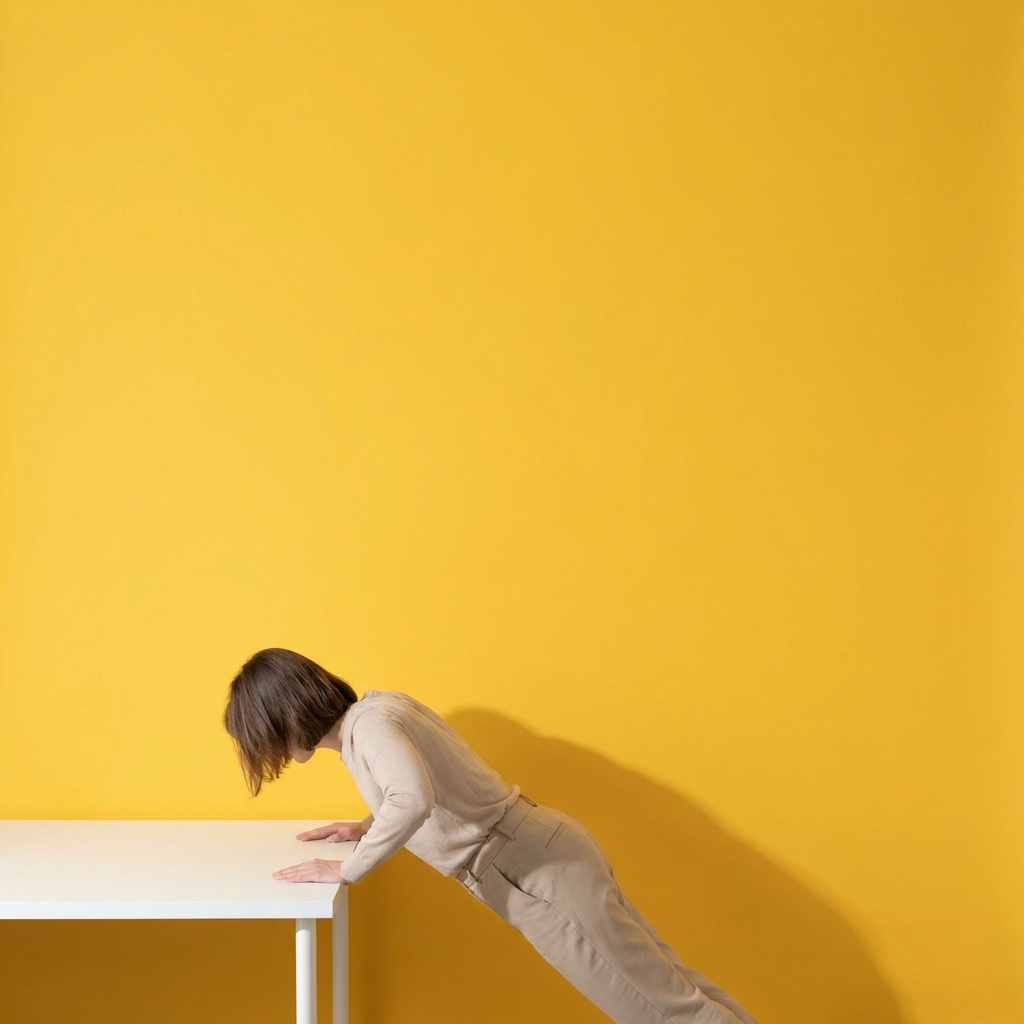
- Desk push-ups (45 seconds): Place hands on the edge of the desk with feet back so the body is at an angle (not a full floor push-up). Lower the chest toward the desk, then push back up. Do this for 45 seconds. Modify by moving feet closer to the desk if full push-ups feel too hard.
- Toe raises (45 seconds): Stand and rise up onto the toes, then lower back down, in rhythm. Do this for 45 seconds. Engage the calves, which pump blood upward and increase circulation throughout the body.
Total time: 3 minutes. This one feels like work. That is the point – it produces the biggest energy shift. The muscles that move the most blood are in the legs, not the arms.
The end-of-day reset (2 minutes)
Do this at 4:30pm when afternoon fatigue is deepest.
- Rapid arm circles (30 seconds): Do 15 fast arm circles forward, 15 backward. Let the movement be rhythmic and energetic.
- Chair squats (60 seconds): 15-20 squats done quickly (but controlled). Do not pause at the bottom.
- Wall push or desk push-up (30 seconds): If space allows, do a wall push (hands on a nearby wall, body at an angle, doing push-up movements). If not, desk push-ups. Just 10-15 reps. The goal is a quick burst, not a full set.
Total time: Under 2 minutes. This one should feel like a sprint – quick, intense, energizing.
Desk exercises for the open office: discreet movements that do not announce fitness
The biggest barrier to desk exercise is not knowledge. It is self-consciousness. Nobody wants to be the person doing squats at their desk during a conference call. For many office workers, self-consciousness is a bigger barrier to desk exercise than lack of motivation.
The best desk exercises look like fidgeting, not fitness. Seated marching looks like someone bouncing their knee – a nervous habit. Seated arm circles and torso rotations look like stretching. Desk push-ups look like checking something at desk level. None of these office exercises to boost energy broadcast “I am exercising.”
Seated marching (the anchor movement for the routine) requires only that knees bounce in rhythm, arms pumping gently. Coworkers see someone focused at their desk. They do not see fitness.
Seated torso twists and arm circles look identical to the desk stretches for alertness most office workers do intuitively after sitting for hours. Lean into this. Do them casually. No one gives it a second look.
Chair squats are the one movement that looks deliberate. If the office is open and self-consciousness is a factor, do these in a private space (bathroom stall, empty conference room, hallway) or modify to seated hip circles – still in the chair, shifting weight side to side in rhythm. It is less effective but still produces an energy shift.
Desk push-ups are legitimately discreet. The desk blocks the view of the upper body from most angles. Anyone passing will not see arms bending.
The core principle: Start with the movements that feel least conspicuous (seated marching, arm circles). As they become regular, the realization sets in that nobody is watching and nobody cares. Self-consciousness drops. After two weeks, the focus shifts from how it looks to how the energy boost feels.
Building the desk exercise habit: from knowing to doing
Knowing these routines exist is not the same as doing them. The gap between knowing and doing is where most people stall. For a detailed guide on building a movement habit at work, that resource covers the psychology of consistency in depth.
Start with one trigger. Do not try to add exercises to all four daily windows at once. Pick the worst energy slump – usually 2pm – and commit to the 3-minute afternoon routine at that exact time for two weeks. Pair it with an existing habit (after lunch, before the 1:30pm meeting, when the afternoon email check finishes) and the pairing makes it automatic. Our habit formation guide covers the psychology of why pairing works.
Track for two weeks. Use a phone calendar, a habit tracker, or a simple check-mark on a sticky note. Seeing the pattern accumulate builds momentum. The energy shifts compound – by week two, anticipation of the routine develops, tied to knowing how good the next 30 minutes will feel.
Add a second window. After the 2pm routine is automatic, add the 11am pre-lunch routine. Do not do them together – do them separately on different schedules. Same two-week ramp.
The realistic progression: In our experience, by week 4-6, two windows are automated. By week 8-10, three windows feel automatic. By week 12, all four feel natural, and Radwan et al. (2022) found measurable improvements in vitality and mental health at that stage of consistent practice [2]. Starting with one energy window and building to four over 12 weeks produces lasting desk exercise habits that survive schedule disruptions.
If a day gets missed, do not restart. One missed routine does not break the habit. Skip Tuesday’s 2pm routine? Do Wednesday’s. The streak resets, but the habit does not.
Common obstacles and how to solve them
Problem: “I am too tired to even start these exercises”
This is the real trap. When the grip of a 2pm energy crash takes hold, the thought of any physical effort feels like climbing a mountain.
Solution: Start absurdly small. Do not do the full 3-minute routine. Do 30 seconds of seated marching – just knee bouncing with arms pumping. The barrier to starting is always higher than the barrier to continuing.
Once movement has lasted 30 seconds, momentum carries through. Most people who start with a 30-second minimum end up doing the full routine.
Problem: “I share a cubicle and everyone will see me”
Real constraint. Open offices create legitimate self-consciousness.
Solution: Use the discreet movements (seated marching, arm circles, torso twists) for the public routine. For anything that feels more conspicuous (chair squats, push-ups), find a transition space – the hallway outside the office, the bathroom, an empty conference room, the stairwell.
Three minutes away from the desk is acceptable. Back in five minutes, and nobody thinks it is unusual to step away.
Problem: “I have back-to-back meetings and no window for exercises”
If the calendar is wall-to-wall, that is a scheduling problem, not an exercise problem. But within that constraint:
Solution: Do 60-second micro-exercises during transitions. Between calls, do 30 seconds of seated marching and 30 seconds of arm circles. Before the next meeting starts, do 10 desk push-ups or 10 chair squats in the hallway.
Sixty-second movement micro-doses scattered throughout the day produce cumulative energy shifts. They are not as powerful as a consolidated 3-minute routine, but they require zero calendar space. Small doses scattered beat large doses skipped.
Problem: “I tried desk exercises once and they did not help”
One or two attempts are not enough to train the body to expect the energy shift. The nervous system needs consistency to rewire its response.
Solution: Commit to the 2-week minimum with the 2pm routine. By day 10-12, the body starts anticipating the movement and priming the energy system. Day 3 might feel useless. Day 12 will feel like a different workday.
The difference is consistency, not luck. For more on why prolonged sitting creates this fatigue pattern, see our guide on sitting disease and cognitive decline.
Ramon’s take
I changed my mind about desk exercises a few months ago. I had dismissed them as insufficient – I figured if I was not sweating, the movement did not count. What shifted my thinking was three straight days of the 2pm seated marching routine, when I noticed my 3pm focus was sharper than my 10am focus. The dose required is almost comically small, and the point is not fitness – it is breaking the sitting pattern before the pattern breaks your energy.
Conclusion
Desk exercises for office workers are not a productivity hack or a fitness substitute. They are a tactical intervention for the specific energy dips built into the workday. The Energy Slump System matches movements to circadian rhythm and sitting-induced fatigue patterns, removing the guessing game about stretching versus something more intense.
The barrier to energy during the workday is not motivation. It is timing and knowing which movement works when.
A 3-minute routine at 2pm produces more energy shift than a 5-minute routine at 4:45pm when the system is already powering down. Desk exercises require no equipment, no changing clothes, and no floor space – they look like fidgeting and stretching to coworkers.
Desk exercises fit into a calendar with back-to-back meetings. Most importantly, they work fast enough that the shift is felt during the same afternoon. The next time your eyelids get heavy at 2pm, three minutes of seated marching will do what your third coffee cannot.
Next 10 minutes
- Identify the worst daily energy crash (usually 2-3pm for most office workers)
- Open the calendar and block 3-5 minutes at that time for the next two weeks – treat it like a meeting that cannot be missed
- Test the corresponding routine from this article once today and notice the energy shift in the next 30 minutes
This week
- Commit to the chosen routine at the same time every day for 7 days straight (do not miss a day during week 1)
- After one full week of the main routine, add a second routine to a different time window
- Track compliance on a phone calendar or a piece of paper – seeing the pattern accumulate builds momentum
There is more to explore
For targeted help with pain caused by sitting, see our guide on back pain from desk work solutions. If the afternoon crash extends beyond what movement can fix, our caffeine and productivity science guide covers how to time caffeine so it supports movement breaks rather than replacing them.
For exercise routines designed for mental clarity, that guide goes deeper into longer routines outside the office.
Related articles in this guide
- desk-stretches-between-meetings
- exercise-routines-for-mental-clarity
- exercise-snacking-for-busy-professionals
Frequently asked questions
What desk exercises give you the most energy?
Seated marching with arm drives for 90 seconds produces a bigger alertness shift than 5 minutes of passive hamstring stretches. Chair squats (10-15 reps) and desk push-ups (10 reps) rank next because they engage the largest muscle groups. The key is dynamic, rhythmic movement rather than static holds – sustained rhythm at moderate intensity beats brief intense bursts for sustained energy.
How many desk exercises should I do to feel more alert?
Two to five minutes total is the effective range. Radwan et al. (2022) found that active microbreaks of 2-3 minutes produce improvements in physical and mental well-being [2]. The Energy Slump System routines are designed to fit into 2-5 minute windows at each energy dip. Consistency and timing matter more than duration – a 3-minute routine at 2pm works better than a 10-minute routine at 4:30pm when energy is already declining.
When is the best time to do desk exercises?
For standard 9-to-5 schedules, 2-3pm is the worst crash and the highest-return window. For shift workers or non-standard schedules, target the point roughly 6-8 hours after waking – that is when the circadian dip hits regardless of clock time. The most effective approach is to do the main routine at the same time every day so the body anticipates the movement and energy boost.
Can desk exercises help with afternoon fatigue?
Yes. Monk (2005) documented the afternoon dip as driven by circadian sleep propensity rather than food intake [4]. The Energy Slump System’s 3-minute afternoon crash routine targets this exact state. If the routine does not help after two consistent weeks, the fatigue may have other causes – poor sleep, nutritional gaps, or medical factors worth discussing with a doctor.
Do I need to break a sweat for desk exercises to boost energy?
No. Breaking a sweat is not required and often signals overexertion for the goal of energy management. A 3-minute seated marching routine may raise heart rate modestly, but arriving at the next meeting breathless is not the goal. The energy boost comes from movement and increased oxygen delivery to the brain, not from intense exertion.
What desk exercises can I do discreetly without others noticing?
Seated marching (bouncing knees and pumping arms gently) looks like fidgeting. Arm circles and torso twists look like stretching. Desk push-ups are hidden by the desk surface. Chair squats are the most conspicuous movement – do these in a hallway or private space if the office is open. Seated marching and arm circles blend into the workday without announcing fitness activity.
How quickly will I feel more energized after desk exercises?
Most people notice a mental clarity shift within the first few minutes of starting rhythmic movement. Fischetti et al. (2024) found a statistically significant increase in alertness after ten-minute physical activity breaks [5]. Physical energy and alertness build over the first 2-3 minutes. The full effect compounds over days and weeks of consistent practice.
How do desk exercises compare to coffee for energy?
Coffee provides rapid alertness through stimulation, but its mean half-life of approximately 5 hours means it lingers in the system long after the alertness fades [1]. Desk exercises boost energy through circulation, endorphin release, and nervous system activation without a subsequent crash. Both work. The advantage of movement is sustainability and lack of side effects like jitteriness or sleep disruption.
References
[1] Institute of Medicine (US) Committee on Military Nutrition Research. “Caffeine for the Sustainment of Mental Task Performance: Formulations for Military Operations.” National Academies Press, 2001. Link
[2] Radwan, A., Barnes, L., DeResh, R., Englund, C., & Gribanoff, S. “Effects of active microbreaks on the physical and mental well-being of office workers: A systematic review.” Cogent Engineering, 2022. DOI
[3] Ogoh, S., & Ainslie, P. N. “Cerebral blood flow during exercise: mechanisms of regulation.” Journal of Applied Physiology, 2009. DOI
[4] Monk, T. H. “The post-lunch dip in performance.” Clinics in Sports Medicine, 2005. Link
[5] Fischetti, F., Pepe, I., Greco, G., Ranieri, M., Poli, L., Cataldi, S., & Vimercati, L. “Ten-Minute Physical Activity Breaks Improve Attention and Executive Functions in Healthcare Workers.” Journal of Functional Morphology and Kinesiology, 2024. Link