The kid who can’t sit still builds a volcano in 40 minutes flat
You’ve seen it happen. The ADHD learner who zones out during a 10-minute lecture locks into a creative project for an hour without blinking. Creative learning for ADHD isn’t feel-good motivation. It’s neurology matching structure.
The neurobiological basis starts with dopamine. Castellanos and Tannock’s analysis of ADHD research (2002) shows that ADHD brains have reduced dopamine responsivity in reward pathways – meaning routine, repetitive information produces little motivational signal [1]. Novel information, by contrast, triggers a dopamine surge that activates dopamine-driven learning in ways traditional instruction rarely generates.
And Martine Hoogman’s 2020 review across 31 behavioral studies found that subclinical ADHD traits correlate with higher divergent thinking scores, though results for clinically diagnosed ADHD were mixed [2]. The creative capacity is real. The gap is in learning structures that match it.
Creative learning for ADHD is an instructional approach that uses novelty, multi-sensory input, and project-based activity to deliver academic or skill-based content in formats compatible with ADHD attention patterns, distinct from traditional accommodation strategies that modify pacing or environment without changing the learning modality itself.
What you will learn
- Why the ADHD brain’s novelty drive is a learning engine, not a defect
- A framework for connecting creative activity to structured learning outcomes
- Six daily rituals that turn ADHD creative energy into retained knowledge
- How to design ADHD-friendly projects that sustain focus across weeks
- What to do when the system breaks down on a bad ADHD day
Key takeaways
- ADHD novelty-seeking and divergent thinking are creative learning assets, not barriers.
- The Novelty-Structure Bridge connects ADHD’s creative drive to measurable learning outcomes.
- Visual encoding creates two retrieval pathways, compensating for ADHD working memory gaps [6].
- Project-based learning for ADHD works best with short milestones and format variety.
- Mind wandering substantially improved creative insight compared to continuous focus [9].
- Music engages overlapping brain networks for reward, emotion, and memory [7].
- Art-based activities reduce working memory load by routing content through visual pathways [6].
- Tiered activities for variable energy days prevent bad days from breaking the system.
Why are ADHD brains wired for creative learning?
The neurology that makes traditional classrooms painful for ADHD learners is exactly what makes creative work feel effortless. Castellanos and Tannock’s landmark analysis, published in Nature Reviews Neuroscience (2002), identified dopamine dysfunction in the mesolimbic reward pathway as a core ADHD mechanism [1]. Routine stimuli produce weak motivational signals. But novel, sensory-rich input triggers a dopamine surge that traditional instruction rarely generates.
Martine Hoogman’s 2020 analysis of 31 studies found that subclinical ADHD traits correlate with higher scores on divergent thinking tasks, though the relationship is less consistent for clinically diagnosed ADHD [2]. But here’s what matters for learning. Boot, Nevicka, and Baas (2020) showed that adults with ADHD generated more original ideas when given competitive framing for a task [3].
“Adults with ADHD reported more real-world creative achievements and generated more original ideas under competitive conditions.” – Boot, Nevicka, and Baas, 2020 [3]
Creative formats aren’t a consolation prize for ADHD learners – they’re the vehicle through which ADHD brains learn most effectively. The same student who can’t remember a list of vocabulary words builds a detailed model from memory. The learning isn’t happening despite the creative format. It’s happening because of it.
Divergent thinking is a cognitive process that generates multiple possible solutions to open-ended problems by exploring many different directions, distinct from convergent thinking which narrows options toward a single correct answer.
Divergent thinking – generating multiple solutions to open-ended problems – is where ADHD learners often outperform peers. A 2022 study by Girard-Joyal and Gauthier found that adults with ADHD-Combined presentation scored higher on creativity measures than those with ADHD-Inattentive presentation alone [4]. The hyperactive component (often treated as the biggest classroom problem) may actually be the engine of creative output.
This reframes the entire conversation. The question shifts from “how do we make this person pay attention?” to “how do we deliver content through a channel that activates their attention naturally?” That shift underlies every strategy that follows. For a broader view of how creativity and learning intersect for all learners, our guide on creativity and learning strategies covers the full spectrum.
The problem isn’t ADHD attention capacity. The problem is ADHD-incompatible instruction.
What is the novelty-structure bridge for ADHD learning?
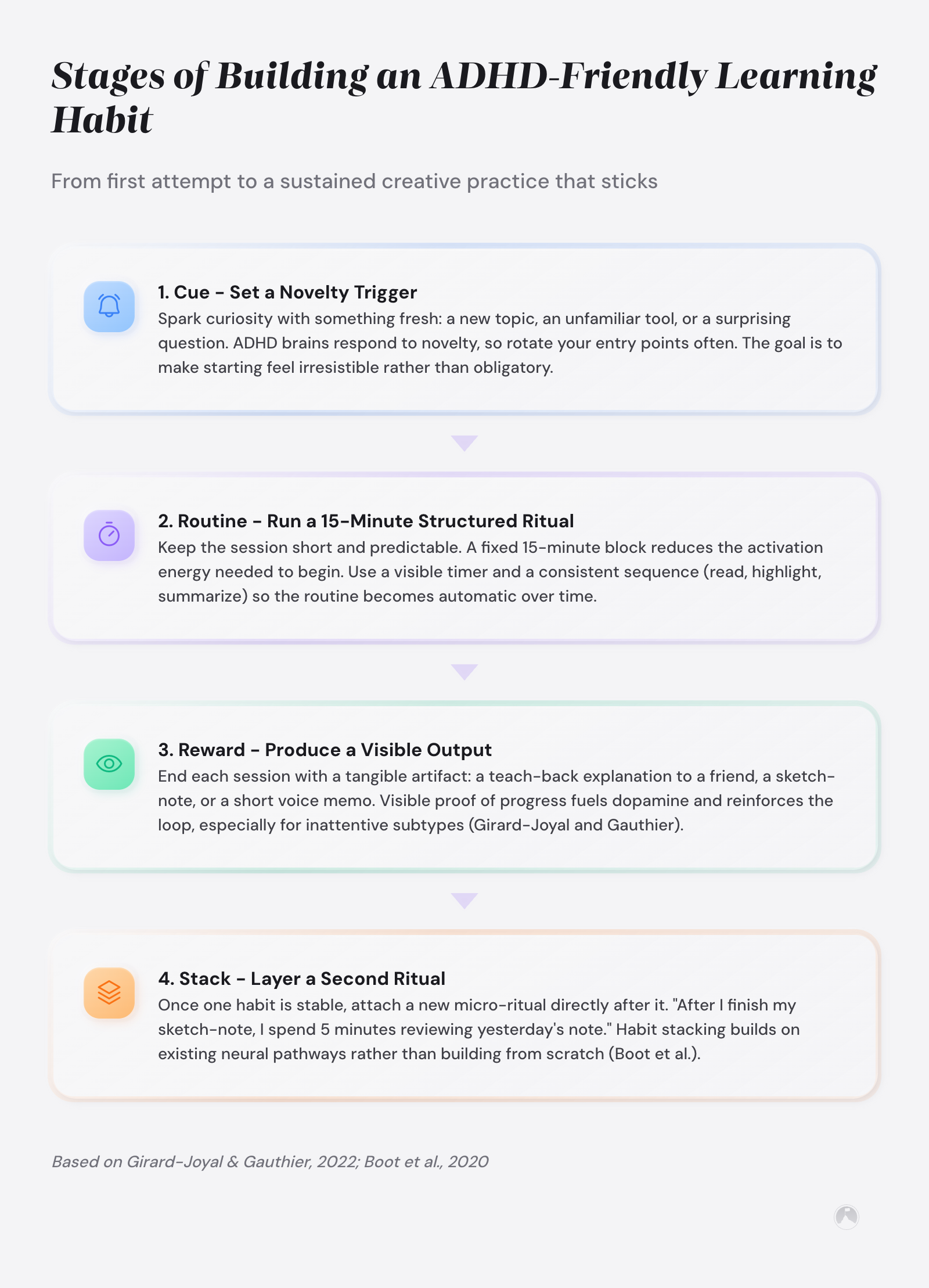
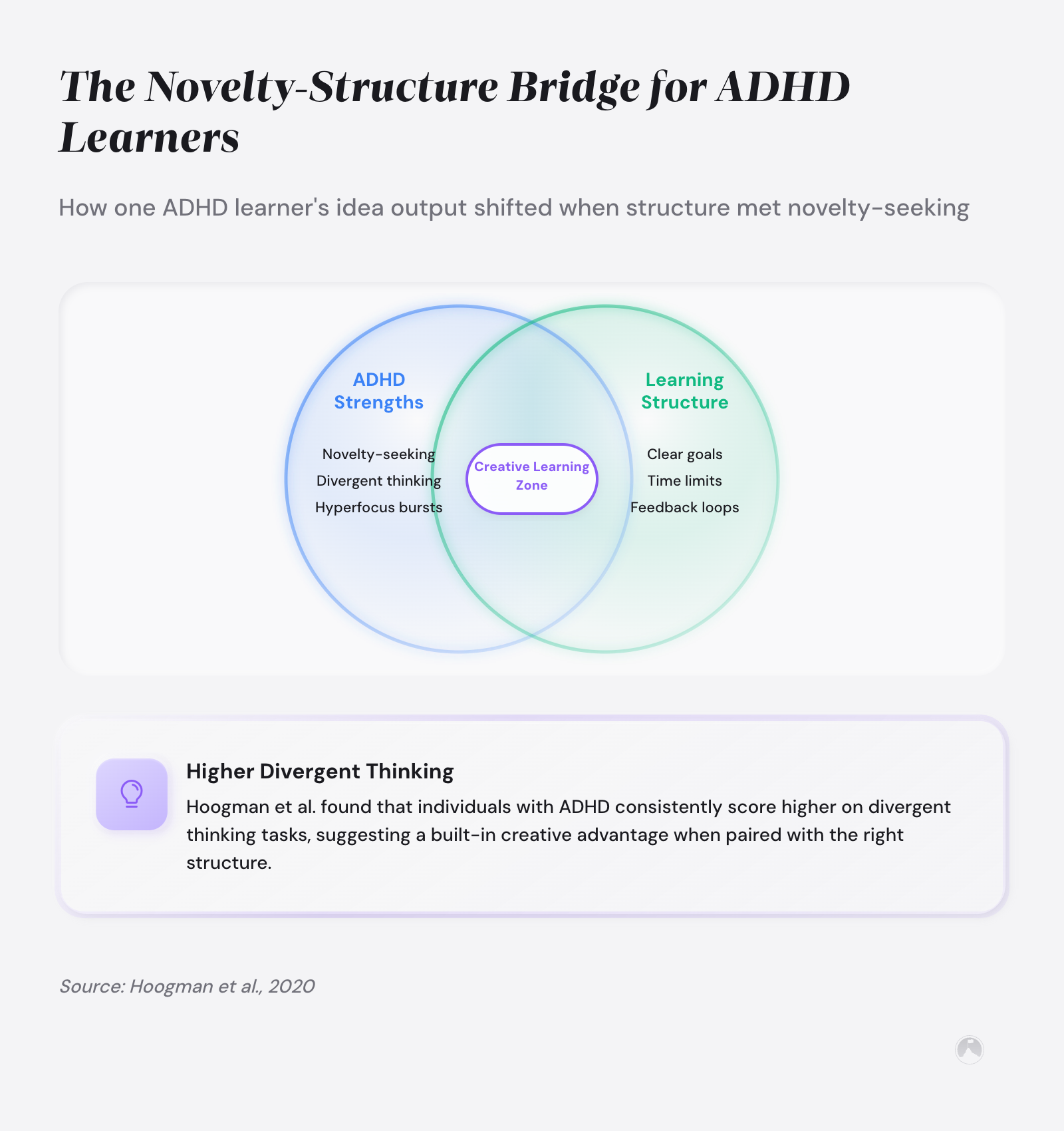
Here’s a pattern that keeps appearing in ADHD learning research. Creative novelty alone isn’t enough. Structure alone doesn’t work either. The sweet spot sits in the overlap — what we call the Novelty-Structure Bridge.
The Novelty-Structure Bridge is a framework that pairs novel creative activities with minimal structural guardrails to convert ADHD attention bursts into retained learning. It combines novelty-seeking research from ADHD neuroscience with structured support principles from Universal Design for Learning (UDL), but using them together produces results neither achieves independently.
The framework has three parts: a novelty trigger (something that activates interest), a learning anchor (the specific knowledge or skill being targeted), and a capture mechanism (how the learning gets recorded before the attention window closes).
Take a concrete example. An adult ADHD learner wants to study behavioral economics. Reading a textbook chapter produces nothing. But drawing a one-page comic explaining the endowment effect to a fictional character? That’s novelty (drawing), learning anchor (endowment effect definition and mechanism), and capture (the comic page as a tangible artifact to review later).
Frolli and colleagues’ 2023 study, published in Children, found that when educators provided multiple means of representation and action – a core UDL principle – ADHD students showed improved performance in reading, writing, and arithmetic [5]. The key mechanism is choice: when learners select how to engage with content, ADHD brains spend less cognitive energy on format negotiation and more on actual learning.
Achieving ADHD focus through creativity is not about lowering standards — it is about changing the delivery channel. The practical application looks different depending on context. For parents, it means offering two or three creative format options for the same homework topic. For teachers, it means designing assignments with fixed learning outcomes but flexible expression methods. For adult self-directed learners, it means rotating through creative formats every 1-2 weeks before novelty wears off.
To apply the Novelty-Structure Bridge to your current learning goal, answer three questions: (1) What format would make this content genuinely interesting? That is your novelty trigger. (2) What specific knowledge or skill must you walk away with? That is your learning anchor. (3) How will you capture the output before the attention window closes? That is your capture mechanism.
Learning systems designed for ADHD need a rotating novelty layer built on top of stable learning objectives.
What creative learning rituals work with ADHD wiring?
Each ritual uses a different sensory channel to deliver learning content. Match the ritual to the learner’s current energy level and interest – not all six every day. Variety is the point.
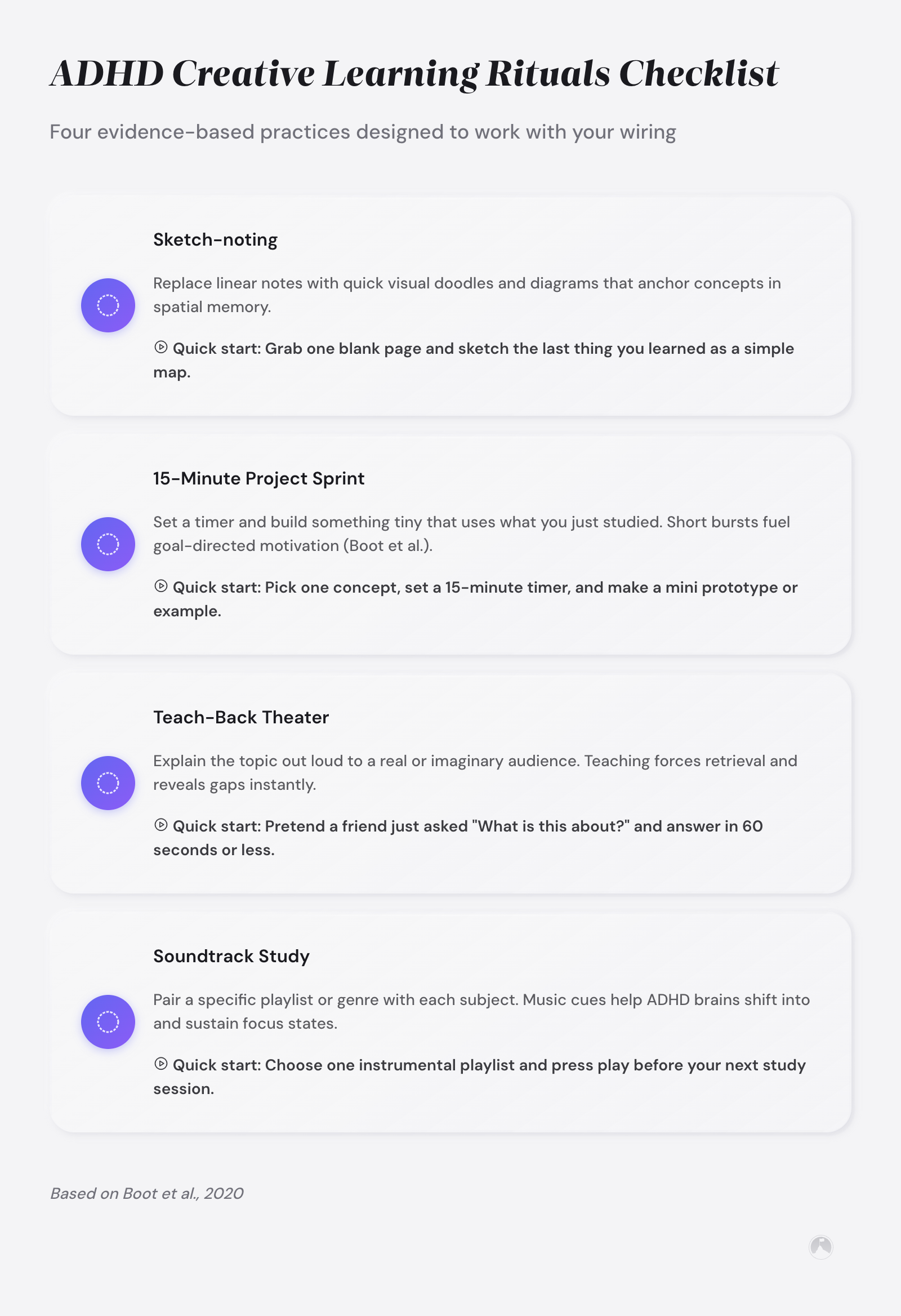
1. Sketch-noting (visual learning techniques for ADHD)
Sketch-noting is a visual note-taking method that combines drawings, icons, arrows, and brief text to capture information spatially rather than linearly, creating dual encoding pathways for improved memory retention.
Replace traditional note-taking with sketch-notes – a combination of drawings, icons, arrows, and brief text that captures ideas spatially rather than linearly. A randomized controlled trial by Almuwaiziri and colleagues, published in the British Journal of Special Education (2023), found that when children with ADHD used visual representations to work through math problems, their performance improved significantly compared to text-only instruction [6].
During any learning session (lecture, podcast, reading), keep a blank page and 3-4 colored pens available. Draw main concepts as connected nodes rather than sequential notes. After the session, spend 5 minutes adding connections you notice between nodes. This works for children doing homework and adults studying for certifications alike.
Visual encoding creates two retrieval pathways instead of one – and for ADHD brains, that redundancy is the difference between remembering and forgetting.
2. The 15-minute project sprint (hands-on learning activities for ADHD)
Long study sessions don’t match ADHD attention cycles. Pick a single concept, set a 15-minute timer, and build something that demonstrates it – a model, a diagram, a short written scene, a recorded explanation. These hands-on learning activities give ADHD brains the tangible output they crave.
The timer creates artificial urgency that activates reward anticipation networks in the brain. ADHD brains show temporal discounting (they respond far more strongly to immediate rewards than delayed ones) [11]. The 15-minute window is short enough to create urgency without triggering anxiety, and the tangible output at the end provides an immediate dopamine hit that reinforces the learning behavior.
3. Teach-back theater (creative expression and ADHD)
After encountering new material, explain the concept out loud – to a person, a pet, a camera, or an empty room. The twist: make it entertaining. This activates the ADHD brain’s social and creative circuits simultaneously.
The entertainment constraint matters because it forces elaborative encoding — the process of connecting new information to existing knowledge through meaningful associations, which creates stronger and more retrievable memories than rote repetition [8]. Teaching through a creative lens – explaining photosynthesis using a cooking metaphor, for example – forces reorganization of the material through a creative filter.
Teaching a concept through a creative lens forces the deep processing that passive review will never replicate. For more on related techniques, our guide on creative thinking techniques covers additional frameworks that pair well with teach-back sessions.
4. Soundtrack study (music and ADHD focus)
Music activates ADHD focus through multiple overlapping mechanisms. Koelsch’s neuroscience review in Nature Reviews Neuroscience (2014) shows that music processing engages brain networks for reward, emotion, and memory simultaneously [7]. For ADHD brains, music provides external dopaminergic support during learning, compensating for the lower basal dopamine state that Castellanos and Tannock identified [1].
But the ritual goes beyond background music. For each topic being studied, create a short playlist (3-4 songs) that matches the emotional tone of the material. Studying the American Revolution? Find songs about rebellion. Studying probability? Find songs with unpredictable time signatures.
“Music processing activates overlapping networks with reward, emotion, and memory in the brain.” – Koelsch, 2014 [7]
Curating the playlist is itself a learning activity – it forces thinking about the emotional and conceptual core of the material. And the music provides an associative memory cue. Hearing those songs later can trigger recall of studied material. For ADHD learners responsive to auditory input, this is one of the most natural methods for learning new skills quickly.
5. The mind-wander capture (divergent thinking activities for ADHD)
Instead of fighting mind wandering, use it. After a focused learning block, deliberately set a 5-minute “wander window” where the learner does something unrelated – walks, doodles, plays with a fidget toy. Keep a capture tool nearby (voice memo, index card, whiteboard).
Research by Baird and colleagues (2012) found that deliberate mind-wandering substantially improved creative insight compared to continuous focus or demanding alternate tasks [9]. This happens because mind-wandering activates the brain’s default mode network, which specializes in making unexpected connections between stored knowledge domains.
For ADHD brains, this network tends to be more active during task performance than in neurotypical brains – which is both the source of distraction and (when paired with a capture system) the source of original thinking.
“Participants who engaged in mind-wandering between problem-solving attempts showed significantly better insight-based solutions than those who stayed continuously focused.” – Baird et al., 2012 [9]
Over time, the capture system builds a collection of original ideas and cross-domain links that traditional study never generates. Mind wandering paired with a capture system converts ADHD’s most criticized trait into a consistent source of original thinking.
6. Art-based projects (art therapy for attention deficit)
Art-based learning goes beyond sketch-noting into full creative production – painting a scene that represents a historical period, sculpting a model of a molecular structure, or designing a poster that explains a scientific concept. The difference between art therapy for attention deficit and traditional art class is intentional content anchoring: every artistic choice maps to a learning objective.
Almuwaiziri’s RCT (2023) showed that self-constructed visual representations outperformed passive ones [6]. Building something from scratch forces deeper engagement than copying or coloring a pre-made template. And the physical nature of art projects (mixing paint, shaping clay, arranging collage elements) provides the sensory input that ADHD brains need to sustain attention.
So a child studying the water cycle doesn’t just read about it – they paint a mural showing evaporation, condensation, and precipitation, explaining each stage as they go. The art is the learning, not a reward for finishing the “real” work. When the creative medium carries the content, ADHD attention follows naturally.
For sketch-noting, apps like Concepts or GoodNotes provide infinite canvas space that matches ADHD nonlinear thinking. For the mind-wander capture system, a voice memo app with one-tap recording removes friction. For project milestone tracking, a simple kanban board in Trello or Notion keeps deliverables visible without adding complexity.
How does project-based learning for ADHD students sustain focus?
Project-based learning for ADHD is an educational approach that structures learning around multi-step creative projects with short milestones and varied output formats, designed to sustain ADHD attention across weeks by preventing novelty decay and providing recurring completion rewards.
Short rituals handle daily learning. But bigger goals – mastering a subject, completing a course, building a portfolio – require multi-week projects. And multi-week projects are where ADHD learners most commonly stall.
The excitement of starting fades, the middle stretch feels monotonous, and the project joins a growing pile of abandoned beginnings. The fix is structural, not motivational.
Working memory research shows that verbal and visual-spatial systems operate as partially independent channels [10]. For ADHD learners with constrained verbal working memory, routing content through visual-spatial encoding — converting information into drawings, spatial maps, or models — provides an alternative processing pathway. ADHD-friendly projects need three design elements built in from the start.
Milestone frequency matters more than milestone size for ADHD project completion. Break the project into small chunks (typically 3-7 days), each with a visible deliverable. Not “research phase” (too vague) but “produce a one-page mind map of the three main theories” (specific and completable).
| Design element | ADHD-adapted approach | Why it works |
|---|---|---|
| Timeline | Instead of a single end deadline, use 3-7 day milestones with visible deliverables | Creates recurring dopamine from completion |
| Format variety | Instead of the same format throughout, use a different creative format per milestone | Prevents novelty decay across weeks |
| Accountability | Instead of self-monitored progress, use external check-ins or share points at each milestone | ADHD responds better to social accountability |
| Scope management | Instead of fixed scope with flexible time, use fixed time per milestone with flexible scope | Prevents perfectionism spirals and scope creep |
| Re-entry plan | Instead of picking up where you left off, start each milestone with a 2-minute review ritual | Compensates for ADHD working memory gaps [10] |
The second element is format variety within the same project. If every milestone requires the same output (written reports), novelty dies by milestone two. Instead, alternate formats: milestone one is a visual map, milestone two is a recorded explanation, milestone three is a hands-on model, milestone four is a written synthesis.
The third element is a re-entry ritual. ADHD learners lose context between sessions faster than neurotypical learners due to working memory differences [10]. Every project session should start with a 2-minute review of the previous milestone’s output – not rereading notes, but looking at the tangible artifact they created.
The artifact triggers associative memory far more effectively than text notes. This is where building a personal learning system becomes critical – the system holds context when the brain can’t.
External learning systems don’t replace ADHD working memory. External systems compensate for working memory gaps by holding context between sessions. For anyone exploring how creative hobbies can fuel this kind of interest-driven learning, our guide on leveraging hobbies for a creativity boost covers how interest-driven activities transfer to broader learning.
What should you do when creative learning stalls on bad ADHD days?
Any system designed for ADHD that doesn’t account for bad days is a system waiting to collapse. The ADHD brain has variable energy and focus levels day to day (sometimes hour to hour). A creative learning approach that requires high output every session will fail the first time the learner hits a low-dopamine morning.
A tiered activity model is a learning system that pre-assigns different activity types to three energy levels (high, medium, low), ensuring that variable ADHD focus days maintain contact with learning material without requiring consistent peak performance.
The solution is a tiered activity model. Plan for three energy levels and have activities ready for each.
High energy: Full creative project work. New milestones, teach-back sessions, sketch-noting from new material. Deep encoding happens here.
Medium energy: Review previous artifacts, add connections to sketch-notes, curate playlists. Maintenance activities that keep the learning thread alive without requiring new production.
Low energy: Passive intake only. Watch a documentary on the topic. Listen to a relevant podcast. Flip through previous sketch-notes without pressure to produce anything new.
The critical rule: low-energy days still count. The goal isn’t maximum output every day. It’s maintaining contact with the material so re-entry cost on the next high-energy day stays low. Consistent contact with learning material matters more than consistent intensity for ADHD knowledge retention.
Two common failure patterns deserve specific attention. The first is hyperfocus misdirection – when the ADHD brain locks onto a creative tangent rather than the intended learning target. The fix isn’t to suppress the tangent. Write it down on a “parking lot” list and return to the planned session.
The second pattern is the post-novelty crash. Every creative format loses novelty after a while. When sketch-noting starts feeling routine, that’s not a learner failure – it’s a signal to rotate to a different ritual from the list. Build the rotation into the plan from the start, and the crash becomes a transition rather than a crisis.
For deeper understanding of the brain science behind these patterns, our article on neuroplasticity and learning explains how the brain adapts to novel stimulation. And if blocks persist, overcoming creative blocks in learning offers targeted strategies.
Ramon’s take
Something about framing ADHD as a creative strength still feels like we’re just doing the opposite of shaming it. Both approaches start from the same place: the kid needs fixing. I’m not sure rebranding the problem gets us where we need to go. Am I reading that wrong?
The conventional approach is to accommodate the person to the container — modified pacing, extended time, separate testing rooms. But the best outcomes I’ve seen in the research come from fixing the container, not the person. Give an ADHD learner a project with clear milestones and creative freedom within each milestone, and the “attention problem” tends to solve itself. The techniques in this article aren’t accommodations or workarounds. They’re what learning should look like when you design it for how the brain works rather than for administrative convenience. The mindset shift required connects to broader growth principles — our guide on cultivating a growth mindset for lifelong learning covers how flexible attitudes toward learning produce better long-term results.
Conclusion
Creative learning for ADHD is not a workaround for broken attention. It’s a design approach that matches instruction to neurology. The ADHD brain’s demand for novelty, sensory richness, and variable attention isn’t a bug – it’s the specification sheet.
The ADHD learner who can’t sit through a lecture but absorbs an entire subject through creative projects isn’t demonstrating inconsistency. They’re demonstrating exactly how their brain was built to acquire knowledge. The failure was never the ADHD learner’s. The failure belonged to the instructional format.
Next 10 minutes
- Pick one topic you or your learner is currently studying and choose one ritual from the six listed above to try with it today.
- Set up a capture tool (index card, phone voice memo, or whiteboard) within arm’s reach of the study space for mind-wander moments.
This week
- Design one current assignment or learning goal using the Novelty-Structure Bridge: identify the novelty trigger, the learning anchor, and the capture mechanism.
- Try three different rituals from the list over the next seven days and note which one produces the strongest focus response.
- Build a tiered activity plan with activities for high, medium, and low energy days so a bad day doesn’t break the streak.
There is more to explore
If you want the full picture of how creativity and learning connect beyond ADHD, start with our guide on creativity and learning strategies. If the brain science behind novelty-driven attention interests you, our article on neuroplasticity and learning explains the underlying mechanisms. And for ADHD learning strategies that work across different contexts, our roundup of the best learning apps highlights options that support non-traditional learning styles.
Related articles in this guide
- creative-thinking-techniques
- cultivating-a-growth-mindset-for-lifelong-learning
- learning-methods-compared
Frequently asked questions
Does ADHD medication reduce the benefits of creative learning?
Research on psychostimulants and creativity in ADHD shows mixed results. Hoogman’s 2020 review found that some studies report decreased divergent thinking on medication while others find no change [2]. The practical approach is to test creative learning activities both on and off medication days and note which produces stronger engagement and retention for the individual learner.
Can creative learning for ADHD work in traditional classroom settings?
Creative learning for ADHD can work within traditional classrooms through small modifications rather than full redesign. Offering two format options for the same assignment (written report or visual presentation), allowing sketch-noting during lectures, and building in 2-minute movement breaks between subjects introduce novelty without disrupting classroom structure. The UDL framework supporting these adaptations has shown improved outcomes in standard school settings [5].
What are the best ADHD creative thinking strategies for adults?
Adult ADHD learners benefit from self-directed creative rituals including sketch-noting, 15-minute project sprints, teach-back sessions, and mind-wander capture protocols. The critical difference for adults is building in format rotation every 1-2 weeks to prevent novelty decay. Adults should pair each creative format with a specific capture mechanism – voice memos, index cards, or digital notes – to preserve insights before the attention window shifts.
At what age should creative learning approaches for ADHD begin?
Creative learning approaches can begin as early as preschool, but the research base is strongest for school-age children (6-12) and adults. Almuwaiziri’s 2023 RCT worked with children aged 9-11 [6]. For younger children, sensory-rich play that incorporates learning content serves the same function as formal creative rituals. For teens, the key adaptation is offering choice in creative format rather than assigning one.
What types of projects work best for ADHD students?
Projects with short milestones (typically 3-7 days), varied output formats per milestone, and visible deliverables at each stage work best. Avoid projects with a single distant deadline and uniform format requirements. Effective ADHD projects let the student choose their expression method (drawing, building, recording, writing) for each stage. Include a 2-minute re-entry review ritual at the start of each session to compensate for working memory gaps between project days [10].
Can creative learning reduce ADHD stress and anxiety?
Creative activity activates the brain’s reward pathways through novelty and self-expression, which can counteract the stress response that ADHD learners experience during traditional instruction [1]. When a learning task feels genuinely interesting rather than coerced, cortisol levels tend to drop and dopamine levels rise. This doesn’t replace clinical anxiety treatment, but it removes the specific trigger of learning-related stress that accumulates in environments designed around sustained linear attention.
How do I help ADHD learners follow through on creative ideas?
The follow-through gap in ADHD is primarily an executive function challenge, not a motivation problem. Build external structure around the ideas: assign each idea a single next physical action, set a 15-minute timer to execute that action, and create a visible tracking system (kanban board or checklist). Parking lot lists for tangent ideas prevent distraction without losing creative insights. The goal is to reduce the cognitive load of deciding what to do next.
What are the benefits of visual learning for ADHD brains?
Visual learning reduces working memory load by offloading information into spatial patterns that the ADHD brain processes more efficiently than linear text. Almuwaiziri and colleagues (2023) found in an RCT that ADHD children using visual representations performed significantly better on problem-solving tasks than those using text-only instruction [6]. A concept encoded as both a visual image and a verbal label has two retrieval pathways instead of one, which compensates for the inconsistent recall that ADHD working memory differences create [10].
References
[1] Castellanos, F. X., & Tannock, R. (2002). “Neuroscience of attention-deficit/hyperactivity disorder: The search for endophenotypes.” Nature Reviews Neuroscience, 3(8), 617-628. https://doi.org/10.1038/nrn896
[2] Hoogman, M., Stolte, M., Baas, M., & Kroesbergen, E. (2020). “Creativity and ADHD: A review of behavioral studies, the effect of psychostimulants and neural underpinnings.” Neuroscience & Biobehavioral Reviews, 119, 66-85. https://doi.org/10.1016/j.neubiorev.2020.09.029
[3] Boot, N., Nevicka, B., & Baas, M. (2020). “Creativity in ADHD: Goal-Directed Motivation and Domain Specificity.” Journal of Attention Disorders, 24(7), 1007-1016. https://doi.org/10.1177/1087054717727352
[4] Girard-Joyal, O., & Gauthier, B. (2022). “Creativity in the Predominantly Inattentive and Combined Presentations of ADHD in Adults.” Journal of Attention Disorders, 26(9), 1316-1330. https://doi.org/10.1177/10870547211060547
[5] Frolli, A., Cerciello, F., Esposito, C., Ricci, M. C., Laccone, R. P., & Bisogni, F. (2023). “Universal Design for Learning for Children with ADHD.” Children, 10(8), 1350. https://doi.org/10.3390/children10081350
[6] Almuwaiziri, H., et al. (2023). “Visualisation to support children with attention-deficit/hyperactivity disorder learning to solve mathematical word problems: A randomised controlled trial.” British Journal of Special Education, 50(4), 452-470. https://doi.org/10.1111/1467-8578.12466
[7] Koelsch, S. (2014). “Brain correlates of music-evoked emotions.” Nature Reviews Neuroscience, 15(3), 170-180. https://doi.org/10.1038/nrn3666
[8] Craik, F. I., & Lockhart, R. S. (1972). “Levels of processing: A framework for memory research.” Journal of Verbal Learning and Verbal Behavior, 11(6), 671-684. https://doi.org/10.1016/S0022-5371(72)80001-X
[9] Baird, B., Smallwood, J., Mrazek, M. D., Kam, J. W., Franklin, M. S., & Schooler, J. W. (2012). “Inspired by distraction: Mind wandering facilitates creative incubation.” Psychological Science, 23(10), 1117-1122. https://doi.org/10.1177/0956797612446024
[10] Swanson, H. L. (1999). “What develops in working memory? A life span perspective.” Developmental Psychology, 35(4), 986-1000. https://doi.org/10.1037/0012-1649.35.4.986
[11] Patros, C. H. G., Alderson, R. M., Kasper, L. J., Tarle, S. J., Lea, S. E., & Hudec, K. L. (2016). “Choice-impulsivity in children and adolescents with attention-deficit/hyperactivity disorder (ADHD): A meta-analytic review.” Clinical Psychology Review, 43, 162-174. https://doi.org/10.1016/j.cpr.2015.11.001