
The blank page problem nobody warns you about
You opened a career development plan template, stared at the first field for ten minutes, and closed the document. It happens more than you’d think. A career development plan template works best when paired with a structured fill-in process that starts with self-assessment, not goal-setting. A 2020 study by Van Wart and colleagues found that career development training programs significantly increased career readiness among graduate and postdoctoral trainees in biomedical sciences – but only when the courses included clear prompts and structured self-assessment activities [1]. The template itself wasn’t the problem. The missing piece was a process for filling it in when you don’t yet know where you’re headed.
And most templates skip that process entirely. They hand you blank fields for “career vision” and “five-year goal” as if those answers were sitting in your back pocket. This guide gives you something different: a free career development plan template paired with a step-by-step process for how to create a career development plan – even when your direction feels uncertain.
A career development plan template is a structured document that maps a professional’s current skills, target goals, and specific action steps across a defined timeline. Unlike performance reviews or annual goal sheets, a career development plan functions as both a self-assessment tool and a growth roadmap.
You can use the table formats below as your career development plan template, or adapt them to a spreadsheet, Notion page, or document that fits your workflow.
What you will learn
- Why most career development plans get abandoned
- The 5P Career Blueprint framework for filling in your career planning template
- How to run a skills gap analysis without expensive assessments
- How to set SMART career development goals that stay relevant six months from now
- The 15-minute quarterly review that keeps your career roadmap alive
Key takeaways
- Career development plans fail when they start with goals instead of self-assessment and purpose alignment.
- The 5P Career Blueprint structures planning around Purpose, Position, Pathway, People, and Progress.
- A 2024 meta-analysis by Ng and colleagues examining employer-sponsored career development practices found meaningfully higher retention rates and performance in organizations with structured programs [2].
- A skills gap analysis comparing current capabilities to target role requirements prevents vague goal setting.
- Career goals need a 90-day action horizon paired with a flexible 2-year direction to stay motivating.
- A 15-minute quarterly review with three focused questions keeps career plans from collecting dust.
- Choosing between a management track and an individual contributor track is the first decision that unlocks the rest of the plan.
- Career goals tied to specific capabilities rather than job titles survive reorganizations and industry shifts.
Why do most career development plans get abandoned?
The standard career development plan template asks you to start with a vision statement. But research tells a different story about what drives career readiness. A meta-analysis by Whiston, Brecheisen, and Stephens examining career interventions found that structured, experiential approaches – where participants assessed real situations and worked through focused goal-setting – produced significantly stronger career decision outcomes than unstructured methods, with an overall weighted mean effect size of 0.352 for career counseling effectiveness [3]. Starting with reflection, not aspiration, is what separates plans that stick from plans that gather dust.
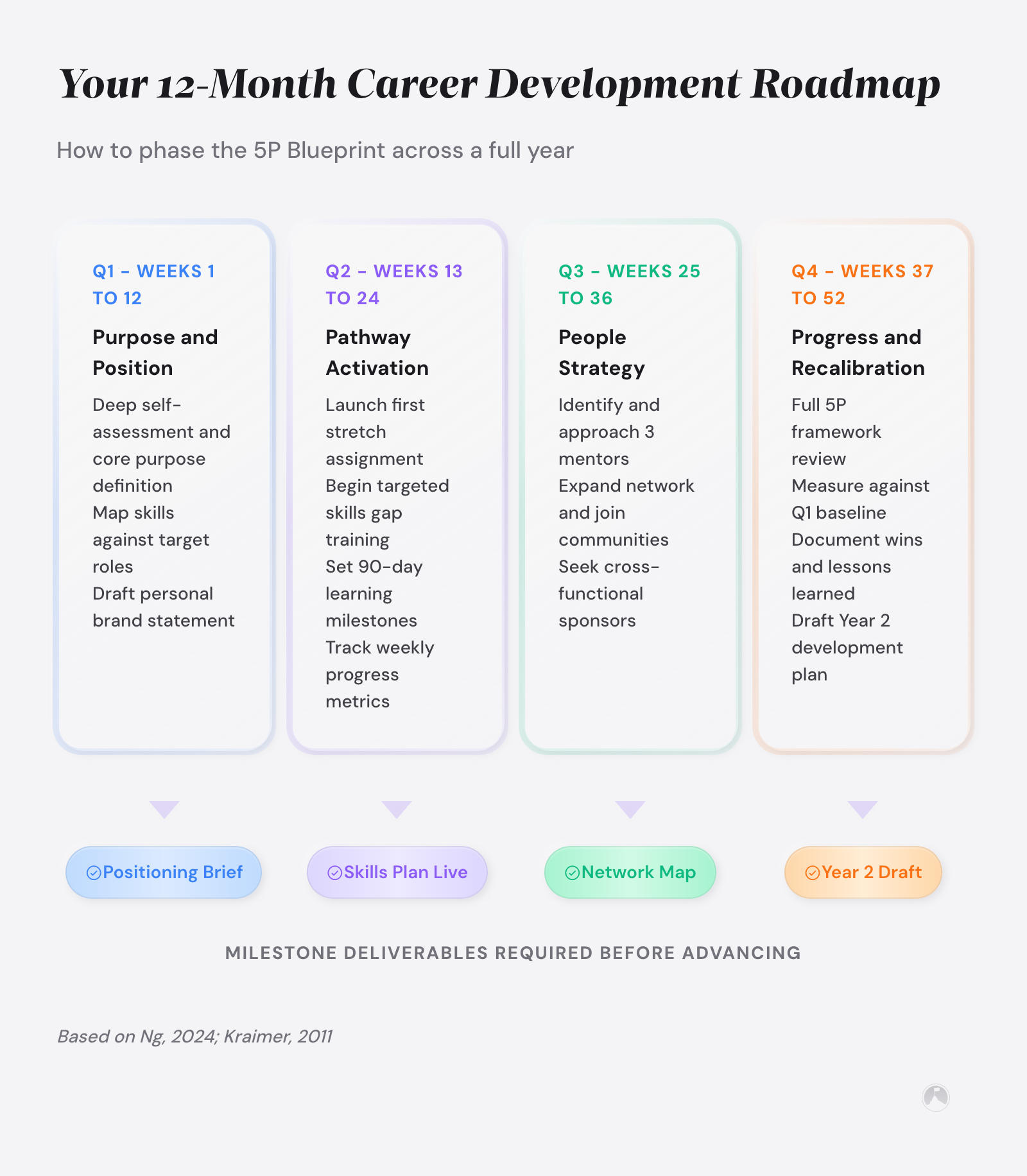
Three patterns kill most career development plans. First, the goals are disconnected from the person’s actual values and strengths. Second, the plan has no built-in review cadence, so it becomes a static document by month two. Third, the template treats career growth as a straight line when real careers zigzag (and sometimes loop back on themselves). Most people don’t realize any of this until they’ve already abandoned the plan.
According to a 2024 meta-analysis by Ng and colleagues examining employer-sponsored career development practices, organizations that implement structured career development programs see meaningfully higher retention rates compared to those without structured programs – confirming that investing in career development yields measurable returns in both employee performance and retention [2].
So the question isn’t whether a career development plan template is worth your time. It’s whether you’re filling it in the right order. The fill-in sequence of a career development plan matters more than the template format. If you’ve been building career connections but still feeling directionless, the issue is probably the planning process rather than the plan itself.
How does the 5P career blueprint framework structure your career development plan template?
Here’s a framework that keeps showing up when you study what makes career plans stick. Five phases, worked through in sequence, that turn a blank template into something you’ll actually use. None of these phases are new on their own – but working through them together produces a career development plan that’s both grounded and flexible. We developed the 5P Career Blueprint by synthesizing research on what makes structured career development work.
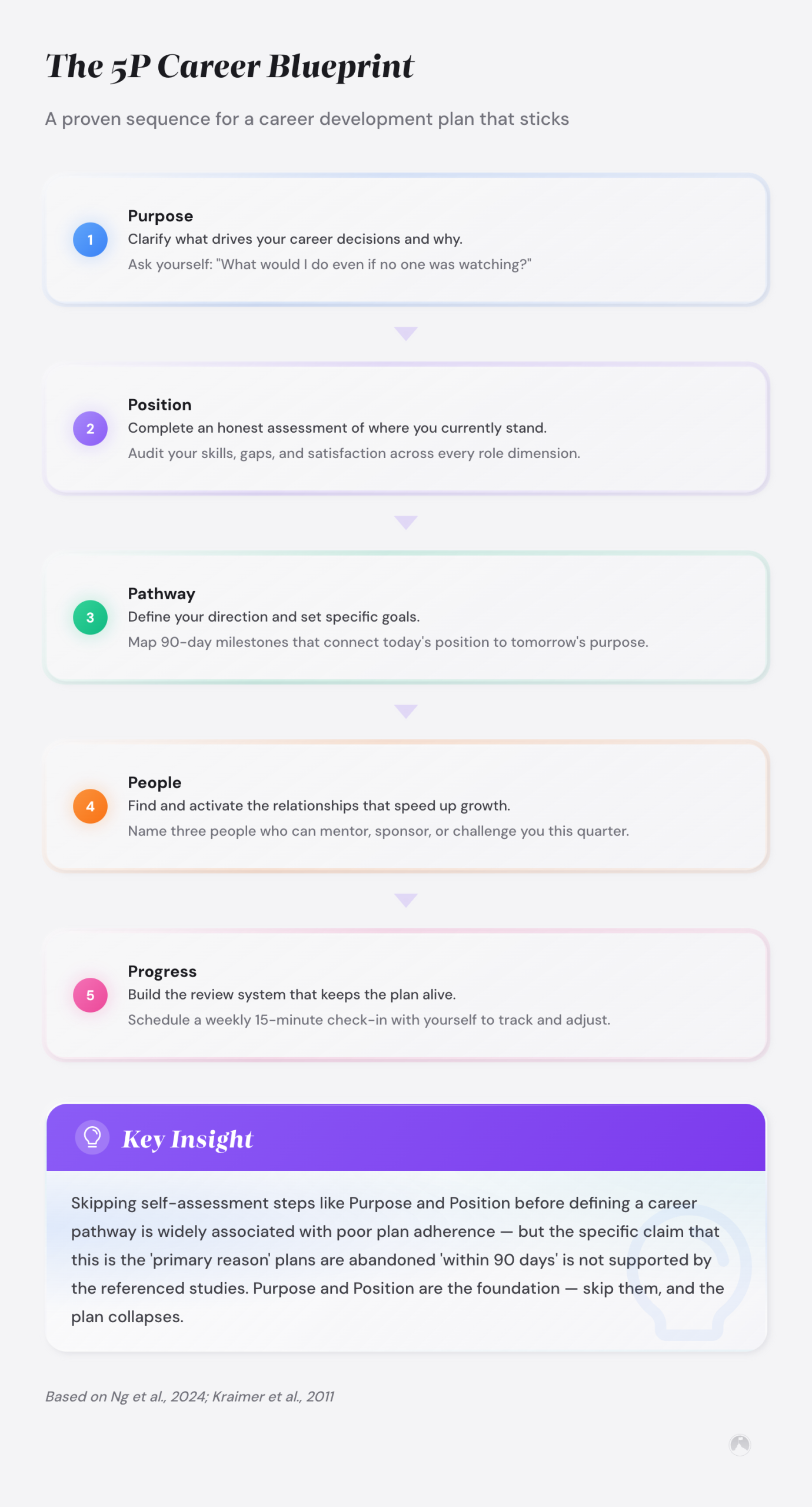
The 5P Career Blueprint is a sequential career planning framework organized into five phases: Purpose, Position, Pathway, People, and Progress. Each phase builds on the previous one, moving from self-assessment through goal-setting to ongoing review.
You can use the table formats below as your career development plan template, or adapt them to a spreadsheet, Notion page, or document that fits your workflow.
The 5P Career Blueprint mirrors how career readiness develops in practice. A 2022 systematic review by Soares, Carvalho, and Silva analyzing 26 studies on career interventions found that programs combining self-assessment, structured goal-setting, and ongoing review produced the strongest improvements in career adaptability and decision-making confidence [4]. The blueprint follows that same sequence – and the psychology behind career development helps explain why the order matters. For more on that, see our guide on career development psychology research.
Soares and colleagues found that multi-phase career interventions combining awareness, planning, and action phases showed measurable improvements across career adaptability, career decision-making self-efficacy, and career readiness, with the strongest effects from group-based programs [4].
Here’s what each phase covers and what you’d write in your professional development plan:
Phase 1: purpose (what drives your career decisions)
Before writing a single goal, identify what you value in your work. This is the foundation every other section builds on. Ask yourself three questions: What type of work makes time disappear? What professional accomplishments felt most meaningful in the past year? And what would you regret not pursuing five years from now?
Write your answers in the Purpose section of your template. You’re not looking for poetry here. A sentence or two per question is enough. The point is creating a filter that every future goal has to pass through. Purpose isn’t a mission statement. Purpose is a decision filter.
Phase 2: position (where you stand right now)
This is your honest inventory. List your current role, your core skills (the ones you’d confidently claim in a job interview), and the skills adjacent to your role that you’ve picked up along the way. Then make a second column: skills you’re missing for where you want to go. This is the skills gap analysis, and it’s the most valuable section in any professional development plan format.
Whether you’re using a career planning template for employees provided by HR or building your own document, the Position phase anchors everything that follows. One decision makes this phase much clearer: are you aiming for a management track or an individual contributor (IC) track? These two paths demand different competency emphases. Management tracks typically require communication, delegation, and team-building capabilities, while individual contributor tracks demand deep expertise, thought leadership, and cross-functional influence.
Research on organizational support for career development confirms that employees who perceive clear development pathways have significantly lower turnover intentions and higher job performance [5]. Choosing between the management track and the individual contributor track is the single decision that makes every other section of your career development plan easier to fill in.
If you’re feeling stuck in your career, the Position phase is often where the clarity starts. You can’t plan a route without knowing your starting coordinates.
Phase 3: pathway (direction and goals)
Now that you know your values and your current position, set goals at two horizons. Your 90-day goals are concrete, specific, and measurable – following a SMART goals format (Specific, Measurable, Achievable, Relevant to your Purpose from Phase 1, and Time-bound to the quarter). Your 2-year direction is flexible and describes a trajectory rather than a fixed destination. A strong career growth strategy uses the 90-day horizon for accountability and the 2-year horizon for motivation.
Here’s what this career progression planning worksheet looks like in practice for each track:
| Goal type | Management track example | IC track example |
|---|---|---|
| 90-day goal | Complete a leadership communication workshop and lead two cross-team project meetings | Publish one internal technical guide and present findings to the department |
| 2-year direction | Move into a team lead role managing 4-6 direct reports | Become the recognized subject matter expert in [specialty] within the organization |
| Skills to develop | Conflict resolution, performance coaching, resource allocation | Advanced technical depth, stakeholder influence, mentoring junior colleagues |
Notice that the 90-day goals are specific enough to complete. The 2-year directions describe a role shift, not a title. This is by design. Career goals tied to specific capabilities rather than job titles survive reorganizations, industry shifts, and the unpredictable reality of how careers unfold. Exploring different strategic career planning frameworks can help you refine which goal structure works best for your situation.
Phase 4: people (relationships that accelerate growth)
Every career development plan needs a People section, and most templates skip it entirely. In your template, list three categories of relationships: a mentor or sponsor who can open doors, peers who challenge your thinking, and someone outside your industry who offers fresh perspective.
You don’t need to have these relationships in place today. The action step is identifying who could fill each role and scheduling one conversation in the next 30 days.
Here’s what that first conversation might look like: for a potential mentor, ask about a specific decision they made in their career and what they’d do differently. For a peer, suggest a monthly coffee to compare notes on a shared challenge. For an outside-industry contact, ask how their field approaches a problem you’re currently facing. If networking for career growth feels uncomfortable, start with the peer category. It’s the easiest entry point and often leads to the other two naturally.
Phase 5: progress (the review system that keeps everything alive)
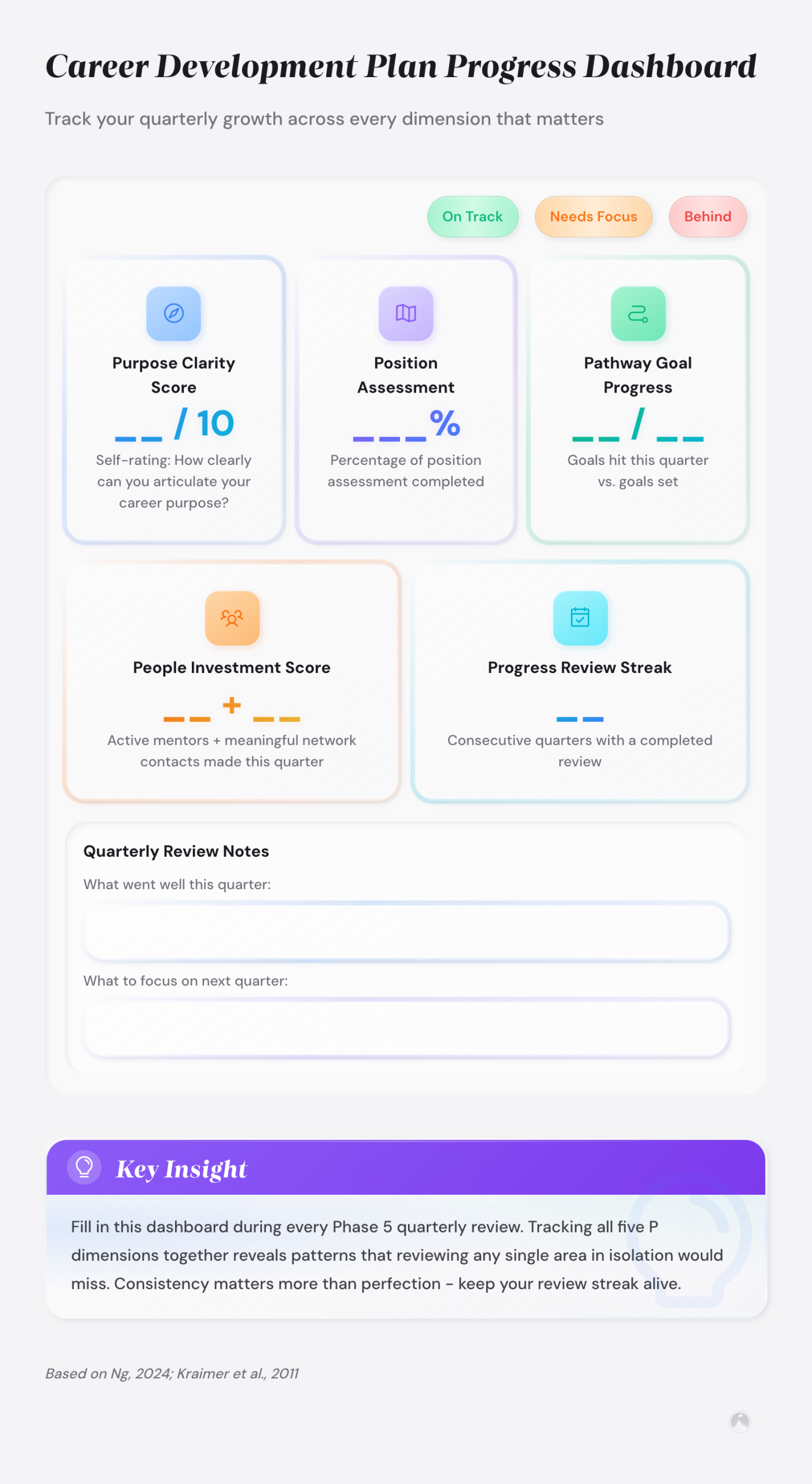
This is where most career plans die. The plan gets filed away and never reopened. The 5P Career Blueprint prevents this with a quarterly review using three questions: What progress did I make on my 90-day goals? Is my 2-year direction still connected with my Purpose? And what’s the one adjustment I need to make for the next quarter?
Schedule 15 minutes at the end of each quarter. That’s it. The difference between career plans that drive real growth and career plans that collect dust is a 15-minute quarterly review with three honest questions.
How do you run a skills gap analysis for your career development plan?
A skills gap analysis sounds formal, but the process is direct. You need three inputs: what you can do now, what your target role requires, and the gap between them. Here’s how to do it without paying for an expensive assessment tool.
Start by pulling up three to five job descriptions for the role you’re targeting (or a role one step above your current position). Highlight every skill and qualification they mention. Then score yourself honestly on each one: strong, developing, or absent. The skills marked “absent” or “developing” become your development priorities for the Pathway section of your career development plan template.
Here’s a sample individual development plan example you can adapt:
| Skill or competency | Current level | Required level | Development action |
|---|---|---|---|
| Project management | Developing | Strong | Lead a cross-functional project by Q3 |
| Data analysis | Absent | Developing | Complete an online analytics course in 60 days |
| Stakeholder communication | Strong | Strong | Maintain through current role |
| Budget management | Absent | Developing | Shadow the finance lead during quarterly planning |
The development actions column is what turns a theoretical analysis into something actionable. Each action should be completable within 90 days and tied to a real opportunity in your current role. If you’re exploring broader career planning tools and frameworks, the skills gap analysis is where they all combine: identifying what to build next.
Simple templates with three columns work well for mid-career professionals who know their direction. Detailed templates with weekly action items and milestone trackers fit career changers or people re-entering the workforce. The 5P framework adapts to either format – start with what feels manageable.
The best career plans start with an honest skills inventory, not ambition.
How do you set career development goals that stay relevant?
The biggest failure in career goal setting isn’t picking the wrong goal. It’s picking a goal that felt exciting in January and feels meaningless by April. The fix is building flexibility into the goal structure itself.
Use a dual-horizon system. Your 90-day goals follow a SMART goals career development template: Specific, Measurable, Achievable, Relevant to your Purpose (from Phase 1), and Time-bound to the quarter. Your 2-year direction uses a looser format – it describes a role or capability level, not a specific title or salary number. This is why the career roadmap template works better than a rigid five-year plan.
Here’s the test for whether a career goal belongs in your template: Would this goal still feel worth pursuing if your company restructured tomorrow? If the answer is no, the goal is tied to a situation rather than to your growth. Rewrite it around a capability. “Get promoted to senior analyst” becomes “develop the analytical and presentation skills that qualify me for senior-level analytical roles.” One survives change. The other doesn’t.
Goals that describe what you can do will outlast goals that describe where you sit. And that’s the real difference between career development plans that work and plans that collect dust.
What does the 15-minute quarterly review look like?
The quarterly review is the engine that keeps your career development plan current. Without it, even the best template becomes a document you wrote once and forgot about. Set a recurring calendar event for the last week of every quarter. Answer these three questions in writing, right on your template:
- What did I accomplish this quarter toward my 90-day goals? Be specific. Partial progress counts. If you completed the goal, note the outcome and what you learned.
- Does my 2-year direction still align with my Purpose? Values evolve. Circumstances change. A direction that made sense six months ago might need updating. This question catches drift before it compounds.
- What is the one adjustment I’m making for next quarter? Not five adjustments. One. This constraint forces prioritization and prevents the plan from becoming an ever-growing wish list.
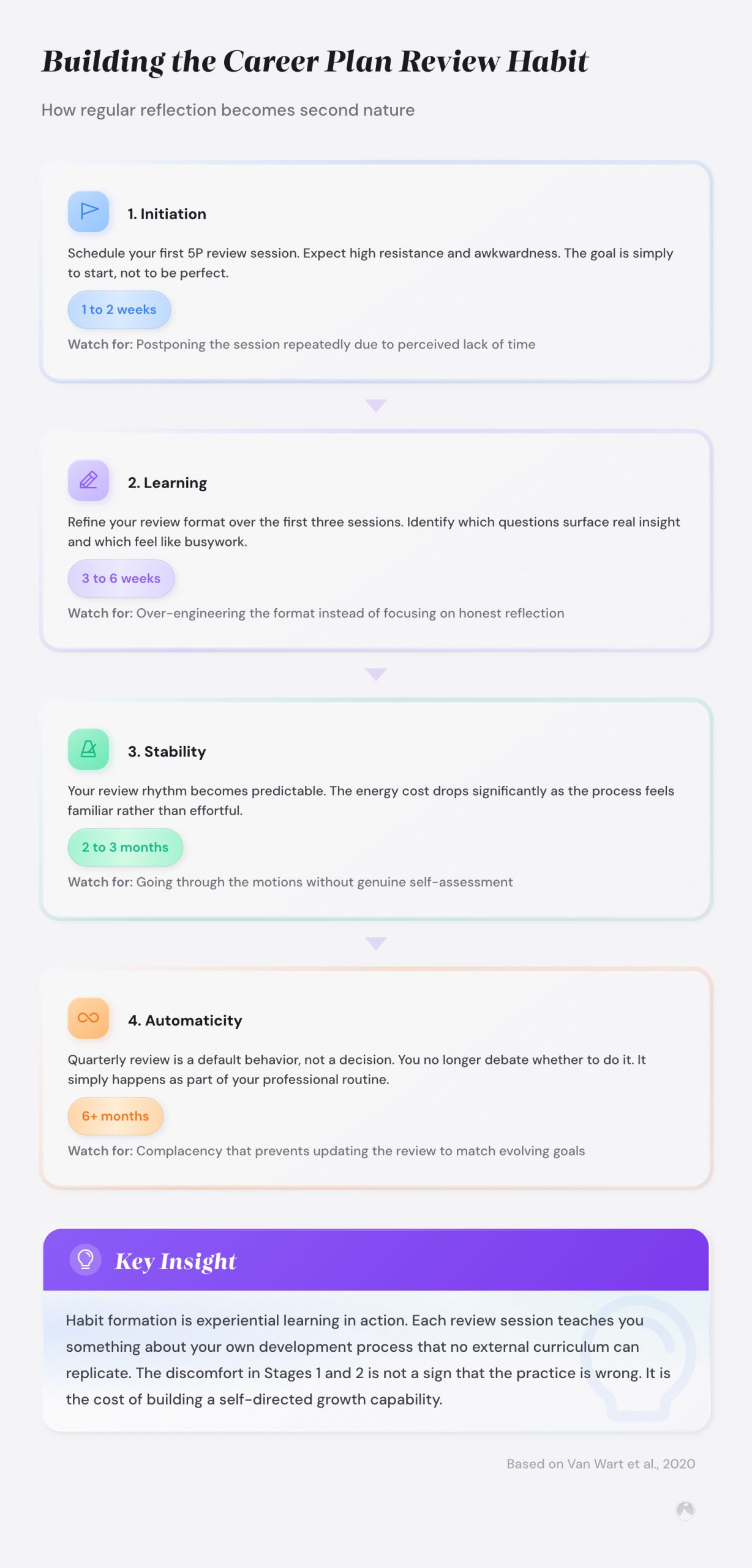
After four quarterly reviews, you’ll have a documented record of growth that’s far more valuable than the original plan itself. This record is what makes development conversations with managers productive – instead of walking in with aspirations, you walk in with evidence. A career development plan’s real value emerges not when you write it, but when you review it for the fourth time and see the trajectory you’ve built.
Ramon’s take
My last career plan had three bullet points and expired when I changed jobs. From what I’ve read, the 15-minute quarterly review is what actually keeps these things alive. Which honestly sounds doable. Why are we all writing five-year manifestos instead?
Conclusion
A career development plan template gives you structure. But the 5P Career Blueprint gives you a sequence for filling it in that works. Start with Purpose, not goals. Assess your Position honestly. Choose a Pathway with dual horizons. Identify the People who’ll accelerate your growth. And build in quarterly Progress reviews.
Next 10 minutes
Answer the three Purpose questions: What type of work makes time disappear? What accomplishments felt meaningful? What would you regret not pursuing? Then decide – management track or individual contributor track.
This week
Pull up three job descriptions for your target role. Create a skills gap analysis using the table format from the Position section. Set your first 90-day goal and your 2-year direction. Schedule your first quarterly review in your calendar for 90 days from now.
The next time you open that blank template, you’ll know exactly which field to fill in first – and why it matters.
There is more to explore
For broader context on career development, explore our guides on career growth strategies, career planning tools and frameworks, and networking for career growth.
Related articles in this guide
Frequently asked questions
What is the difference between a career development plan and a performance review?
A performance review evaluates your past performance in your current role. A career development plan charts your future trajectory across roles and capabilities. Performance reviews are backward-looking and annual. Career development plans are forward-looking and quarterly. A strong career development plan makes your performance review conversation more productive because you can show progress against your own development goals [1].
How do I choose between a management track and an individual contributor track?
Ask yourself: Do you get energy from developing people or from developing expertise? Do you want to influence through direct reports or through thought leadership? Management tracks require delegation, communication, and people management. IC tracks require deep expertise, stakeholder influence, and mentoring junior colleagues. There’s no right answer – pick the track that aligns with how you actually want to work.
How often should I review my career development plan?
Quarterly reviews strike the right balance for most professionals. If you miss a quarter, don’t try to catch up – just answer the three review questions for the current quarter and reset your 90-day goals. If you’ve made zero progress, that data point itself is valuable: it usually means the goal was wrong, not that you were lazy. Adjust the goal rather than doubling down on one that didn’t stick.
What if my career goals change before the 90 days is up?
That’s normal – adjust them. The 2-year direction gives you flexibility for the bigger picture, while 90-day goals stay specific. If circumstances change midway through the quarter, update the goal rather than abandoning it. The point of the quarterly review is to catch these adjustments intentionally rather than letting your plan silently become irrelevant.
Should I share my career development plan with my manager?
Yes. A career development plan is most effective when your manager knows your goals and can help you access opportunities that support them. Research by Kraimer and colleagues found that employees who perceived strong organizational support for their career development had significantly lower turnover intentions and higher performance [5]. The plan becomes a shared reference point for your development conversation.
How do I handle the skills gap analysis if my target role isn’t clear yet?
Pick a role that interests you and run the analysis against that target – even if it’s not your final destination. The analysis will show you what gaps exist and which areas you need to develop. After 6-12 months, you can re-assess and adjust your target. The goal of the skills gap analysis is clarity on next steps, not a permanent career path.
References
[1] Van Wart, A., O’Brien, T. C., Varvayanis, S., et al. (2020). Applying Experiential Learning to Career Development Training for Biomedical Graduate Students and Postdocs: Perspectives on Program Development and Design. CBE-Life Sciences Education, 19(3), es7. https://doi.org/10.1187/cbe.19-12-0270
[2] Ng, T. W. H., Yim, F. H. K., Chen, H., and Zou, Y. (2024). Employer-sponsored career development practices and employee performance and turnover: A meta-analysis. Journal of Management. https://doi.org/10.1177/01492063221125143
[3] Whiston, S. C., Brecheisen, B. J., and Stephens, J. (2003). Does treatment modality affect career counseling effectiveness? Journal of Vocational Behavior, 62(3), 390-410. https://doi.org/10.1016/S0001-8791(02)00050-7
[4] Soares, J., Carvalho, C., and Silva, A. D. (2022). A systematic review on career interventions for university students: Framework, effectiveness, and outcomes. Australian Journal of Career Development, 31(2), 81-92. https://doi.org/10.1177/10384162221100460
[5] Kraimer, M. L., Seibert, S. E., Wayne, S. J., Liden, R. C., and Bravo, J. (2011). Antecedents and outcomes of organizational support for development. Journal of Applied Psychology, 96(3), 485-500. https://doi.org/10.1037/a0021452