
Why your willpower keeps failing you
You’ve tried discipline. You’ve tried motivation. You’ve tried telling yourself to just ship it and move on. Yet the perfectionist voice still whispers that one more hour of editing, one more revision, one more pass will make this project ready. Here’s what you need to know: this pattern isn’t a character flaw. It’s a system design problem. And no amount of willpower fixes a broken system.Building systems that beat perfectionism is the practice of designing repeatable processes and structural checkpoints–before starting work–that prioritize consistent progress over flawless output, removing the need for constant willpower in the moment.
What you will learn
- Why willpower alone fails against perfectionism and how systems beat perfectionism differently
- The 4-step perfectionism framework for building your first anti-perfectionism system
- How to define minimum viable standards that aren’t just perfectionism in disguise
- How time-boxing and checkpoints work as behavioral “stops” instead of suggestions
- Three domain-specific templates (work, creative, learning)
- How to diagnose and fix the four most common system failures
Key takeaways
- Perfectionism is a system problem, not a discipline problem–willpower cannot fix it.
- The 4-step framework uses defined minimums, time-boxing, checkpoints, and accountability.
- Minimum viable standards prevent the perfectionist spiral by answering “how much is enough.”
- Time-boxing works because it shifts perfectionist focus from outcome to process.
- Implementation intentions–pre-planned “if-then” rules–produce medium-to-large effects on goal completion (d = 0.65) [4].
- Accountability transforms internal pressure into external structure.
- The perfectionism framework applies across work, creative, and learning domains.
Why willpower never wins against perfectionism
Building systems that beat perfectionism: the 4-step framework
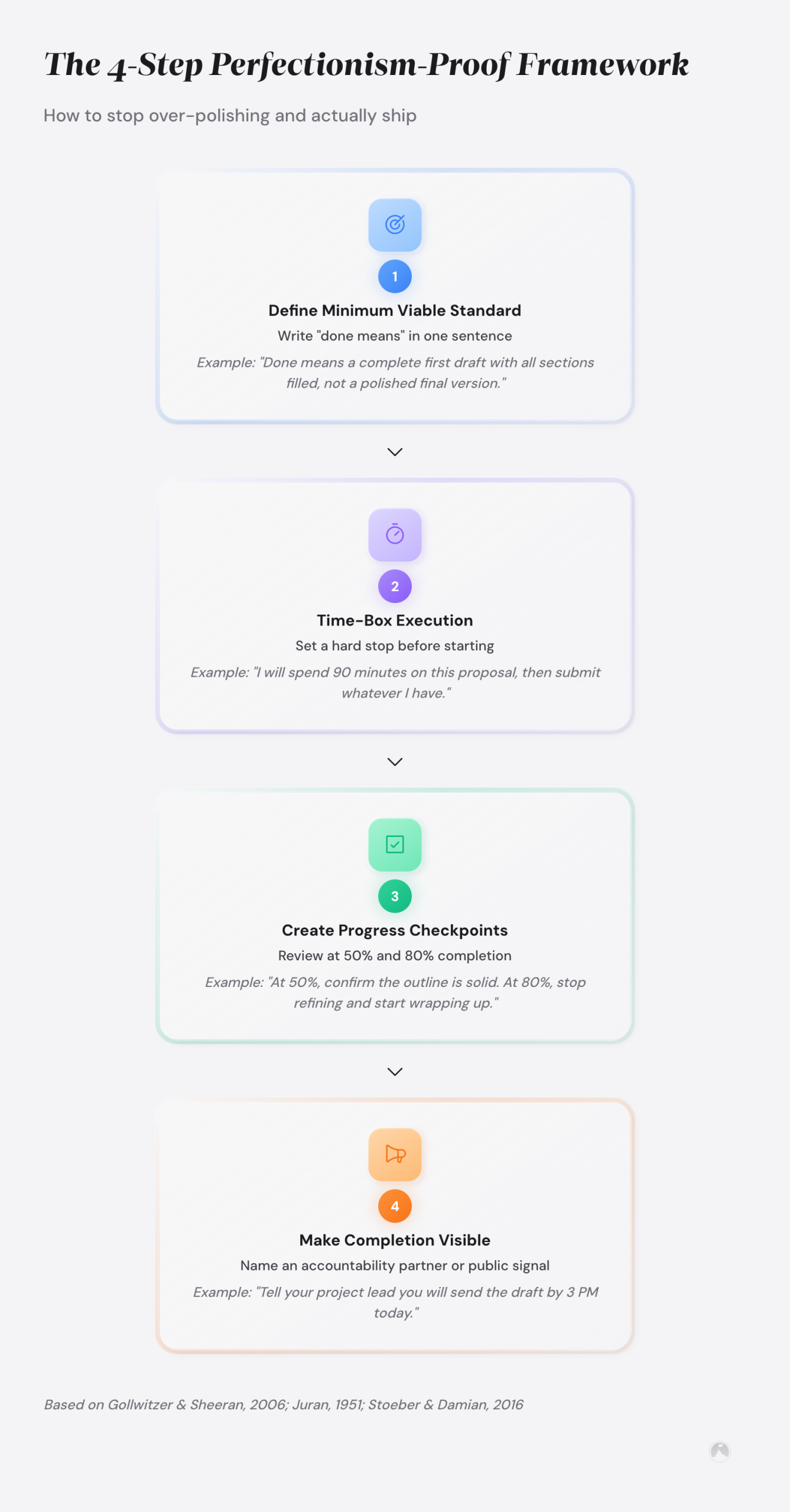
- Define your minimum viable standard
- Time-box your execution
- Create progress checkpoints (not perfection checkpoints)
- Build accountability that makes completion visible
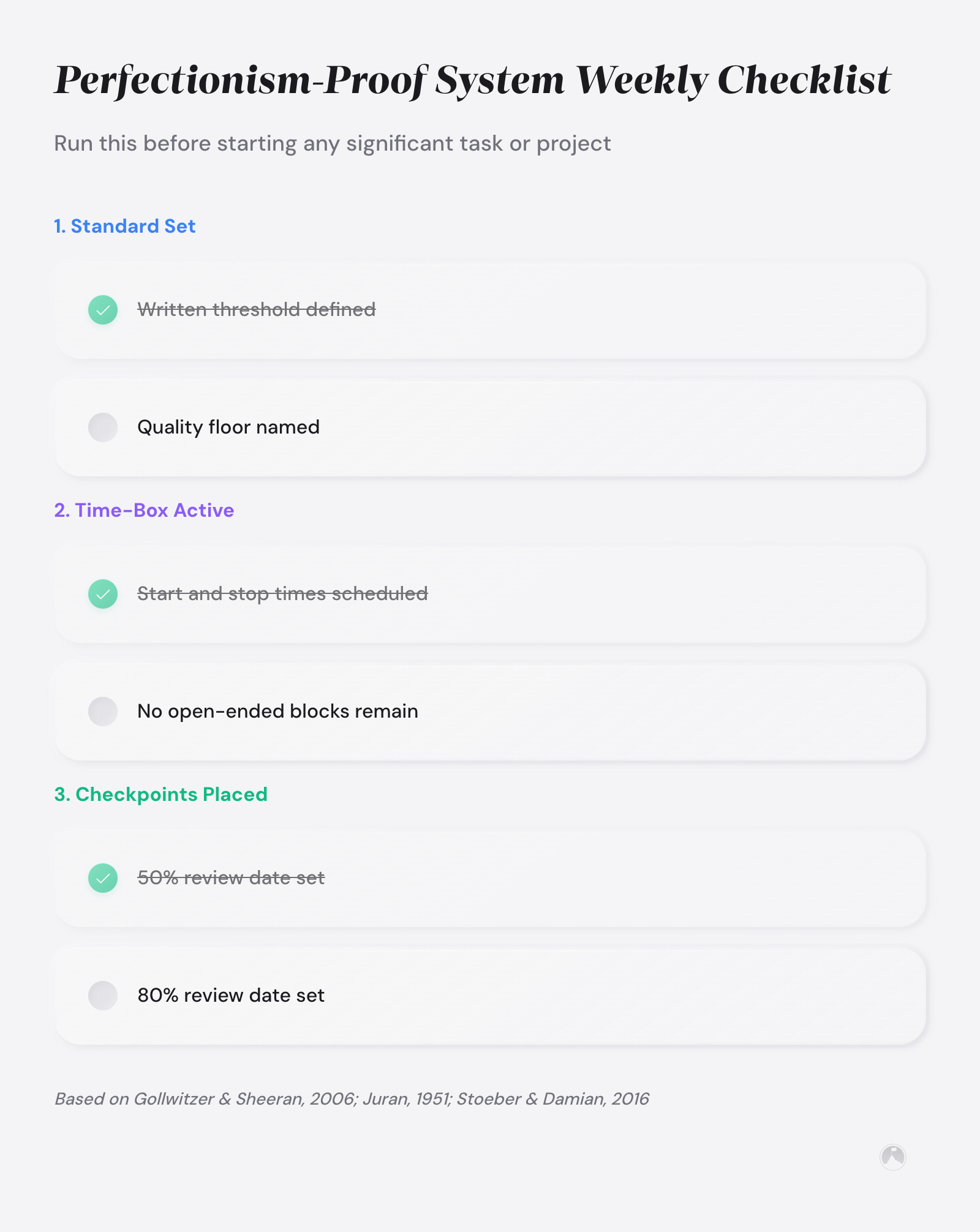
- Defining done: You cannot decide when work is finished (start with Step 1)
- Stopping on time: You keep revising past the deadline (prioritize Step 2)
- Measuring progress: You measure quality instead of completion (focus on Step 3)
- Shipping publicly: You avoid sharing until it feels perfect (strengthen Step 4)
Step 1: Define your minimum viable standard
Before you start work, define what “done” looks like. Not perfect. Done. This is the single most important step because it removes the ambiguity that feeds perfectionism. Write it down: what must be present for this project to count as complete? What can you cut without destroying the core value? A minimum viable standard is a pre-defined set of criteria that specifies the fewest deliverables a project must contain to provide its core value–distinct from a perfectionist standard because the criteria are fixed before work begins and cannot expand during execution. For a work project, this might be: “The report includes executive summary, three key findings, and one visual. It doesn’t require perfect design or flawless prose.” For a creative piece: “The first draft is complete, all sections are covered, and I’ve done one full revision.” For learning goals: “I’ve completed the course modules and one practice project. I don’t need to score 100%.” Once you define the minimum, perfectionism loses half its power because you’ve answered the question it keeps asking: “How much is enough?”Step 2: Time-box your execution
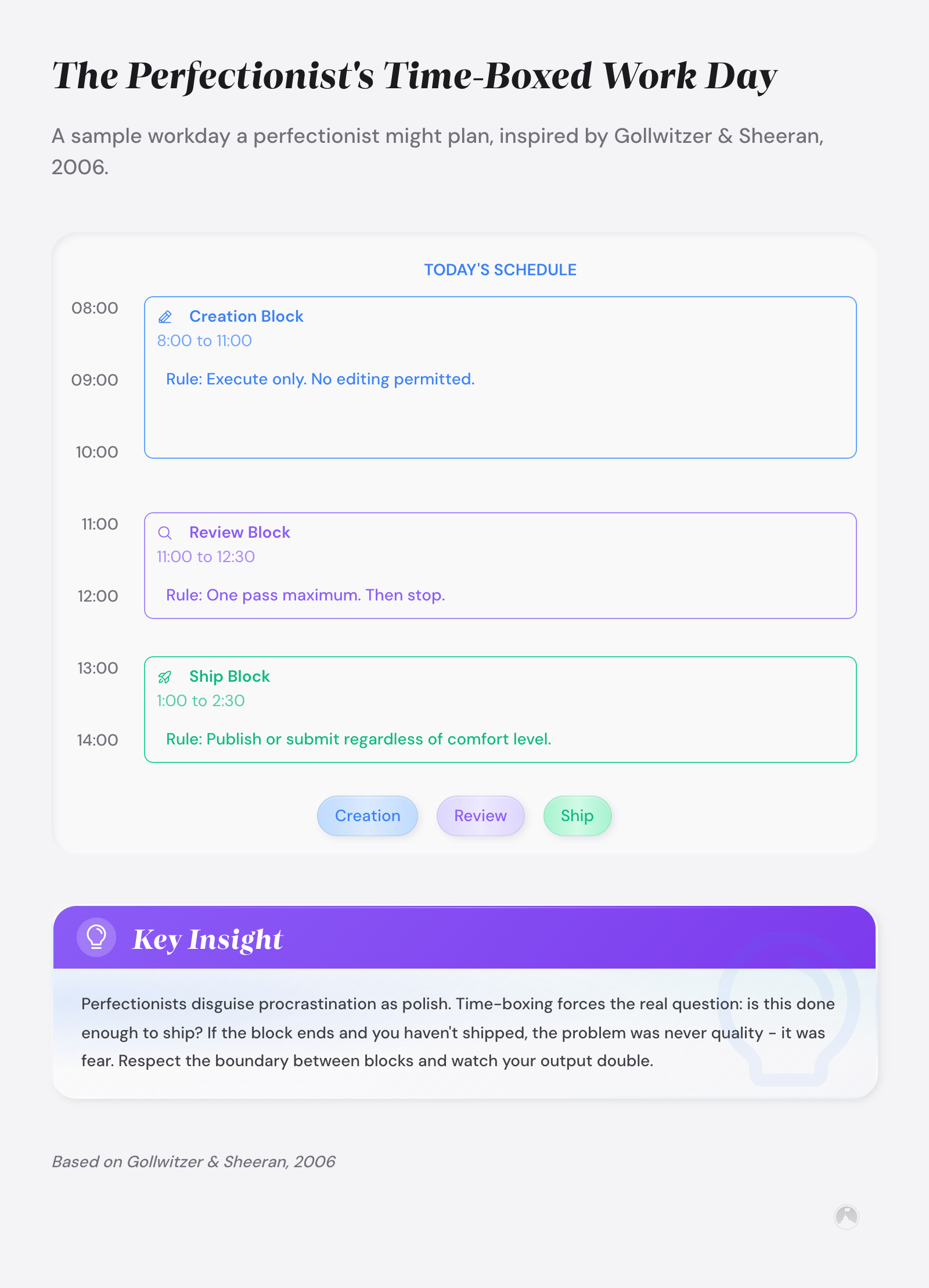
Set a hard deadline for reaching your minimum standard. Not a goal deadline. A structural deadline. Calendar it. Tell someone. Make it real in a way that your future self can’t negotiate with at 11pm when perfectionism whispers that you need more time. Time-boxing is a scheduling technique that assigns a fixed, non-negotiable time allocation to a task, creating an external constraint that overrides the perfectionist impulse to refine indefinitely. Time-boxing works because it creates natural stopping points. When your time is up, the work is done–not because it’s perfect, but because the time allocation says so. This removes the perfectionist’s favorite sentence: “I just need one more hour.” There is no one more hour. Time-boxing prevents the 10-hour task from becoming a 40-hour obsession. The Pareto Principle–often called the 80/20 rule–demonstrates that roughly 80% of a project’s impact comes from the first 20% of effort [5]. Set your time-box generously enough to produce real work, but firmly enough to create constraint. Your perfectionism is spending time on the remaining 80% of effort that produces only 20% of marginal value. If your minimum standard truly captures the core value, your time-box should be enough.Step 3: Create progress checkpoints (not perfection checkpoints)
Perfectionism measures work against an infinite standard: “Is this perfect yet?” Checkpoints measure work against a progress standard: “Did I complete this section? Is it good enough for the next step?” The frame shift transforms perfectionism from a blocker into a compass. A progress checkpoint is a pre-scheduled evaluation point that measures whether a task has moved forward to the next stage–not whether the current stage is flawless. Design checkpoints that mark progress: outline complete, first draft done, initial revision done, ready to ship. At each checkpoint, ask “Does this meet the minimum standard for this stage?”–not “Is this perfect?” This keeps momentum forward instead of stuck in refinement loops. Progress checkpoints celebrate completion. Perfection checkpoints celebrate flawlessness. Pick one.Step 4: Build accountability that makes completion visible
The final system layer is accountability–external structure that makes shipping real. Tell a colleague when your project is due. Set up a shared tracker. Join an accountability group. Something that moves the decision from “Should I ship this?” to “I said I’d ship this on Tuesday.” Research on commitment and consistency shows that public commitments–specific promises made to specific people–increase follow-through compared to private resolutions. Accountability works because it creates external structure that perfectionism cannot privately negotiate away. Perfectionism thrives in private where no one can see your struggle. It weakens quickly when you’ve made a public commitment to completion. You still have the perfectionist impulse, but you’ve redirected it toward finishing rather than obsessing.Applying the perfectionism framework: three templates
For work projects
Minimum Standard: “The deliverable includes all required sections, meets technical requirements, and is proofread once. It doesn’t require design perfection or stakeholder alignment on every detail.” Time-Box: 8 hours for a 1-day project. 20 hours for a 1-week project. Block this time on your calendar. Tell your manager: “I’m shipping Friday at 5pm, no matter what state it’s in.” This sounds scary. It’s actually liberating. Checkpoints: Outline done (day 1), draft complete (day 2), one round of edits (day 3), final proofread (day 4), ship (day 5). Each checkpoint is a mini-completion. You move forward, not deeper into revision. Accountability: Email your team the draft on schedule. Put it in the shared folder. Make it real. Once others have access, perfectionism usually stops trying to hide it.For creative work
For learning goals
Minimum Standard: “I’ve completed the course material, built one practice project, and tested my knowledge. I don’t need 100%–70% is enough to move forward and learn through application.” Time-Box: The course already has a timeline. Honor it. Don’t retake sections because you didn’t master every detail on first exposure. Progress through the material as designed, taking notes, building practice work, moving forward. Checkpoints: Weekly check-in with yourself: Am I progressing through the material at the scheduled pace? Yes = continue. No = adjust the time-box or reduce the scope. This keeps you from the perfectionist trap of never moving forward by answering “I haven’t mastered this yet, so I can’t move on.” Accountability: Join the course community. Post your work in progress. Join a study group. The presence of others learning alongside you normalizes imperfection and keeps momentum forward.Common system failures and how to fix them
The framework works, but implementation often hits predictable obstacles. Research on habit formation by Lally, van Jaarsveld, and colleagues found that behavioral automaticity–where a new process feels natural rather than effortful–typically takes 18-254 days to develop, with an average of 66 days [6]. So expect some friction in the first few cycles. Here’s how to diagnose and fix the most common failures.Failure mode 1: Your minimum standard is still too high
The problem: You’ve defined a minimum, but you keep exceeding it before you feel ready to ship. Your “minimum viable standard” is actually your previous perfectionist standard with a new label. The fix: Cut your minimum in half. Really. If you said “one revision,” ship the first draft. If you said “three sections,” ship two. The point is to train yourself to let work go before perfectionism takes over. You can’t do that if your minimum is still tied to perfectionist standards. Once you ship at 60% and discover the world doesn’t end, your perfectionist brain recalibrates.Failure mode 2: Your time-box keeps expanding
The problem: You set a deadline but your perfectionist brain negotiates: “Just one more day to perfect this.” The time-box becomes a suggestion instead of a structure. The fix: Make the deadline external and visible. Tell someone specific. Put it in a shared calendar others can see. Post it in your accountability group. The more friction you create around moving the deadline, the more likely you’ll actually meet it. Perfectionism is shameless in private, but peer commitment usually stops it.Failure mode 3: Your checkpoints feel like more perfectionism
The problem: You’ve created checkpoints but you’re treating each one as another opportunity for perfectionism. “First draft” becomes “first draft perfected.” You’re now stuck at checkpoint 1 instead of the original finish line. The fix: Make each checkpoint a quick yes/no: “Is this section done enough to move to the next section?” Yes = move. No = spend 15 more minutes fixing the specific blocker, then move anyway. Checkpoints are progress markers, not quality gates.Failure mode 4: Accountability isn’t creating enough pressure
The problem: You told someone about your deadline, but the accountability doesn’t feel real. They won’t actually judge you if you miss it, so perfectionism takes over. The fix: Make the stakes visible. Not catastrophic–just real. Set up an accountability system where non-completion has small consequences: you owe someone a coffee, you post about the delay publicly, you lose a privilege for a week. Perfectionism respects external pressure more than internal discipline. Use that.Building systems that beat perfectionism means designing processes where the perfectionist impulse has nowhere to hide.A 2017 meta-analysis by Sirois and colleagues found that maladaptive perfectionism significantly predicts procrastination, with significant positive associations across 43 studies [1].
Ramon’s take
I used to think perfectionism was a strength. Then I tracked the numbers: I was shipping 60% less work and burning out faster, while the “perfect” version rarely outperformed the good-enough version sent three weeks earlier. The shift came when I stopped trying to willpower my way out and started building systems that made the perfectionist choice unavailable–hard time-boxes, public deadlines, visible checkpoints. The perfectionism didn’t disappear. It redirected into building better systems, and that’s when productivity actually accelerated.Conclusion
Perfectionism isn’t a character flaw. It’s a system problem. You can’t willpower your way out of a system designed to enable endless refinement, but you can redesign the system itself. Define what “good enough” means before you start. Time-box execution to make stopping automatic. Create progress checkpoints instead of perfection checkpoints. Build accountability that makes shipping real. These four steps replace the discipline game with a perfectionism systems approach that works whether you’re feeling motivated or not. The goal isn’t to care less about your work. The real goal is to care about completing your work enough to let it go.Next 10 minutes
- Identify one project you’re currently stuck on due to perfectionism
- Write down your minimum viable standard for that project in one sentence
- Set a time-box on your calendar for when this project ships (not when you’ll start–when it ships)
This week
- Tell at least one person about your time-box deadline for that project
- Build the four checkpoints into your calendar between now and the deadline
- Ship the project on your time-box deadline using your minimum standard, even if it feels unfinished
There is more to explore
For more strategies on overcoming perfectionism, explore our overcoming perfectionism guide and strategies for breaking free from perfectionism. If procrastination is part of the pattern, see our guide on procrastination for perfectionists. And for practical systems beyond perfectionism, check out our task management techniques and progress over perfection practices.Related articles in this guide
Frequently asked questions
What is the difference between systems thinking and goal setting for perfectionists?
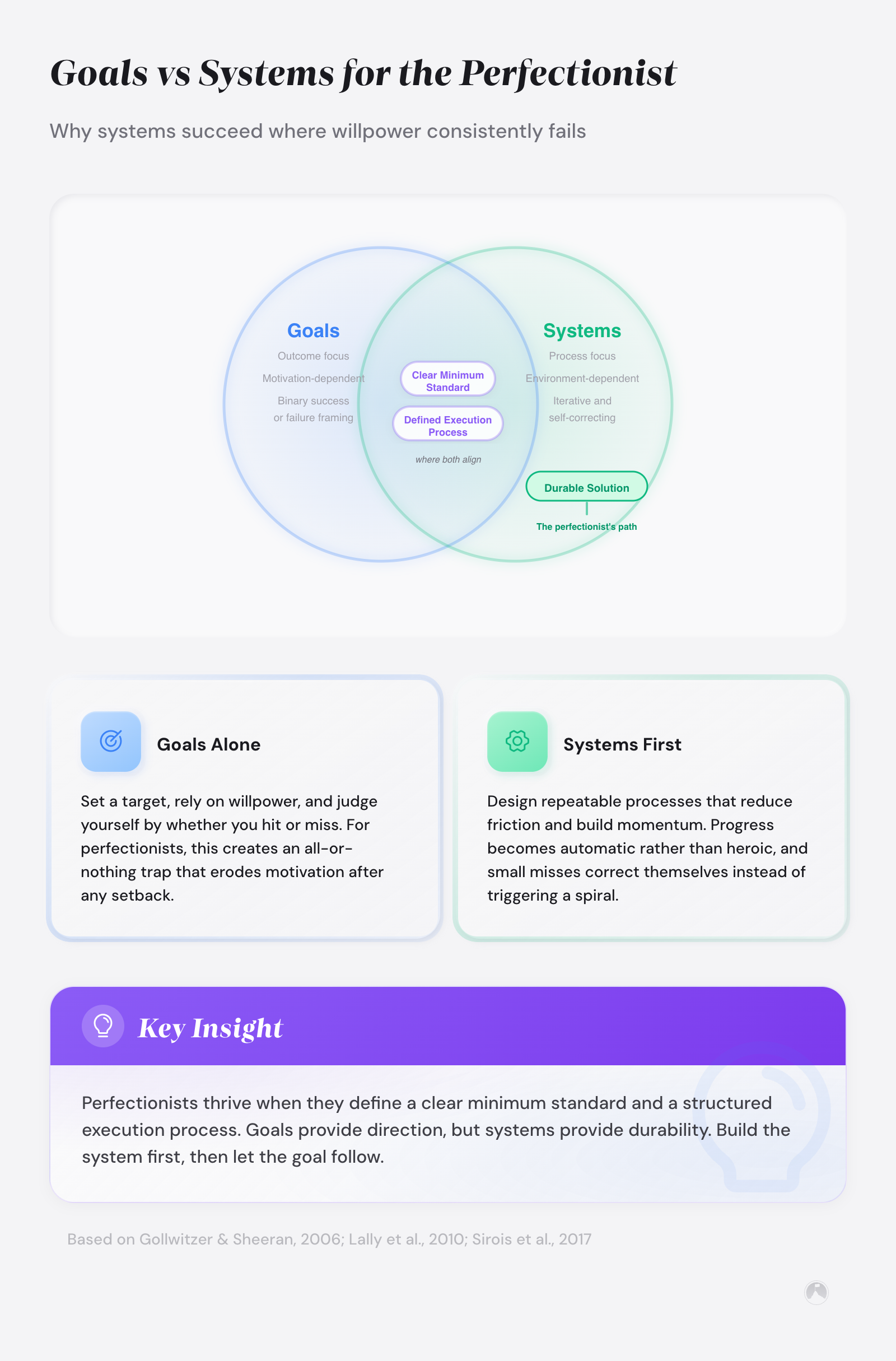
Goal setting focuses on the outcome–what you want to achieve. Systems thinking focuses on the repeatable processes that make achievement automatic. For perfectionists, systems are more powerful because they remove the need for constant decision-making and willpower. Goals can become perfectionist traps if you tie your self-worth to achieving them perfectly. Systems sidestep this by defining clear processes instead.
How do I know what my minimum viable standard should be?
Ask one question: what is the least amount of work that still delivers the core value to the audience? Write that down in one sentence. Then test it: ship at that level and track the actual response. If nobody notices the missing polish, your minimum was correct. If the work underdelivers, raise the minimum by one specific element–not back to your old perfectionist standard.
Won’t time-boxing force me to ship low-quality work?
Time-boxing protects quality by focusing effort where it matters most. The Pareto Principle shows roughly 80% of impact comes from the first 20% of effort [5]. When a stakeholder pushes for more polish, redirect the conversation: ask which specific element they believe is missing from the minimum standard. If they can name it, add it. If they cannot, the work is ready.
How do I set accountability that actually works for perfectionists?
Create an accountability contract with one specific person. The contract states: what you will ship, when you will ship it, and what happens if you miss the deadline. The consequence should be mildly uncomfortable–buying coffee for a colleague, posting publicly about the delay–not catastrophic. Perfectionism responds to social visibility more than personal willpower, so make the commitment where others can see it.
What if my field requires perfectionism (like medicine, engineering, law)?
The distinction matters: perfectionism about critical systems–surgical checklists, load calculations, legal compliance–is appropriate. Perfectionism about every detail is not. Build systems with built-in quality checkpoints for the areas where mistakes are dangerous. Tolerate good enough everywhere else. The framework still applies–you’re just shifting your minimum standard, not eliminating it.
How long does it take before this system actually works?
Most people see results in their first project–reduced time to completion, shipped work instead of stuck work. The bigger shift, where perfectionism actually feels less controlling, usually takes 3-4 cycles of using the system. Research by Lally and colleagues found that behavioral automaticity typically develops in 66 days on average. Your perfectionist brain resists the first few times. By the fourth or fifth project, shipping on schedule feels normal instead of terrifying.
Can I use this framework for ongoing work, or just project-based work?
The framework works for both. For ongoing work, define your minimum standard for each cycle–weekly report, daily output, quarterly goals. Set your time-box for the cycle. Create checkpoints within the cycle. Add accountability that checks in at each cycle boundary. The repeatable structure is what makes it work long-term.