
Why your learning streaks keep failing at the same point
You downloaded the course. You blocked 45 minutes nightly for “personal development.” And for about two weeks, it worked.
Then something disrupted the pattern. A late meeting. A rough morning. Suddenly you missed one day, and the whole thing collapsed like it was never there.
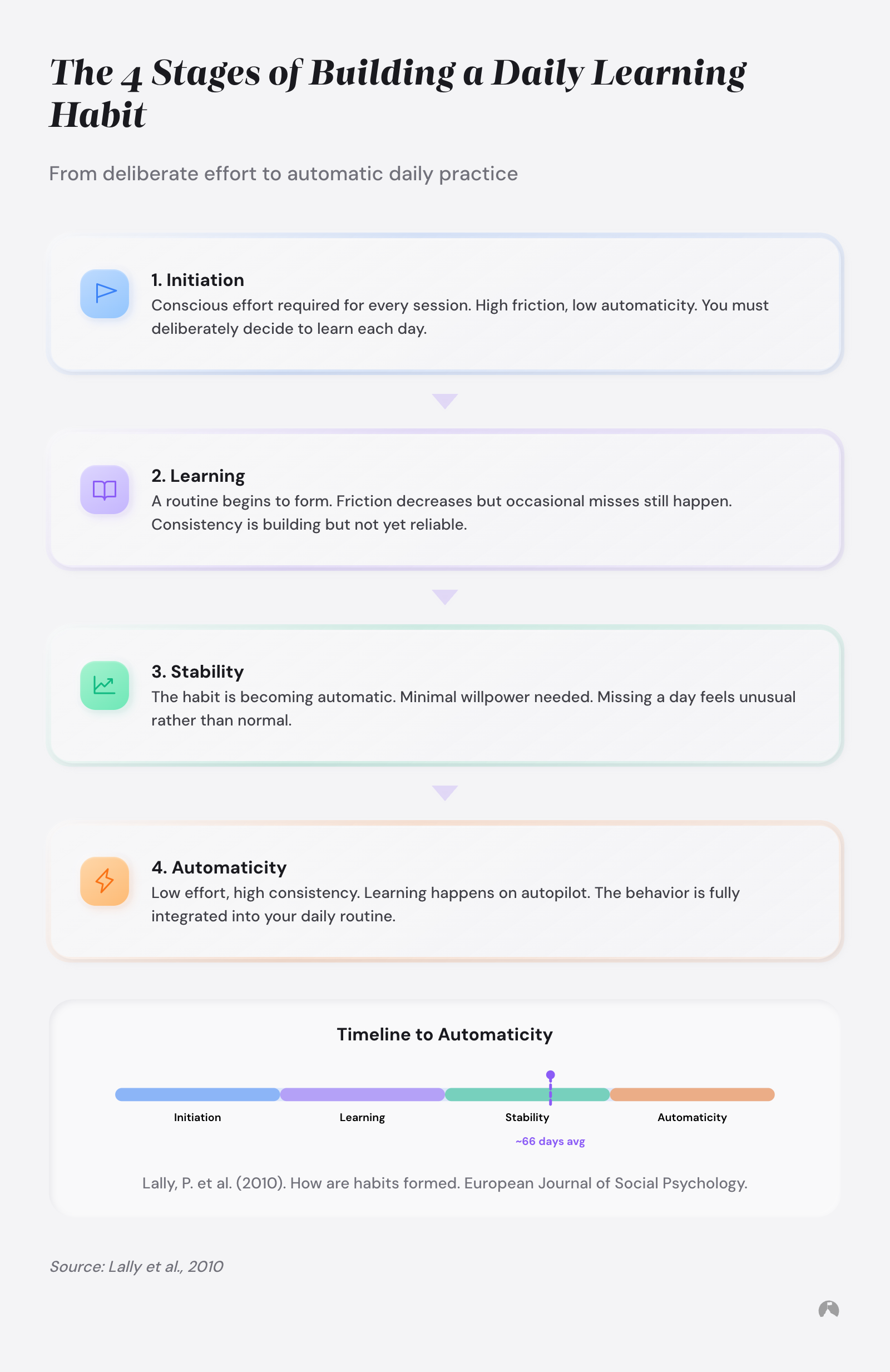
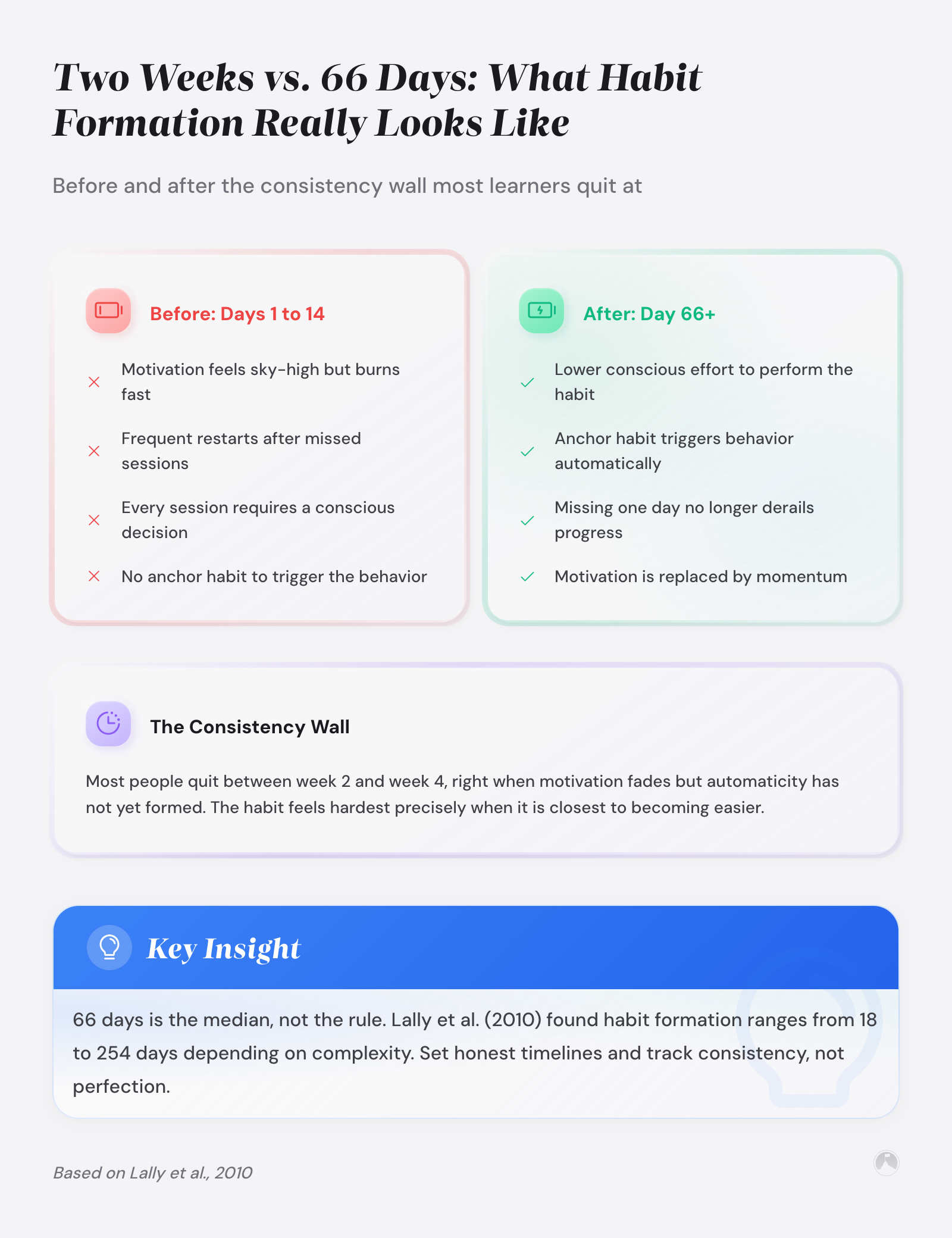
The problem is not your motivation. It’s the timeline you set. Phillippa Lally and colleagues at University College London tracked 96 volunteers forming new habits over 12 weeks and found that habits take an average of 66 days to become automatic, with a range stretching from 18 to 254 days depending on the behavior [1].
That means your two-week attempt never had a biological chance. You quit a process that was mathematically still in the beginning.
Building a daily learning habit is creating a system where planned knowledge acquisition becomes a default daily behavior — not through willpower, but through environmental cues and reward structures that make execution automatic. Unlike motivation-dependent approaches, this method succeeds by matching learning format to available time and energy rather than increasing effort intensity.
What you will learn
- Why the learning habit formation timeline has a predictable failure point in the first three weeks
- How habit stacking learning onto existing routines eliminates the need for new time blocks
- Why matching learning format to your energy level matters more than content choice
- How to make invisible progress visible before motivation fades
- What the research says about recovering from skipped days
- How to adapt the system for ADHD or unpredictable schedules
Key takeaways
- Habits average 66 days to form – two-week attempts are statistically designed to fail [1].
- Missing one day does not reset habit formation; consecutive missed days do [1].
- Habit stacking learning onto existing daily behaviors beats carving out new time slots [2].
- Start with 10 minutes daily – not the ambitious 45-minute block your ambition demands.
- Match learning format to your energy: active study when fresh, passive intake when drained [2].
- Weekly checkpoints reveal progress your brain cannot feel during the habit formation process [1].
Why the two-week wall is predictable, not a personal failure
Most people blame themselves when a learning habit breaks. But the failure has a biological timeline that researchers can predict. Lally and colleagues’ 2010 research found something critical: the habit strength curve is not a straight line [1]. It accelerates early, then gradually flattens into a plateau where behavior becomes automatic.
Here’s what matters for anyone wondering how to form a learning habit: the habit strength curve shows early acceleration followed by a slow plateau around 66 days on average [1]. For anything cognitively demanding – like learning a new skill – it takes longer. You’re not just pushing through two weeks. You’re committing to two months.
“Missing a single opportunity to perform the behavior did not materially affect the habit formation process.” – Phillippa Lally, University College London [1]
This detail changes everything about daily learning routine consistency. The habit strength curve barely dipped after one skip. What killed habits was consecutive missed days – the researchers found that while single misses barely registered, the data implies that strings of missed days would erode automaticity gains [1]. So when you skipped once around day 10 and assumed your streak was broken, you actually quit a process still on track.
The real problem is not “how do I stay motivated for two weeks” – it is “how do I design a system that survives 66 days without depending on motivation.”
How to use habit stacking for learning you already do daily
This is where building a daily learning habit shifts from aspiration to engineering. Instead of carving out a new time block, you attach learning to something you do already. Gardner, Lally, and Wardle’s research on habit formation identifies contextual cues and behavioral repetition as the mechanical backbone of the process [2].
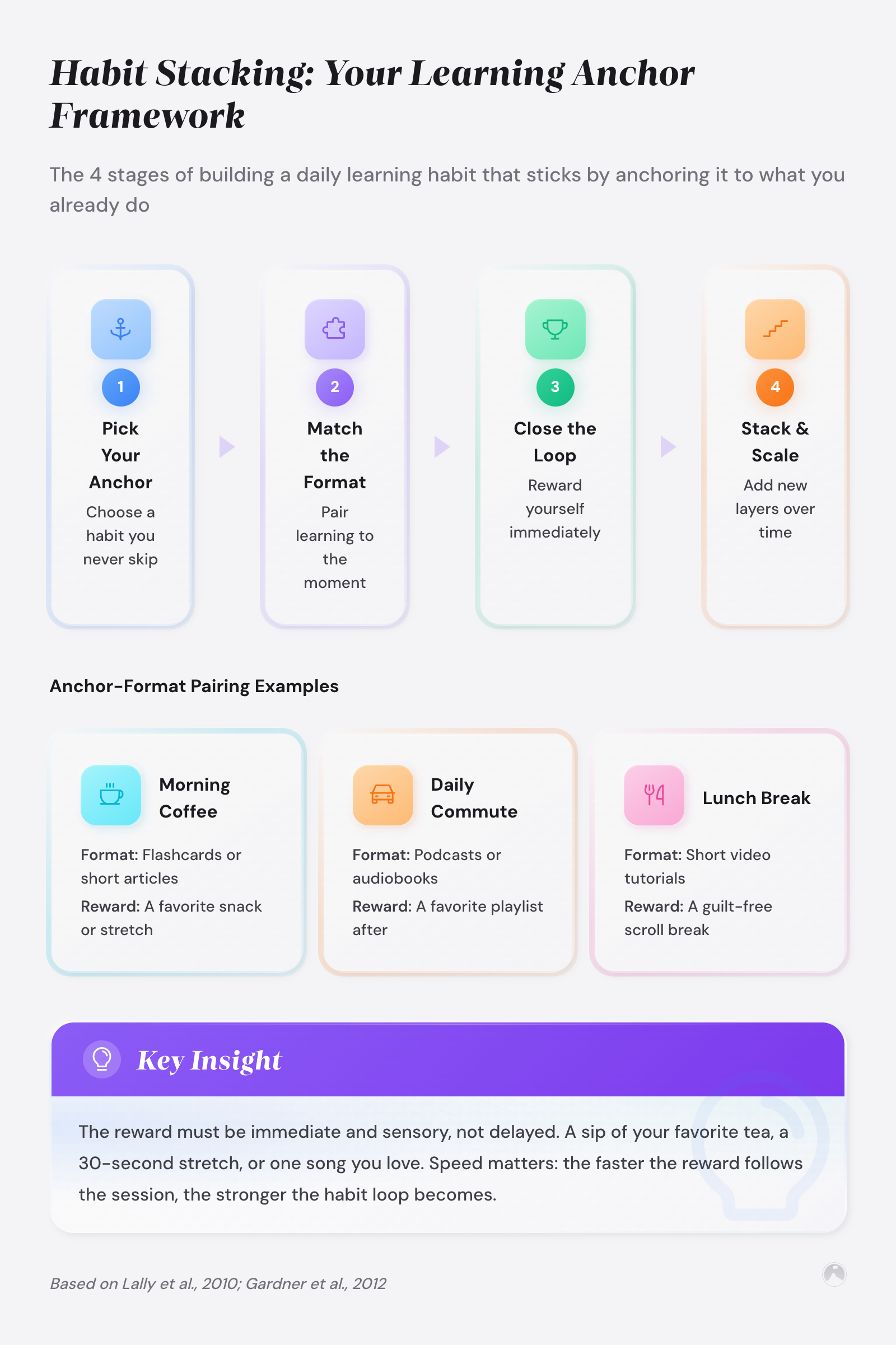
The concept is simple. The execution is what matters.
Step 1: Pick your anchor habit
Your anchor should be something you do daily without thinking. Morning coffee. The commute. Lunch. The five minutes after putting kids to bed. The key: it happens at roughly the same time and requires no decision.
AARP’s 2021 research on lifelong learning found something revealing about intention versus action: 83% of adults aged 45 and older agree that keeping the brain active is vitally important [3]. But belief doesn’t produce behavior. What produces behavior is a cue – something already baked into your day.
Step 2: Match the learning format to the moment
Not all learning activities demand the same cognitive energy. Reading dense technical material at 9 PM after a full workday is engineering failure, not motivation failure.
| Energy level | Best formats | Examples |
|---|---|---|
| High (morning, fresh) | Active recall, problem-solving, writing | Practice exercises, write summaries, code challenges |
| Medium (midday, stable) | Reading, structured courses, note-taking | Read one chapter, watch one lesson, annotate articles |
| Low (evening, drained) | Passive intake, review, listening | Podcasts, audiobooks, review flashcards, skim highlights |
The format is the habit’s armor. When you match learning type to your energy window, friction drops. Suddenly “I’m too tired” stops being an excuse because you already planned for tiredness.
Step 3: Close the loop with a micro-reward
Gardner, Lally, and Wardle’s research on the habit loop shows that a reward immediately after the routine is what cements the neural pathway [2]. This doesn’t need to be elaborate. A check mark on a tracker. A sip of a drink you like. The satisfying close of a notebook.
The reward needs to follow immediately and feel good. Here’s a sample daily learning habit stack you can copy and adapt:
Morning version: After I pour my morning coffee (anchor), I read one article on my learning topic for 10 minutes (routine), then I open my email (reward/next behavior).
Commute version: After I sit down on the train (anchor), I listen to one podcast episode on my learning topic (routine), then I check my phone for messages (reward/next behavior).
Evening version: After I put the kids to bed (anchor), I review five flashcards on my phone (routine), then I watch whatever I want (reward/next behavior).
Learning sits between two things that were happening anyway. It doesn’t need its own time slot, its own reminder, or its own motivation. A habit that borrows structure from your existing day is harder to break than one that demands its own.
Why microlearning techniques beat ambitious study sessions
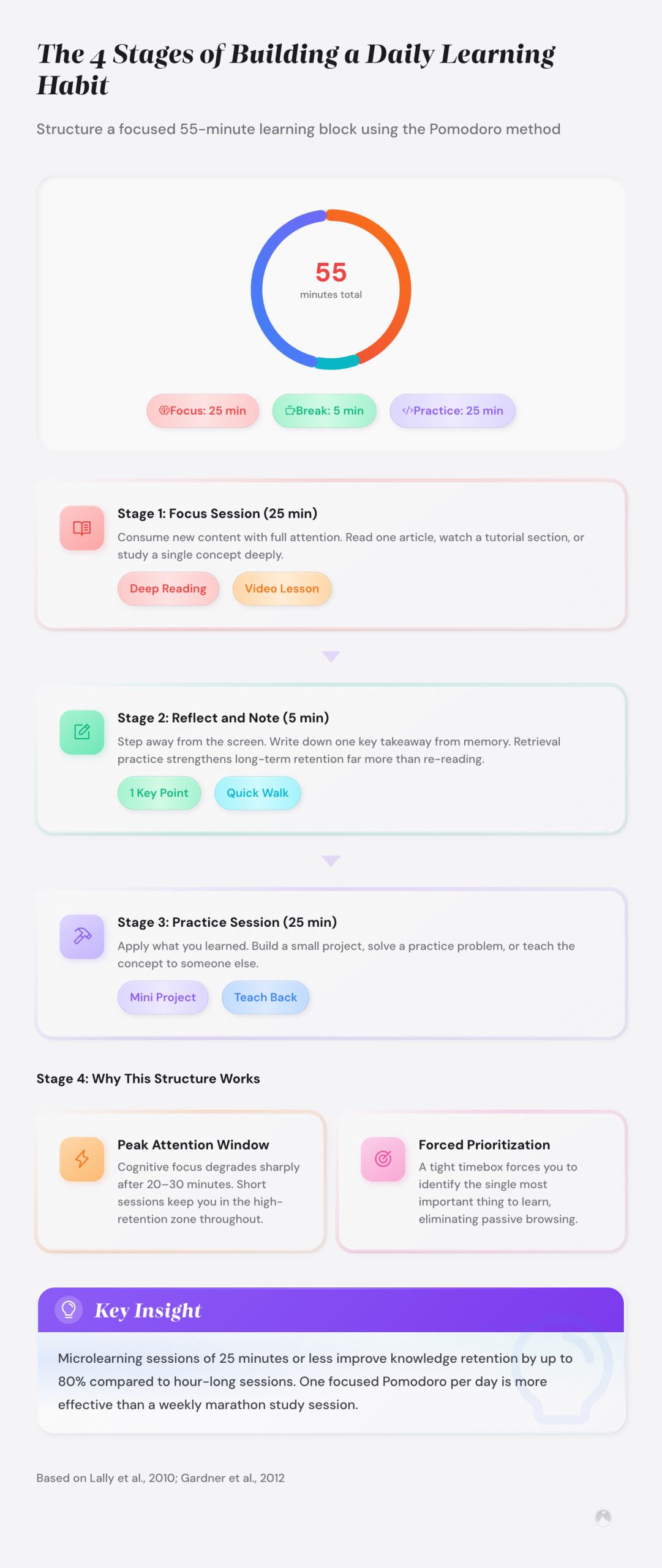
Starting with microlearning sessions of 5 to 15 minutes works because, according to eLearning Industry’s 2024 analysis, these formats show completion rates near 80%, while traditional long-form online courses average completion rates around 20% [4]. The reason is friction. A 10-minute podcast episode has almost zero startup cost. A 90-minute video lecture requires clearing your schedule, finding headphones, locating where you left off, and convincing yourself to commit.
If your daily learning session takes longer to set up than to complete, the habit will not survive its first real test.
The first two weeks should use the lowest-friction format available for your energy level. Here’s a progression that respects the learning habit formation timeline:
| Weeks | Daily minimum | Format guidance |
|---|---|---|
| 1-2 | 10 minutes | Lowest friction only: podcasts, short articles, flashcard review |
| 3-4 | 10-15 minutes | Introduce one active format: note-taking, practice problems |
| 5-8 | 15-20 minutes | Mix active and passive based on energy; add one weekly deep session |
| 9+ | 15-30 minutes | Full format flexibility; the habit carries itself |
Starting at 10 minutes when your ambition says 45 feels insufficient. But a 10-minute session you complete is infinitely more useful than a 45-minute session you skip. Consistency is the only metric that matters during habit formation. Duration is a dial you turn up later.
How to make invisible progress visible
The second reason learning habits die – after the two-week wall – is invisible progress. You’ve been reading about personal development strategies for three weeks and feel like you know nothing new. The knowledge is accumulating, but you cannot see it, so motivation erodes.
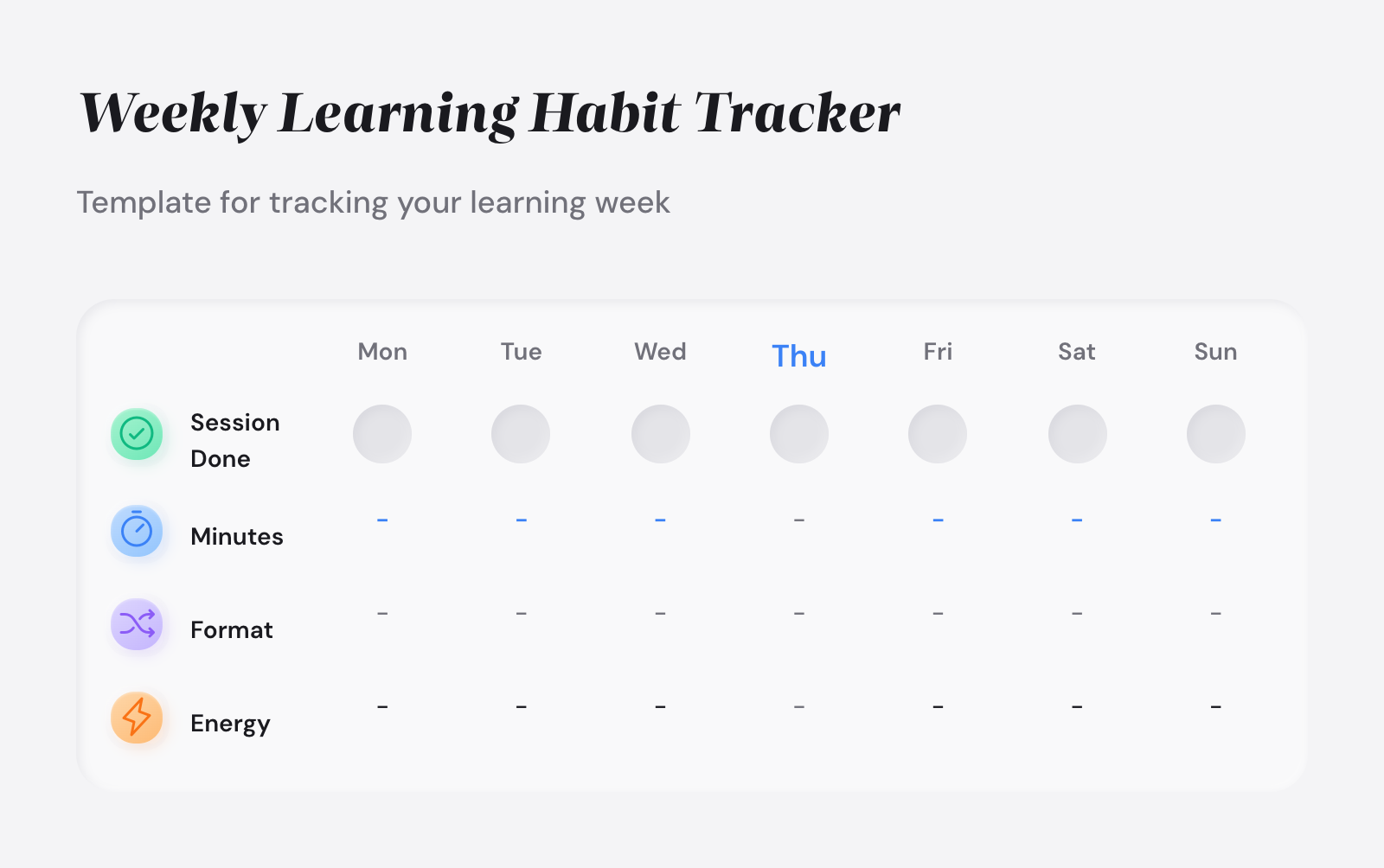
Weekly checkpoints fix this. Every seven days, spend five minutes on one of these:
- The explain test: Pick one thing you learned this week and explain it out loud (or in writing) without looking at notes. If you can, the knowledge stuck.
- The connection test: Link something you learned this week to something you already knew. The ability to connect ideas across domains is a reliable signal of deepening knowledge.
- The speed test: Revisit a concept from week one. If you recall it faster than you could on day seven, your retention is growing.
These are not exams. They’re mirrors. They exist to show you progress your brain cannot feel, and they take less than five minutes. What you cannot measure, you will quit.
What to do when you miss a day (or a week)
You will miss days. Travel, illness, a brutal workday – something will break the chain. Lally’s research says this is fine, as long as you follow one rule: never miss two consecutive days [1].
One skip is noise. Two skips in a row start a new pattern. The habit strength curve barely dips after one missed day, but the model suggests that consecutive misses would erode automaticity gains over time [1]. The key is: don’t let one disrupted day become a habit itself.
Here’s how to recover in practice:
- Planned skip: You know tomorrow will be impossible. Do a 2-minute micro-session today (reviewing one flashcard counts) and pick up normally the day after.
- Unplanned skip: You missed yesterday. Today’s session is non-negotiable, but it can be the easiest possible version. Listen to one podcast. Skim one article. Two minutes resets the counter.
- Extended disruption: Drop to absolute minimum format for as long as needed. A 2-minute review during recovery counts. The goal is not learning – it’s maintaining the cue-routine-reward cycle.
Perfectionism is the enemy of every 66-day process. A messy, minimal, barely-there learning session on a hard day is worth more than a perfect 30-minute session you skip.
Building a daily learning habit with ADHD or a chaotic schedule
Everything above assumes your day has some predictable structure. But if you have ADHD or you’re a parent with a schedule that changes hourly, the anchor-habit approach needs adapting.
The fix is not a different system. It’s a shorter leash on the same system. Instead of picking one anchor time, pick three possible anchors ranked by preference. Morning coffee is first choice. If that window is gone by 8 AM, the commute is backup. If that fails, the five minutes after lunch is the final option.
For ADHD brains specifically, the format match matters even more. Novelty-seeking means the same learning format every day will lose its pull faster. Rotate between reading, listening, and watching on a simple three-day cycle. And keep the minimum session at 5 minutes – not 10. The kaizen approach to personal productivity applies here: the lower the bar, the more often you clear it.
For parents, the real trick is accepting that your “learning session” might be a single flashcard reviewed while standing in the kitchen. That counts. During chaotic weeks, the goal is keeping the daily cue alive, not making meaningful progress. The habit survives the chaos. The learning catches up later.
Conclusion
Building a daily learning habit is not a motivation problem. It’s an engineering problem. The 66-day timeline from Lally’s research [1], the cue-routine-reward loop from Gardner, Lally, and Wardle [2], the energy matching, the two-day recovery rule – these are mechanical components of a system that works whether you feel inspired or not.
You don’t need to love learning every day. You need a system that doesn’t depend on you loving it.
After 66 days, the system becomes invisible. You stop being someone who is trying to build a learning habit. You become someone who learns.
In the next 10 minutes
- Pick one existing daily behavior that will be your learning anchor (coffee, commute, lunch).
- Choose one learning topic where you can see results within 30 days.
This week
- Complete your first seven days of 10-minute anchored learning sessions.
- Run the “explain test” at the end of day seven to surface your first week of progress.
- Set a calendar reminder for day 14 – the two-week wall – so you expect the motivation dip instead of being surprised by it.
Ramon’s take
Before you map out your perfect 30-minute learning block, just pick one thing you already do every day and attach five minutes to it. That’s the whole strategy. Everything else in this article is just support for that one move.
If you’re sitting on a stack of unfinished courses right now, the answer isn’t finishing them. The answer is picking the smallest possible learning action, attaching it to something you do already, and protecting it for 66 days.
There is more to explore
For structuring what you learn after the habit is in place, see our guide on continuous learning and the science of skill development. If you’re wondering whether to follow a structured path or explore freely, the comparison of self-paced vs structured personal development breaks down when each approach works.
If mornings turn out to be your best anchor time, our guide on personal growth goals that stick goes deeper on designing that window. For tools and platforms to fill your daily sessions, check best personal development apps and resources.
And if the habit is solid but you’re feeling stretched across too many goals, personal development overwhelm solutions covers how to stay focused without burning out.
Related articles in this guide
- continuous-learning-research-and-science
- finding-a-mentor-and-coaching-guide
- how-to-create-a-personal-development-plan
Frequently asked questions
How long does it take to form a daily learning habit?
Phillippa Lally’s research found habits take an average of 66 days to become automatic, with a range of 18 to 254 days depending on complexity [1]. Simple passive-intake habits like listening to a podcast form faster than active study habits requiring effortful recall. A practical rule: set a 90-day calendar marker rather than 66 days to give yourself buffer for the upper range of the timeline.
What are the best habit stacking techniques for adding learning to existing routines?
Identify a daily behavior you do without thinking – morning coffee, commute, lunch break – and insert learning immediately after it. The existing behavior acts as your cue. Match the learning format to that time slot’s energy level: podcasts for low-energy windows, active practice for high-energy windows. The anchor habit triggers the learning automatically without requiring a separate reminder or decision.
How can I minimize distractions during my daily learning time?
Keep your learning material ready before the anchor habit begins. If you read during coffee, have the article open on your phone the night before. Put your phone in Do Not Disturb mode for the session. Shorter sessions of 10 to 15 minutes need less distraction management because you finish before attention wanders.
What tools help track daily learning consistency?
A basic paper habit tracker works as effectively as any app. If you prefer digital, apps like Streaks, Habitica, or a spreadsheet track daily completion. The tracking method matters less than doing it immediately after each session. The check mark itself becomes part of the reward loop that strengthens the habit.
Should I focus on one learning goal or multiple topics simultaneously?
During the first 66 days of habit formation, focus on one topic. The habit itself is fragile and adding the decision of ‘what should I learn today’ creates friction that kills consistency. Once daily learning becomes automatic, you can rotate topics. Single-topic focus protects the habit during formation.
How do I adapt my learning habit when my schedule changes?
Keep the anchor habit and adjust the format. If your morning coffee routine disappears, pick the next most consistent daily behavior as your new anchor. During schedule transitions, drop to minimum viable sessions of 2 to 5 minutes of passive learning rather than skipping entirely. The cue-routine-reward cycle survives as long as it fires daily.
Does daily learning routine consistency matter more than session length?
Yes. Performing the behavior daily builds automaticity faster than occasional longer sessions [1]. The concept of minimum effective dose matters here: as little as 2 minutes preserves the cue-routine-reward chain when time is genuinely unavailable. There is also a useful distinction between the habit formation phase (consistency is everything) and the skill development phase (duration starts to matter more). If you have to choose between a 5-minute session today and a 30-minute session tomorrow, always choose today.
How can I make learning feel less like a chore and more enjoyable?
Match the format to your energy instead of forcing ‘study time’ when drained. Use formats you genuinely enjoy – podcasts if you like listening, videos if visual, articles if you prefer reading. Pick a topic where you see progress within two weeks. Keep sessions short enough to finish wanting more rather than feeling relieved it’s over.
How do I build a daily learning habit if I have ADHD?
ADHD brains benefit from shorter minimum sessions (5 minutes rather than 10), format rotation across reading, listening, and watching on a three-day cycle to satisfy novelty-seeking, and three ranked backup anchor times rather than one fixed slot. Body doubling can help: apps like Focusmate pair you with a remote accountability partner working silently alongside you. The dopamine mechanics of ADHD mean that novelty is a feature to exploit, not a distraction to manage – rotating formats uses this directly.
References
[1] Lally, P., van Jaarsveld, C. H. M., Potts, H. W. W., and Wardle, J. (2010). “How are habits formed: Modelling habit formation in the real world.” European Journal of Social Psychology, 40(6), 998-1009. https://doi.org/10.1002/ejsp.674
[2] Gardner, B., Lally, P., and Wardle, J. (2012). “Making health habitual: the psychology of ‘habit-formation’ and general practice.” British Journal of General Practice, 62(605), 664-666. https://doi.org/10.3399/bjgp12X659466
[3] AARP. (2021). “Lifelong Learning Among 45+ Adults.” AARP Research. https://www.aarp.org/pri/topics/social-leisure/activities-interests/lifelong-learning-older-adults/
[4] eLearning Industry. (2024). “Microlearning Statistics, Facts And Trends.” eLearning Industry. https://elearningindustry.com/microlearning-statistics-facts-and-trends