
Your phone is full of personal development apps you abandoned after a week
You’ve downloaded what reviewers called the best personal development apps before. Several of them. Each promised clarity, better habits, or genuine growth. Each one got opened for about five days before getting buried in a folder you forgot existed.
The reason isn’t app quality. It’s app fit. Most “best apps” lists rank tools by features or download counts, but neither predicts whether you’ll use a tool 30 days from now.
Researcher Mehul Shah’s usability study on self-improvement apps observed that the app market ranks tools mainly by downloads and market share, not by whether users actually formed lasting habits [1]. And mobile analytics data backs this up – apps lose roughly 77% of their daily active users within the first three days after installation [2]. That gap between popularity and usefulness is why you keep downloading and abandoning.
Personal development apps are software tools designed to support habit building, skill acquisition, stress management, and progress tracking toward specific growth goals. Unlike generic productivity apps, personal development apps target sustained behavior change through tracking, coaching, or guided practice – not just task management.
What you will learn
- How to match apps to your actual goals and time constraints (so you stop downloading ones you’ll abandon)
- Which habit tracking apps use behavioral science instead of just counting streaks (and why it matters for long-term consistency)
- Why microlearning platforms have 80% completion rates versus 20% for traditional courses
- Which meditation apps work if you don’t like the famous ones
- What goal setting apps pair well with habit trackers
- How to combine 2-3 tools without creating app overload
Key takeaways
- App popularity metrics like downloads and ratings don’t predict habit formation – app fit matters more [1].
- Microlearning apps achieve 80% completion rates versus 20% for traditional online courses, according to data compiled by eLearning Industry [3].
- Three factors determine app success: matching your goal, fitting your daily time, and your accountability preference.
- Research suggests gamification can meaningfully increase habit tracking adherence in the first weeks of use, with a majority of studies reporting positive effects [4].
- Test one app for 30 days before adding a second tool to your personal development stack.
- Insight Timer (free), Coursera (free audit), and Habitica (strong free tier) deliver real value without subscriptions.
How to pick the right app for your personal development goal
Before scrolling through categories, answer three questions. One: What area do you want to grow in – habits, skills, mindset, or wellness? Two: How much focused time can you give this per day – five minutes, 15 minutes, or 30 minutes plus? Three: Do you stick better when something checks on you, or when you track solo?
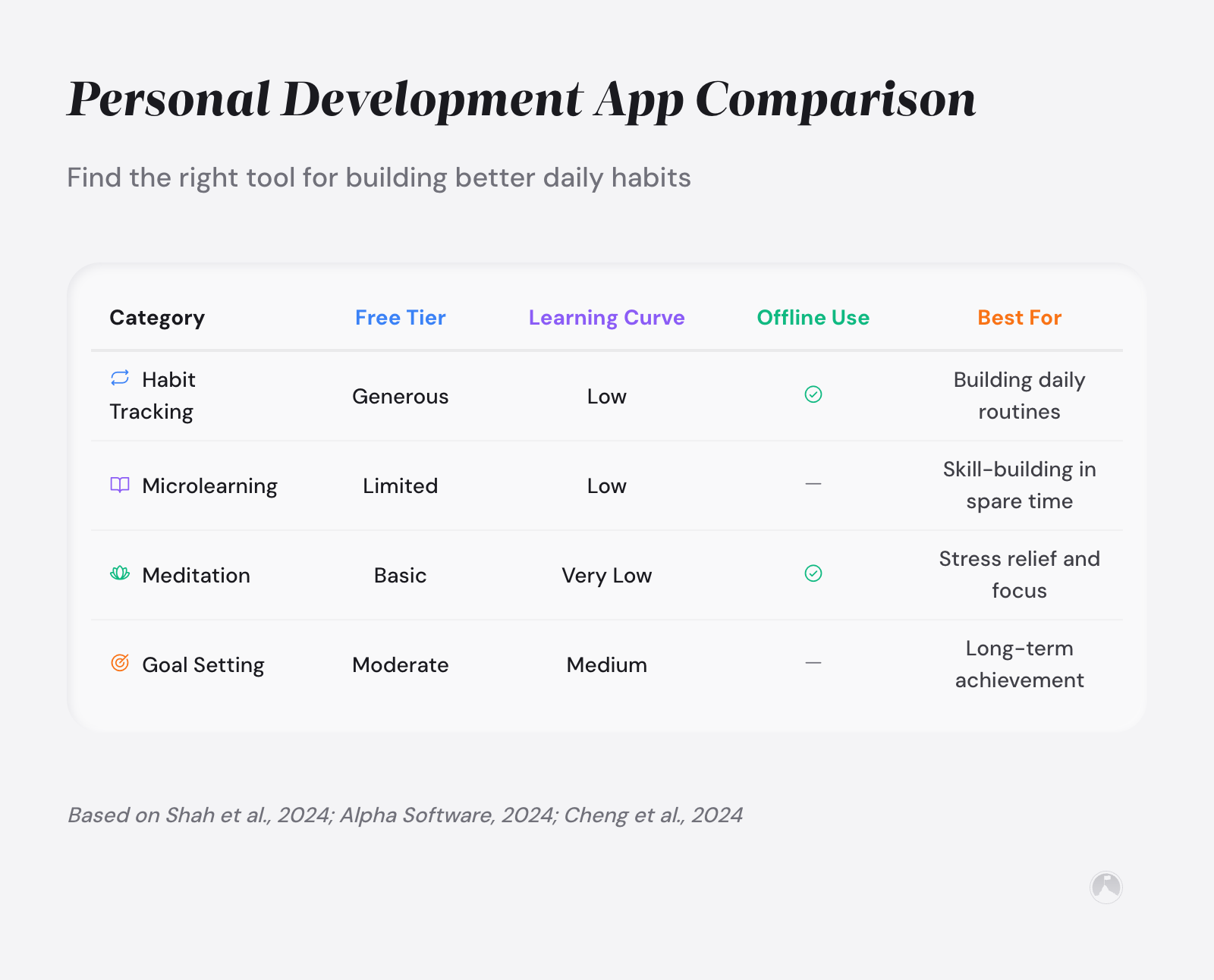
Your answers narrow the field dramatically. An app that needs 30 minutes daily will fail if you have 10 minutes available. An app that requires social accountability will frustrate you if you prefer working alone.
This is why apps lose roughly 77% of their daily active users within three days [2] – the apps they download don’t match their actual life constraints. People almost never choose based on fit. They download whatever has the highest rating and hope it sticks.
An app that needs 30 minutes daily will fail if you have 10 — and no feature list or 4.8-star rating will change that. Tech reviewers test tools for a weekend. You’ll be using this for months. Your daily rhythm trumps reviewer enthusiasm every time.
“The metrics used to assess app success are mainly based on market share rather than successful habit formation.” – Mehul Shah, usability study on self-improvement apps [1]
According to market research from Precedence Research, the personal development app market in 2026 is projected to reach $86.54 billion by 2034, growing at 5.55% annually [5].
That projection is noise if you’re trying to pick one tool to stick with. You don’t need to evaluate the whole market. You need to find the single app that fits your life. If you’re working on a broader personal development strategy, the app you choose should support that strategy – not replace it.
Which habit tracking apps work best if you’re serious about consistency?
Habit trackers split into two camps: simple streak counters and behavior-science systems. Streak counters track whether you did the thing. Behavior-science apps try to reshape the conditions that make doing the thing automatic. Both work – for different people.
Streaks (iOS) keeps it minimal. Up to 24 habits, clean interface, Apple Health integration, done. Two-to-three minutes per day to log your habits. If you want zero-friction tracking, this is it.
Fabulous takes a different approach. According to the Fabulous team, the app is built on behavioral science principles from Duke University’s Center for Advanced Hindsight, studying how gradually introducing routines makes them stick [6]. Instead of tracking existing habits, Fabulous builds new ones step-by-step. It takes longer upfront but produces stickier results if you’re building from scratch.
Habitica turns habit tracking into a role-playing game. You earn experience points for completions, level up a character, lose health for skips. It sounds gimmicky until you see the research: a systematic review by Cheng, Yeh, and Kuo found that 19 of 27 studies reported positive effects of gamification on adherence across disciplines [4].
Gamification doesn’t just make tracking fun – it extends engagement past the two-week dropout window where most apps die. The social features (team quests where your group suffers if you skip) add accountability that solo tracking can’t replicate.
| App | Best for | Daily time | Cost | Key strength |
|---|---|---|---|---|
| Streaks | Simple daily tracking | 2-3 min | $5 one-time | Minimal interface, Apple Health sync |
| Fabulous | Building new routines | 10-15 min | Free or $50/year | Behavioral science approach [6] |
| Habitica | Gamification seekers | 5-10 min | Free or $10/month | Social accountability, RPG mechanics |
| HabitNow | Android flexibility | 3-5 min | Free with ads | Detailed analytics, scheduling |
If you’re building personal growth goals that actually stick, pairing a tracker with clear goal definitions makes both stronger. The tracker holds you accountable. The goals give the tracker something meaningful to track.
What makes some learning apps stick and others fail?
Online learning platforms split into two models: long-form courses and microlearning. Coursera, LinkedIn Learning, and Udemy deliver full courses – 30 to 60 minutes per session. Headway and Blinkist compress books into 10-to-15-minute summaries. The right choice depends on your goal and your actual available time.
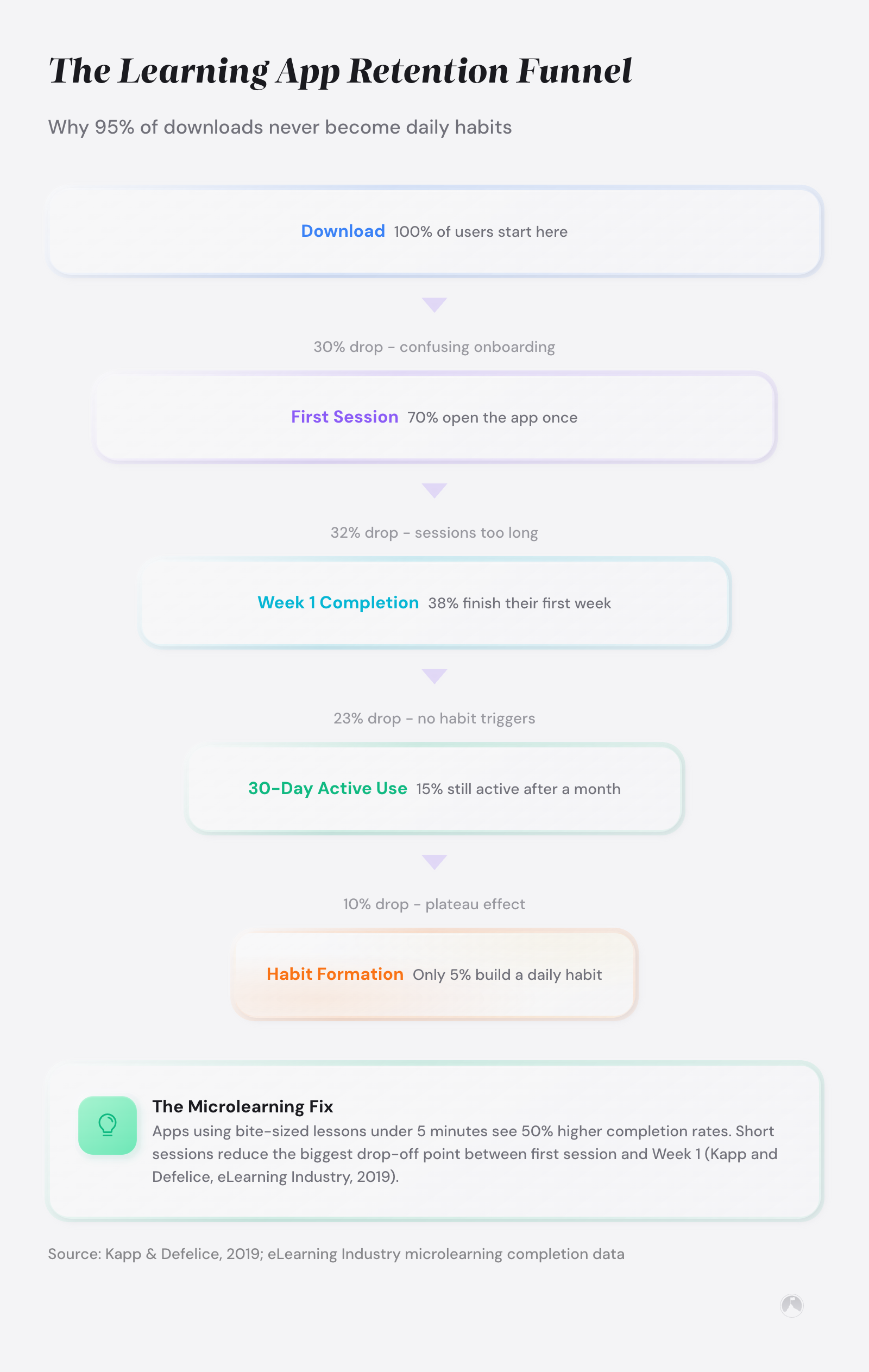
Here’s the research that matters. According to data compiled by eLearning Industry, microlearning apps achieve completion rates above 80%, while traditional online courses manage around 20% [3].
That doesn’t mean microlearning is objectively better. It means shorter formats remove the friction that kills long-form course completion. If you have 30 minutes daily to invest in learning, Coursera works. If you have 10 minutes, microlearning wins.
Coursera stands out if you want credentials that carry weight. University partnerships with Stanford, Yale, and MIT give certificates real academic value.
Coursera’s free audit tier provides access to Stanford-taught lectures at no cost – though without graded assignments or credentials. The trade-off: no feedback, no credential.
Headway and Blinkist fill different gaps. Headway includes interactive exercises after each summary, boosting retention. Blinkist has a larger library – over 7,000 titles [7] compared to Headway’s roughly 1,500 – but less interactivity. If you choose between them: Headway for application, Blinkist for breadth.
These pair well with deeper reading – check the guide on personal development books that changed lives for full-length recommendations when you want to go deeper. And if you’re building a broader learning routine, building a daily learning habit explains how to make your learning app usage automatic.
| Platform | Best for | Session length | Free option | Credential value |
|---|---|---|---|---|
| Coursera | Career-track credentials | 30-60 min | Audit most courses | High (university-backed) |
| Udemy | Practical skills cheap | 20-40 min | Frequent $10 sales | Low (portfolio only) |
| LinkedIn Learning | Corporate professionals | 15-30 min | 1-month trial | Medium (profile badge) |
| Headway | Applied learning via summaries | 10-15 min | Limited daily | None |
| Blinkist | Wide reading in short form | 10-15 min | 1 free summary/day | None |
Which meditation apps work if Calm and Headspace don’t click for you?
Meditation apps divide by teaching style and flexibility. Headspace teaches progressively – courses build step-by-step. Calm offers flexibility – dip into sleep stories, ambient soundscapes, or guided sessions without a program structure.
Insight Timer offers something different: over 200,000 free guided meditations from thousands of teachers [8]. The biggest predictor of sticking with meditation is finding a teacher whose voice doesn’t make you want to quit. Insight Timer’s scale means you’ll find someone.
Insight Timer’s free library of 200,000-plus sessions is the strongest free meditation option for anyone still searching for a teaching style that fits.
“Habit formation times ranged from 18-254 days with a median of 66 days.” – Lally, van Jaarsveld, Potts, and Wardle, habit formation research published in the European Journal of Social Psychology [9]
That 66-day median matters for meditation especially. Research on meditation programs suggests that consistent daily practice of 10-15 minutes leads to noticeable stress reduction, with a systematic review finding moderate evidence of benefit across meditation program durations [10].
Intensive programs with 30-plus minutes daily showed faster results. So if you’re downloading a meditation app expecting to feel different after five days, recalibrate. The shift happens in weeks three through eight.
If your interest in mindfulness connects to a broader personal mission statement, these tools work best paired with clear intention-setting. Meditation without direction becomes another to-do. Meditation tied to a specific outcome – reducing meeting anxiety, sleeping better, managing parenting stress – tends to stick.
And if you’re feeling overwhelmed by growth efforts generally, you might be dealing with personal development burnout, which needs strategy, not another app.
What goal setting apps pair well with personal growth tools?
Habit trackers and learning apps are strongest when they connect to something bigger. That’s where goal setting apps come in. They provide the “why” behind your daily tracking.
Todoist works well as a flexible goal organizer. You can set up projects per goal area, break them into sub-tasks, and track weekly. It’s not a dedicated goal-setting tool, but its flexibility means it bends to your system instead of forcing you into one. Coach.me adds a coaching layer – human or AI – on top of goal tracking, which helps if you need someone asking “did you do this today?” to stay accountable.
The best personal growth tools don’t compete with each other – they divide labor. Your habit tracker handles daily behavior. Your goal setting app holds the bigger picture. Your learning app builds the skills you need to get there. Three roles, three tools, zero redundancy.
For more on structuring goals that feed into daily habits, see the guide to creating a personal development plan.
How do you combine apps without creating tool overload?
The biggest mistake is downloading five apps on Monday thinking you’ll use all of them. App overload means you spend more time managing tools than using them. Three apps is the sweet spot – one for habit tracking, one for learning, one for mindset. That’s it.
Here’s a 30-day approach that prevents the graveyard problem. Week one: pick one app from your priority category. Use only that app.
Week two: evaluate whether it fits your actual schedule, not your imagined one. Week three: if it stuck, add a second from a different category. Week four: assess whether both create flow or friction. If friction, drop the weaker one and keep testing.
That gradual-introduction principle matters more than which specific app you pick. Research by Lally and colleagues on habit formation found that introducing one behavior at a time produces far better results than attempting multiple simultaneous changes [9].
Don’t install five apps on Monday. The app graveyard on your phone exists because you tried to change everything at once instead of one thing at a time.
| Your primary goal | Recommended starter app | Daily time | Cost |
|---|---|---|---|
| Build daily habits | Streaks (simple) or Fabulous (guided) | 5-15 min | Free-$50/year |
| Learn new skills | Coursera (deep) or Headway (quick) | 15-60 min | Free audit or $100/year |
| Stress and focus | Insight Timer (free) or Headspace (structured) | 10-20 min | Free or $70/year |
| Productivity and discipline | Todoist (flexible) or Coach.me (coached) | 10-20 min | Free tier or $25/month |
If you’re feeling overwhelmed by the number of options in this article alone, that’s a signal. Pick one row in the table above that matches your biggest pain point. Download that app. Give it 30 days. Everything else can wait.
Ramon’s take
My gut says most people pick apps based on App Store screenshots and Reddit threads. There’s probably a version of you that’d click with one app and ignore an almost identical one just because the layout feels right. That part never gets measured, does it?
Conclusion
The best personal development app is the one you’re still using 90 days after downloading it. That filter eliminates most of the market. As these tools increasingly integrate AI coaching and adaptive learning, the fit question will shift from “does this match my schedule” to “does this understand how I learn” — but the principle stays the same.
The personal development market will keep growing – Precedence Research projects it at $86.54 billion by 2034 [5] – and the number of options will keep expanding. Your job isn’t to evaluate all of them. Your job is finding the 2-3 that fit your life and ignoring the rest.
Next 10 minutes
- Answer the three filtering questions: primary goal, available daily time, accountability preference
- Identify which table row matches your situation
- Download the recommended app and complete onboarding
This week
- Use your chosen app every day for seven days
- Note whether it fits your actual schedule or only your imagined one
- Delete any personal development apps you haven’t opened in 60 days
Related articles in this guide
- building-a-daily-learning-habit
- continuous-learning-research-and-science
- finding-a-mentor-and-coaching-guide
Frequently asked questions
What personal development apps are best for beginners feeling overwhelmed?
Start with one app matched to your biggest growth area rather than downloading several at once. Fabulous works well for beginners building daily routines because it introduces one habit at a time using behavioral science principles from Duke University [6]. Insight Timer is the best free starting point for meditation given its library of over 200,000 free sessions [8] letting you sample different teaching styles.
How do I stay consistent with personal development apps after the first week?
Consistency depends on time-matching, not motivation. Pick an app whose minimum session length fits a gap already in your day – a 3-minute commute check-in or 10-minute lunch break session. Apps requiring sessions longer than you naturally have available will always lose to real life. Research shows apps lose 77% of daily active users within three days [2], so surviving week one is already a strong signal of fit.
Which apps are best for building specific habits like reading or exercise?
For reading habits, Headway or Blinkist deliver 15-minute book summaries you can complete during a commute. Blinkist’s library of 7,000-plus titles [7] gives you wide selection. For exercise habits, Streaks paired with Apple Health lets you set custom activity targets and track in under 30 seconds. Match the app’s tracking speed to how often you do the activity.
Can I use multiple personal development apps together without overwhelm?
Yes, but cap at three maximum across different categories – one for habits, one for learning, one for mindset. Using two apps in the same category creates redundancy. Test each app solo for two weeks before combining it with another tool. Research on habit formation shows that introducing one behavior at a time beats simultaneous changes [9].
What is the difference between coaching apps and habit tracking apps?
Coaching apps like Coach.me and BetterUp connect you with a human or AI coach who provides personalized guidance and feedback. Habit tracking apps like Streaks and Habitica record whether you completed a behavior but don’t adapt recommendations based on your progress. Coaching apps cost more but provide external accountability that solo trackers lack.
Are there self improvement apps free enough to be worth trying?
Insight Timer offers over 200,000 free guided meditations [8] with no paywall on core content. Coursera lets you audit most university courses for free – you only pay for certificates. Habitica’s free tier includes full gamification features. These three cover meditation, learning, and habit tracking without requiring subscriptions.
How do Blinkist and Headway compare for learning?
Blinkist offers a larger library of over 7,000 titles [7] with text and audio summaries, making it better for breadth. Headway includes interactive exercises and spaced repetition, making it better for retention. Both cost roughly $100 per year with limited free tiers. Microlearning formats like these achieve completion rates around 80% compared to 20% for traditional courses [3].
How long before you see results from personal development apps?
Initial behavior change appears within two to three weeks of consistent tracking. Automatic habit formation – where the behavior requires no conscious effort – takes a median of 66 days according to Lally and colleagues’ research [9]. For daily 10-15 minute meditation practice, a systematic review found moderate evidence of stress reduction across meditation program durations [10].
References
[1] Shah, M., Burke, J., Chentakul, M., and Abraham, Z. “A Usability Study on Self-Improvement and Productivity Apps.” Medium, 2019. https://medium.com/@mehulshah1995/a-usability-study-on-self-improvement-and-productivity-apps-ac910d8b9ae7
[2] Alpha Software. “80% of Users Abandon Mobile Apps Fast – How to Prevent It.” Alpha Software, 2024. https://www.alphasoftware.com/blog/80-of-users-abandon-mobile-apps-fast.-how-to-prevent-it
[3] eLearning Industry. “Microlearning Statistics, Facts and Trends for 2025.” eLearning Industry, 2025. https://elearningindustry.com/microlearning-statistics-facts-and-trends
[4] Cheng, V. W. S., Yeh, T., and Kuo, L. “A Systematic Review of the Effect of Gamification on Adherence across Disciplines.” Universal Access in the Information Society, 2021.
[5] Precedence Research. “Personal Development Market Size, Share, and Trends 2024-2034.” Precedence Research, 2024. https://www.precedenceresearch.com/personal-development-market
[6] Fabulous. “The Science Behind Fabulous: Behavioral Science and Habit Formation.” Fabulous, 2025. https://www.thefabulous.co/science-behind-fabulous/
[7] Blinkist. “Blinkist – Read and Listen to Book Summaries.” Blinkist, 2025. https://www.blinkist.com/
[8] Insight Timer. “About Insight Timer.” Insight Timer, 2025. https://insighttimer.com/
[9] Lally, P., van Jaarsveld, C. H., Potts, H. W., and Wardle, J. “How Are Habits Formed: Modelling Habit Formation in the Real World.” European Journal of Social Psychology, 40(6), 998-1009, 2010. https://doi.org/10.1002/ejsp.674
[10] Goyal, M. et al. “Meditation Programs for Psychological Stress and Well-being: A Systematic Review and Meta-analysis.” JAMA Internal Medicine, 174(3), 357-368, 2014. https://www.ncbi.nlm.nih.gov/pmc/articles/PMC4142584/