
Why do standard accountability strategies fail working parents?
You mapped out the week. You set three clear goals. Then your toddler spiked a fever at dawn, your partner got called into an early meeting, and by 9 AM the plan was gone. Most accountability strategies for working parents fail for the same reason: they assume a level of schedule control that parents of young children simply don’t have.
Alsarve’s 2024 qualitative research on parental work-family dynamics identified recurring time-based difficulties: volume pressures (not enough hours), coordination challenges (mismatched schedules), and simultaneous demands (everything happening at once) [1]. So the answer isn’t trying harder to stick to a rigid system. It’s building an accountability framework flexible enough to absorb the chaos without collapsing.
Accountability strategies for working parents Accountability strategies for working parents are goal-tracking and self-monitoring methods designed around the constraints of parenting, including unpredictable schedules, limited solo time, and competing family and professional demands, to help parents maintain consistent progress on personal and career goals without requiring rigid routines.
What you will learn
- How to use natural transition moments for 5-minute accountability check-ins
- Why micro-commitments outperform weekly goal reviews for busy parents
- The Parenting Accountability Ladder, a framework we developed for adjusting accountability intensity to match your week
- Visual progress tracking methods that work in a family household
- The three most common accountability mistakes working parents make
Key takeaways
- Five-minute transition-time reviews during drop-off or bedtime replace the long weekly sessions most parents never complete.
- The Parenting Accountability Ladder scales accountability intensity across three tiers based on how demanding the week is.
- Timing of work matters more than total hours for parent-child interaction, making schedule-aware accountability critical [2].
- A workplace flexibility intervention studied by Davis, Goodman, and colleagues found that participants spent an average of 39 more minutes per day with their children [3].
- Hsin and Felfe’s 2014 analysis found that working mothers who allocate available time to quality interactions can maintain comparable developmental activities, though effects vary by child age and work arrangement [4].
- A meta-analysis of 138 studies found that monitoring goal progress significantly promotes goal attainment, with larger effects when progress is recorded physically or reported publicly [5].
- Micro-commitments of 5-10 minutes fit into the unpredictability of parenting schedules better than ambitious blocks that are harder to protect.
- Goal tracking that lives on a shared family surface creates passive accountability without requiring a dedicated review session.
- Partner-based accountability check-ins work best during existing routines, not as separate calendar events.
How accountability strategies for working parents use transition times
Traditional accountability systems assume you can carve out a 30-minute block each week to sit down, review your goals, and plan ahead. That assumption breaks immediately in a household with young children. But every parent has natural transitions built into their day: the drive to daycare, the quiet after bedtime, the wait at school pick-up. These 5-to-10-minute pockets are the real accountability windows for parents.
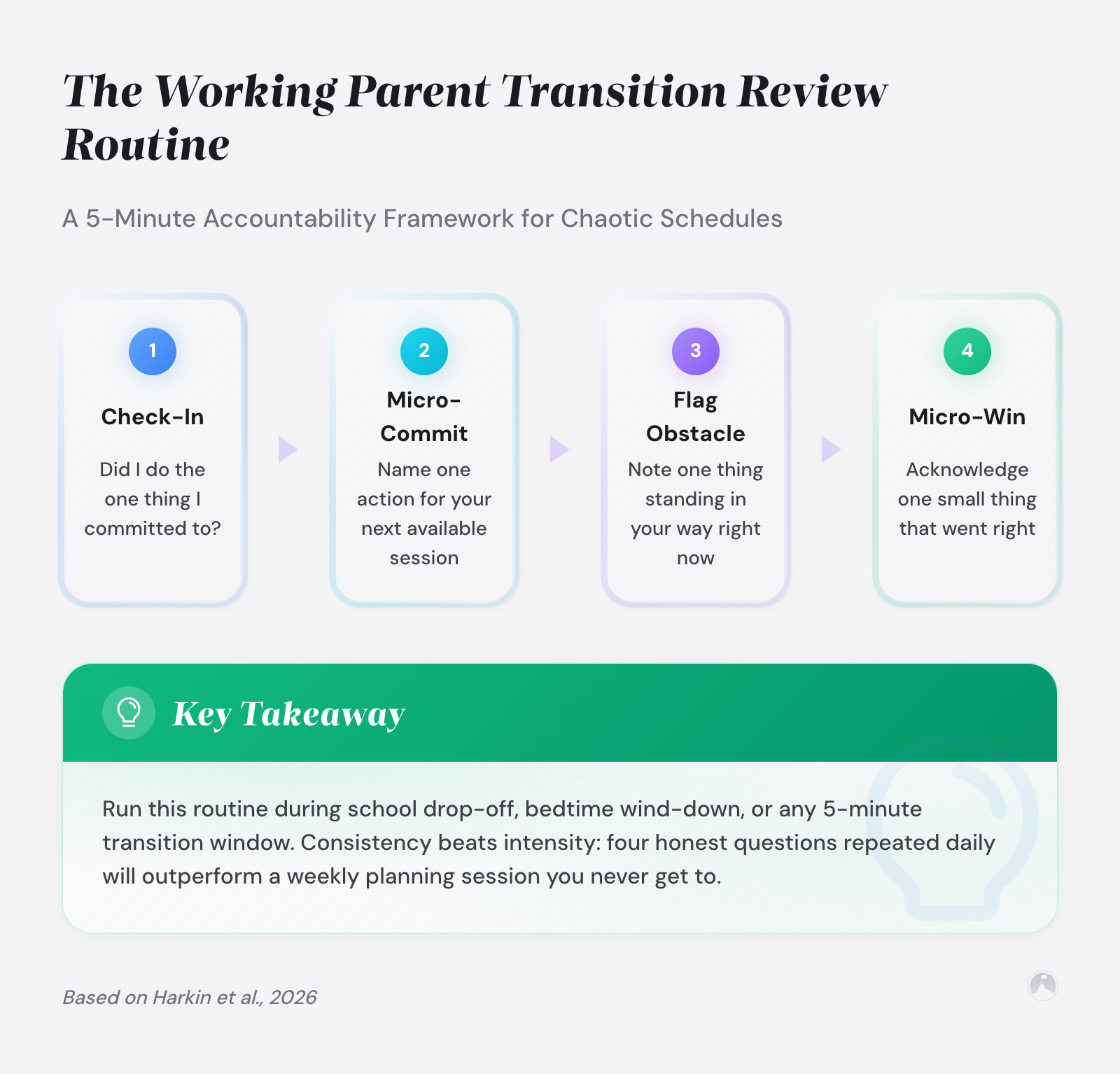
Here’s the thing: it’s not about finding more time. Wight, Raley, and Bianchi’s 2008 analysis of parental work schedules found that timing of work matters more than total hours worked for parent-child time [2]. The same principle applies to accountability. It’s about placing your practice at the right moments in your existing schedule.
The timing of parents’ work schedules is more consequential for time with children than the total number of hours worked.
Wight, Raley, and Bianchi, Social Forces, 2008 [2]
Their research showed that parents working nonstandard hours experienced different effects on family time based on when they worked, not how much [2]. A well-timed 5-minute check-in during a natural transition can do more than a poorly timed 30-minute session that competes with family demands.
Transition-time accountability places goal reviews at natural schedule breaks rather than requiring parents to create new time blocks that compete with family obligations. Here are the highest-value transition windows most parents already have:
| Transition Window | Duration | Best Use | Why It Works |
|---|---|---|---|
| Morning commute or drop-off wait | 5-10 min | Set one daily intention | Primes focus before work starts |
| Lunch break (first 5 min) | 5 min | Quick progress check | Mid-day course correction |
| Pick-up wait line | 5-10 min | Review daily win or obstacle | Captures learning before evening chaos |
| Post-bedtime window | 10-15 min | Weekly goal scan and next-day prep | Quiet time with lowest interruption risk |
The key is matching the accountability task to the window length. A 5-minute window is enough to answer one question: “What is the one thing I can move forward today?” A 10-minute window can handle a broader weekly review. Neither requires a dedicated planning session that gets cancelled the moment a child wakes up early.
If you’ve been using goal tracking systems that assume predictable schedules, transition-time placement is the first adjustment to make. Accountability that fits into the gaps survives longer than accountability that demands its own protected time. And once those gaps are working for you, the next question is what to do inside them.
Why micro-commitments work better than weekly goal reviews for busy parents
Weekly goal reviews are the standard recommendation in most productivity advice. Block out Sunday evening, review the past week, plan the next one. For parents of young children, this approach has a fundamental problem: the week-to-week variance is so high that a plan made on Sunday can be irrelevant by Tuesday.
A child gets sick. A work deadline moves up. A partner’s travel schedule shifts.
Micro-commitments solve this by shrinking the commitment window. Instead of planning an entire week, you commit to one small action for the next 24 hours. That action takes 5-10 minutes to complete. If you get it done, you’ve made progress. If you don’t, you haven’t failed an entire week’s worth of planning.
Micro-commitments Micro-commitments are accountability units of 5-10 minutes, small enough to fit into any day’s schedule, that maintain goal momentum by targeting one specific action rather than an entire weekly plan.
Hsin and Felfe’s 2014 analysis supports this smaller-unit approach: working mothers who allocate available time to quality interactions can maintain comparable developmental activities, though effects vary by child age and work arrangement [4]. The same trade-off applies to personal accountability: consistency of check-ins matters more than how long they last.
Harkin and colleagues’ 2016 meta-analysis of 138 studies confirms that monitoring goal progress promotes goal attainment, with stronger effects when progress is physically recorded [5]. A 5-minute daily check-in with a written log outperforms an untracked ambitious plan.
Here’s how to implement micro-commitments as busy parent productivity systems:
- Pick your anchor moment. Choose one transition time (see table above) as your daily commitment window.
- Ask the one question. “What is the smallest step I can take on my goal in the next 24 hours?”
- Cap the action at 10 minutes. The commitment must be completable in a single short window. Reading two pages. Sending one email. Writing three bullet points.
- Log the result. A checkmark on a sticky note, a line in a notes app, or a mark on a wall calendar. Tracking takes under 30 seconds.
The core mechanism is simplicity: a single question, a single action, a single mark. Five-minute micro-commitments fit the rhythm of parenting better than ambitious weekly plans that collapse under real life.
Micro-commitments handle the daily level well, but some weeks overload every day at once. When a stomach bug, a work deadline, and a partner’s travel all land in the same five days, even 5 minutes feels unreachable. That’s when the system needs an intensity governor — a way to scale down without quitting entirely.
The Parenting Accountability Ladder: adjusting intensity to match your week
Not every week is the same. Some weeks, both partners are healthy, childcare runs smoothly, and work stays predictable. Other weeks, a stomach bug tears through the household, a deadline accelerates, and sleep drops below five hours a night.
A rigid accountability system treats both weeks identically. That’s why it breaks.
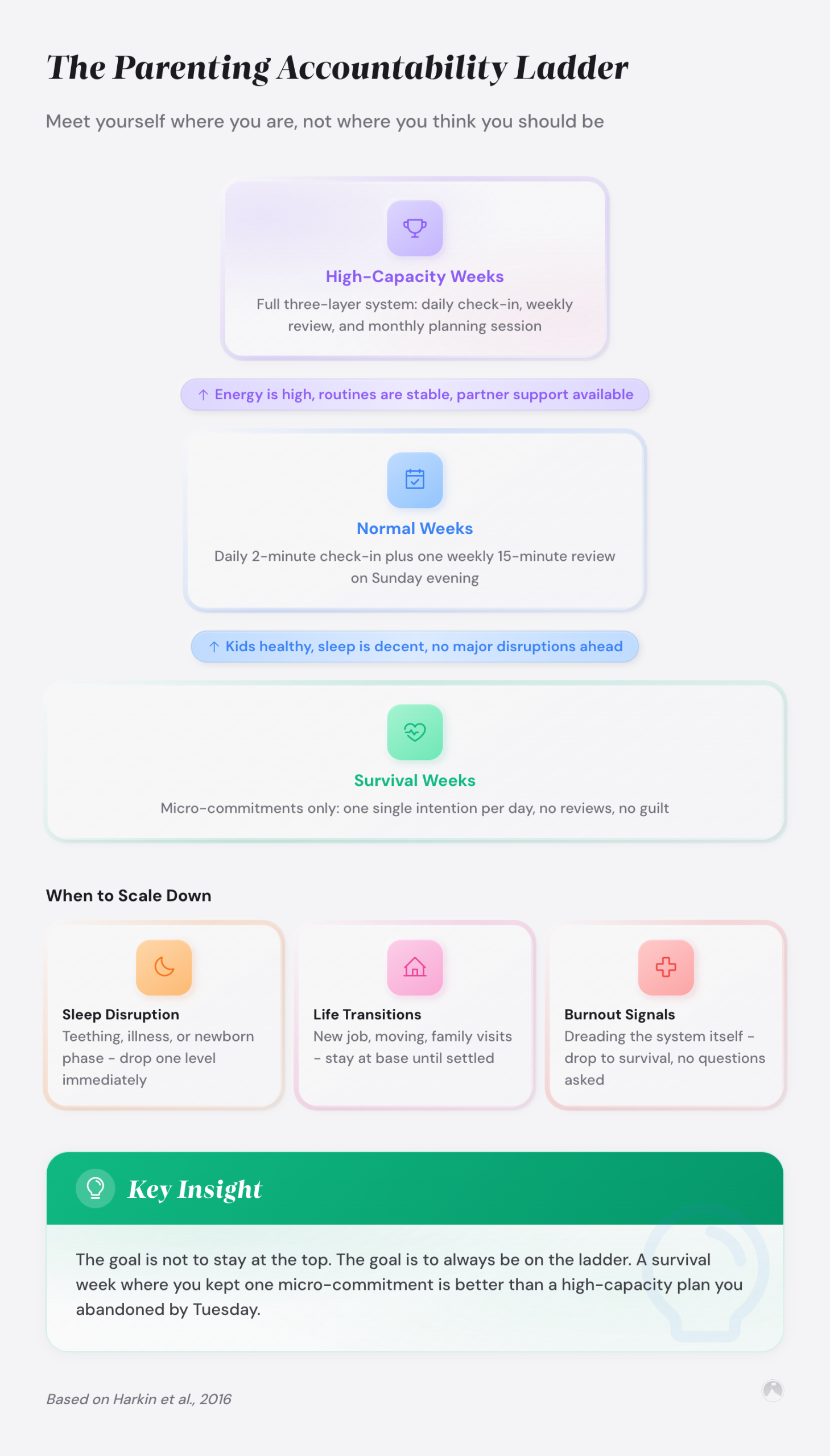
The flexibility principle demonstrated in workplace intervention research [3] and the time-quality findings from parenting studies [2][4] point toward a common insight: effective accountability for parents requires variable-intensity systems, not fixed schedules. We developed a three-tier framework based on this research and call it the goalsandprogress.com Parenting Accountability Ladder. None of the tiers are new individually. But stacking them into an explicit protocol gives parents permission to adjust without feeling they’ve quit.
The Parenting Accountability Ladder The Parenting Accountability Ladder is a three-tier accountability framework that adjusts goal-tracking intensity based on current family demands, allowing parents to scale down during high-stress weeks and scale up during calmer periods without losing overall momentum.
| Tier | When to Use | Daily Commitment | Tracking Method | Review Frequency |
|---|---|---|---|---|
| Tier 1: Full Stride | Stable week, childcare covered, normal workload | 10-15 min focused action | Written daily log | End-of-week 10-min review |
| Tier 2: Steady Pace | Minor disruptions, slightly heavier week | 5-10 min micro-commitment | Checkmark on wall calendar | 2-min daily scan only |
| Tier 3: Survival Mode | Sick kids, crisis week, sleep-deprived | 1 min: read your goal aloud | Mental check-in only | None until the storm passes |
Downshifting is a feature, not a failure. Most accountability systems are binary: you’re either on track or you’ve fallen off. The Ladder gives parents three gears.
The Parenting Accountability Ladder applies the flexibility principle from Davis and colleagues’ research [3], where schedule flexibility increased parent-child time by 39 minutes per day, to personal goal tracking for parents navigating weeks of varying intensity.
Dropping from Tier 1 to Tier 3 during a sick-kid week means you’re still in the system. You haven’t quit. You’ve adapted.
Here’s what this looks like in practice. A remote marketing manager pursuing a career certification has a Tier 1 week: study 15 minutes after bedtime and log progress. The next week, a toddler ear infection hits and a client presentation moves up. She drops to Tier 2: a 5-minute flashcard review during lunch, marked with a checkmark on the fridge calendar. By Wednesday, the toddler is up three times a night. She shifts to Tier 3: reads the certification goal from a card on the fridge each morning. No studying, no logging. When the child recovers, she shifts back to Tier 1 without the psychological weight of “starting over.”
A 2015 workplace intervention study by Davis, Goodman, and colleagues demonstrated this flexibility principle in action. When employees participated in a schedule flexibility program, they spent an average of 39 more minutes per day with their children at the 12-month follow-up [3]. Davis and colleagues studied parents of children aged 9 to 17, but the principle that workplace flexibility increases parent-child time applies across age groups. The accountability didn’t demand more time. It restructured existing time to match real priorities.
Employees in the intervention group reported spending an average of 39 more minutes per day with their children at 12 months post-intervention.
Davis, Goodman et al., Pediatrics, 2015 [3]
The research on accountability psychology supports tiered approaches. But most accountability frameworks are designed for professionals with predictable schedules. The Parenting Accountability Ladder is designed for the person whose schedule gets rewritten by a 3-year-old at 2 AM. The most effective accountability system for working parents has survival mode built into the framework design.
Of course, a tiered system only works if you can see where you stand. That’s where tracking comes in.
How visual progress tracking works in a family household
Tracking progress on a spreadsheet or app works if you’re the only person in the household. With children, tracking needs to be visible, physical, and quick to update. The best parental goal setting strategies use tracking surfaces the whole family can see.
A wall calendar with colored stickers or checkmarks does three things at once. It makes the parent’s commitment visible. It normalizes goal pursuit for children who see it daily. And it requires zero technology at 6 AM with one hand holding a bottle (which, if you know, you know).
Visual progress tracking Visual progress tracking is a goal-monitoring method that uses physical, visible markers (calendars, charts, stickers) placed in shared household spaces so that progress is immediately apparent without opening an app or logging into a system.
Four visual tracking methods that work well for time management for working parents:
- The fridge calendar method. A monthly calendar on the fridge with one symbol per day (checkmark for Tier 1 or 2 actions, circle for Tier 3 mental check-in). Entire family sees it. Takes 5 seconds to update.
- The habit chain strip. A paper strip on a bulletin board where each completed day gets a colored link added. The growing chain creates a visible streak that’s satisfying to maintain and painful to break.
- The shared whiteboard dashboard. A small whiteboard near the door with three sections: “This Week’s Goal,” “Today’s Micro-Commitment,” and “Wins So Far.” Both parents can update it. It creates work-life balance accountability that the household participates in.
- The desktop sticky note (for remote workers). A pinned digital sticky note on the computer desktop or a dedicated Slack channel shared with a partner. For parents who spend the day at a screen rather than near a fridge or whiteboard, this keeps the goal visible in the actual work environment.
Harkin and colleagues’ meta-analysis found that physically recording progress produces stronger goal attainment effects than mental tracking alone [5], which is why a simple checkmark on a fridge calendar outperforms “keeping track in my head.”
For digital options, the simplest approach is a shared notes file between partners. For more structured goal tracking with digital spreadsheets, a shared Google Sheet with one row per day and three columns (date, micro-commitment, done/not done) gives you the data without the overhead. For app-based tracking, explore our guide on the best goal tracking apps to find one that supports quick daily entries.
Goal tracking that lives on a shared family surface creates passive accountability without requiring a dedicated review session.
The three biggest accountability mistakes working parents make
The first mistake is copying systems designed for professionals without children. A solo entrepreneur can block two hours every Saturday morning for a goal review. A parent of a 2-year-old cannot.
Accountability with limited time requires systems built from scratch for that constraint, not adaptations of full-time systems. For a look at those full-control systems, see accountability for solo entrepreneurs and notice how the assumptions differ.
The second mistake is treating every missed day as a failure. Alsarve’s 2024 research found that working parents face simultaneous demands from work, childcare, and household tasks that create structural barriers to consistency [1]. Missing a day isn’t a discipline problem. It’s a structural outcome. The Parenting Accountability Ladder addresses this by making “survival mode” an explicit tier rather than a euphemism for giving up.
And the third mistake is keeping accountability private. Harkin and colleagues’ meta-analysis found that progress monitoring had larger effects on goal attainment when outcomes were reported publicly or made visible to others [5]. For working parents, the most natural accountability partner is a co-parent. A 30-second post-bedtime check-in (“Did you get your 5 minutes in today?”) costs almost nothing and provides the external nudge private systems lack.
If you’ve been struggling with accountability, run through these three mistakes before adding anything new. Often the fix is subtraction: removing the parts of your system never designed for a parenting schedule. The most common accountability failure for working parents is not a lack of discipline but a system that ignores the structural realities of raising kids.
These mistakes point to a bigger question: once you’ve fixed the system, how do you review progress without creating another obligation?
How should working parents review their goal progress?
The standard advice is a weekly review. For parents, that cadence often creates more guilt than clarity. A more effective approach uses two review cycles: a daily micro-review (30 seconds during a transition time) and a monthly macro-review (15 minutes during a calm evening).
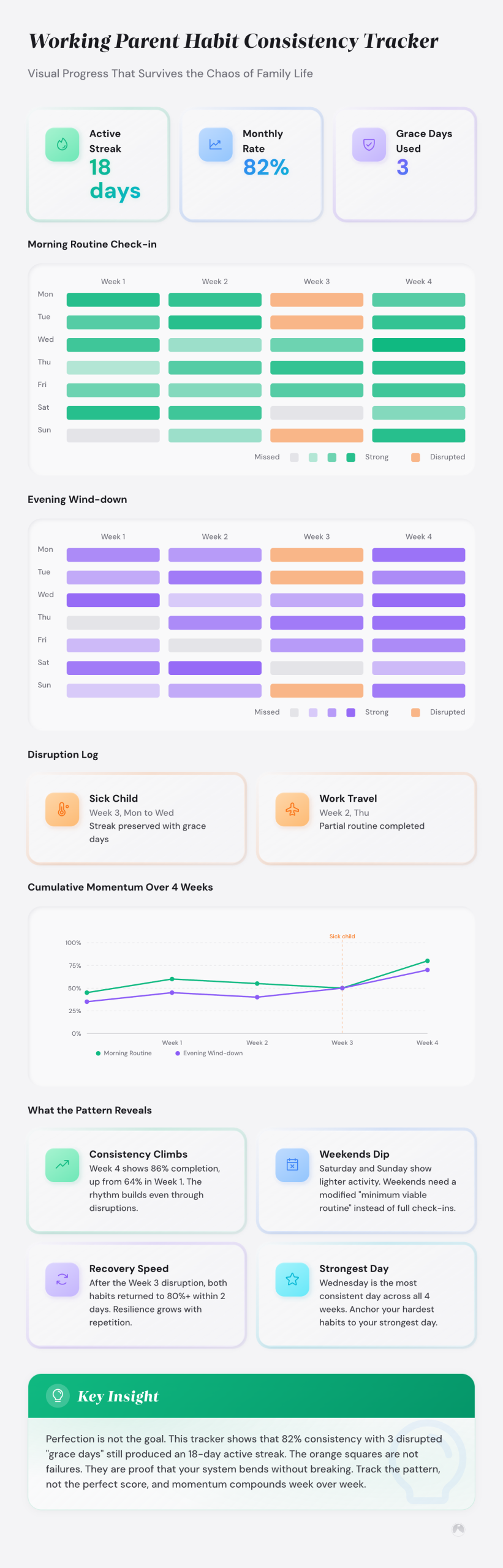
Working parent review cadence Working parent review cadence combines two distinct review types: a daily micro-review (30 seconds answering “did the micro-commitment happen today?”) and a monthly macro-review (15 minutes answering “is this goal still the right goal for this season of parenting?”). The two reviews operate on separate time horizons and answer separate questions, preventing the common mistake of mixing execution tracking with strategic goal evaluation.
The daily micro-review answers one question: “Did I do my micro-commitment today?” Yes or no. Mark it. Move on.
The monthly macro-review answers a different question: “Is the goal I’m working toward still the right goal for this season of parenting?” Priorities shift as children grow, as work demands change, and as family circumstances evolve.
Separate the “am I on track today?” question from the “am I pursuing the right goal?” question. They need different cadences and different headspaces.
This dual cadence pairs well with goal achievement reviews for course correction. The daily check keeps momentum. The monthly check keeps direction. For a structured approach to the weekly cadence that Tier 1 weeks can accommodate, our guide on the weekly goal review process offers methods that scale to fit a parent’s available time.
Ramon’s take
Nobody warned me that having a kid would make my old productivity system look like it was built by someone who’d never met a human child. I haven’t tried the ladder system yet, but I’m already wondering if ‘tier one’ weeks will feel like relief or surrender.
Conclusion
Accountability strategies for working parents don’t need to be smaller versions of systems designed for people without children. They need to be structurally different: built around transition times instead of dedicated blocks, scaled through the Parenting Accountability Ladder instead of binary on/off tracking, and made visible through physical surfaces rather than buried in apps.
Research consistently shows that timing and flexibility matter more than total hours [2] [3], quality outperforms quantity [4], and physically recording progress strengthens follow-through [5]. Your accountability system should reflect those principles.
The system that survives a sick-kid week is the system that was designed to survive a sick-kid week. If you’re ready to build a broader planning system around your parenting reality, our guide on planning for working parents covers the full framework beyond accountability alone.
What would your accountability look like if it was designed for your worst week instead of your best one?
In the next 10 minutes
- Identify your two best transition-time windows from the table above
- Write your current top goal on a notecard and put it on your fridge or bathroom mirror
- Decide which Parenting Accountability Ladder tier fits this week
This week
- Try the daily micro-commitment approach for five consecutive days using your chosen transition window
- Set up one visual tracking method (fridge calendar, whiteboard, or shared digital note)
- Ask your partner or a friend for a 30-second daily check-in during post-bedtime time
- If you want to compare different goal tracking methods to find the right fit, start there before building out a full system
There is more to explore
For more on building systems that hold up under real-life pressure, explore our guide on goal tracking templates and worksheets.
Related articles in this guide
- accountability-systems-for-adhd-creatives
- best-goal-setting-methods-compared
- best-goal-tracking-apps
Frequently asked questions
How can I stay accountable when my schedule changes daily with kids?
Use the Parenting Accountability Ladder to match your accountability intensity to the current week. On stable weeks, commit to 10-15 minute daily actions with written tracking. On disrupted weeks, drop to a 1-minute mental check-in where you read your goal aloud. The key is having pre-defined tiers so shifting down feels like an adaptation, not a failure.
What is the minimum time needed for effective accountability as a working parent?
One minute per day is the floor. Reading your goal statement aloud each morning takes under 60 seconds and maintains mental connection to the goal during high-stress weeks. For active progress, 5-10 minutes per day through micro-commitments during transition times (commute, pick-up wait, post-bedtime) produces consistent results over months.
Should I involve my partner in my accountability system?
Yes, if both partners are willing. A co-parent accountability check-in works best when embedded in an existing routine rather than scheduled as a separate event. The post-bedtime window is the most common choice. Keep it under 60 seconds: one question each about whether the daily micro-commitment happened. Avoid turning it into a performance review.
How do I set realistic goals as a working parent?
Start by cutting your pre-parenthood goal volume by at least half. Pick one primary goal per month rather than three to five. Define success in terms of consistency (did I show up 4 out of 7 days?) rather than output volume. Hsin and Felfe’s 2014 research found that working mothers who allocate available time to quality interactions can maintain comparable developmental activities [4], and the same quality-over-quantity logic applies to personal goal pursuit.
What accountability strategies work during school breaks and summer?
Drop to Tier 3 (Survival Mode) of the Parenting Accountability Ladder for the first week of any schedule transition. Children’s routines shift during breaks, and parents absorb most of the adjustment cost. After the first week, assess whether Tier 2 is sustainable. Summer accountability works best with a single monthly goal rather than weekly targets, since weeks blur together when school structure disappears.
Can I use family time for accountability check-ins?
Brief check-ins during shared transition moments (breakfast table, car ride) are fine if they take under two minutes and don’t turn into a planning session. Longer goal reviews should happen during solo time or partner-only time. Using family dinner for a 30-second “what did we each accomplish today” round can model goal-oriented behavior for children without stealing quality family connection.
How do I avoid guilt when I miss my goals as a working parent?
Reframe missed days as data, not verdicts. If you miss three days in a row, the system needs adjustment, not more willpower. The Parenting Accountability Ladder normalizes this by making Tier 3 a planned response rather than a sign of failure. Research by Alsarve shows that working parents face structural time difficulties that have nothing to do with personal discipline [1], so blaming yourself for systemic constraints is both inaccurate and counterproductive.
What is the best time of day for goal review as a working parent?
Post-bedtime consistently ranks as the most reliable review window for parents of young children. Mornings are too unpredictable with children’s wake-up variability. Lunch breaks work for a 2-minute check but rarely allow deeper reflection. If post-bedtime is consumed by household tasks, the morning commute or school drop-off wait line offers a secondary option with fewer interruptions than in-home time slots.
References
[1] Alsarve, J. (2024). “Managing families, managing time. Parents’ work-family difficulties and work-family strategies over time.” Community, Work & Family, 29(1). https://doi.org/10.1080/13668803.2024.2425377
[2] Wight, V.R., Raley, S.B., & Bianchi, S.M. (2008). “Time for children, one’s spouse, and oneself among parents who work nonstandard hours.” Social Forces, 87(1), 243-274. https://doi.org/10.1353/sof.0.0092
[3] Davis, K.D., Goodman, W.B., Pirretti, A.E., Almeida, D.M., King, R.B., Okechukwu, C.A., & Kelly, E.L. (2015). “Parents’ Daily Time With Their Children: A Workplace Intervention.” Pediatrics, 135(5), 875-882. https://doi.org/10.1542/peds.2014-2057
[4] Hsin, A., & Felfe, C. (2014). “When does time matter? Maternal employment, children’s time with parents, and child development.” Demography, 51(5), 1867-1894. https://doi.org/10.1007/s13524-014-0334-5
[5] Harkin, B., Webb, T.L., Chang, B.P.I., Prestwich, A., Conner, M., Kellar, I., Benn, Y., & Sheeran, P. (2016). “Does monitoring goal progress promote goal attainment? A meta-analysis of the experimental evidence.” Psychological Bulletin, 142(2), 198-229. https://doi.org/10.1037/bul0000025