
Why do solo entrepreneurs struggle with accountability without a team?
You left the nine-to-five for freedom. Now nobody checks your work, nobody asks about deadlines, and nobody notices when Monday’s plan quietly dies by Wednesday. Accountability for solo entrepreneurs is the structural gap most founders don’t see until months of missed targets pile up.
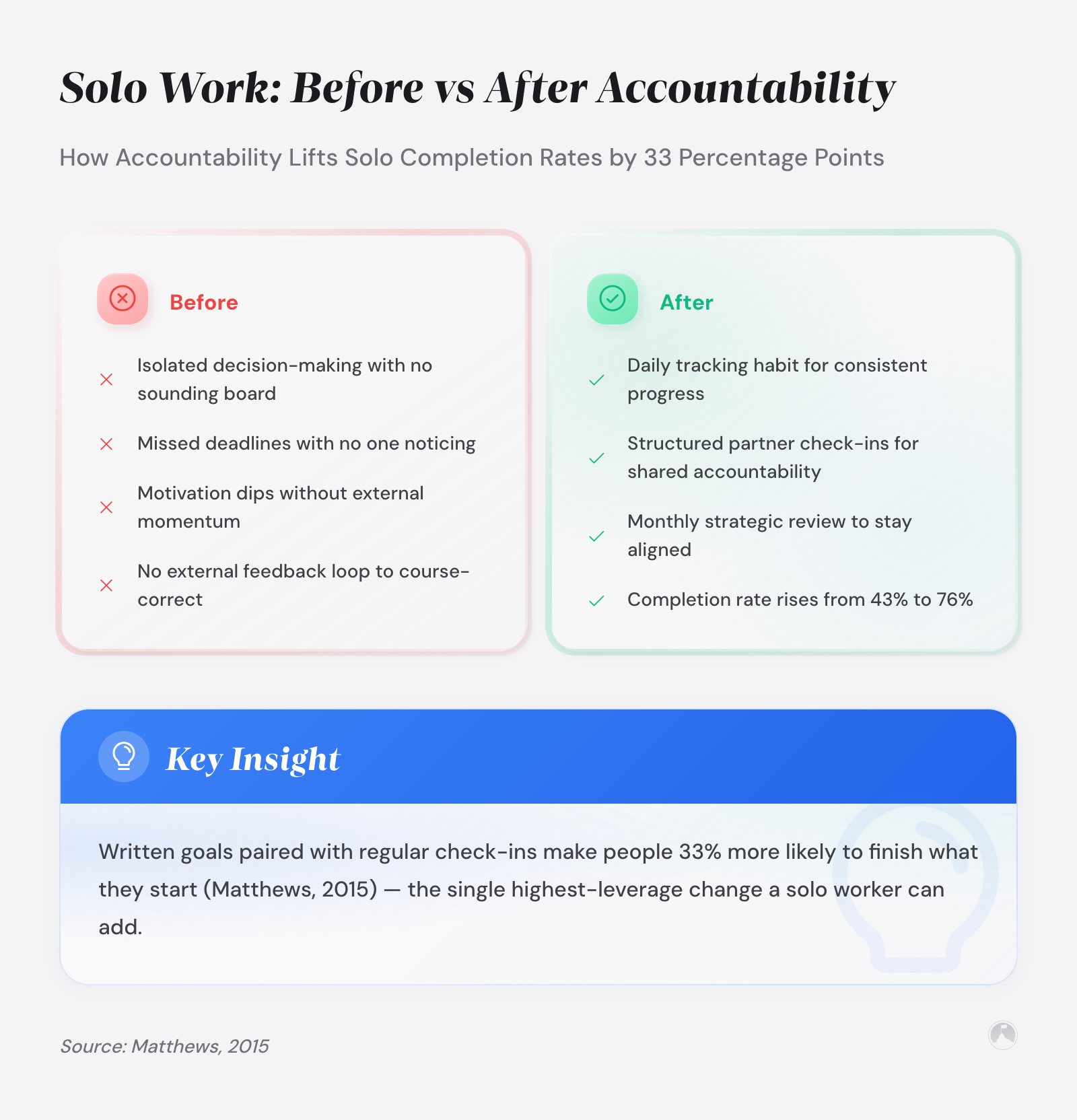
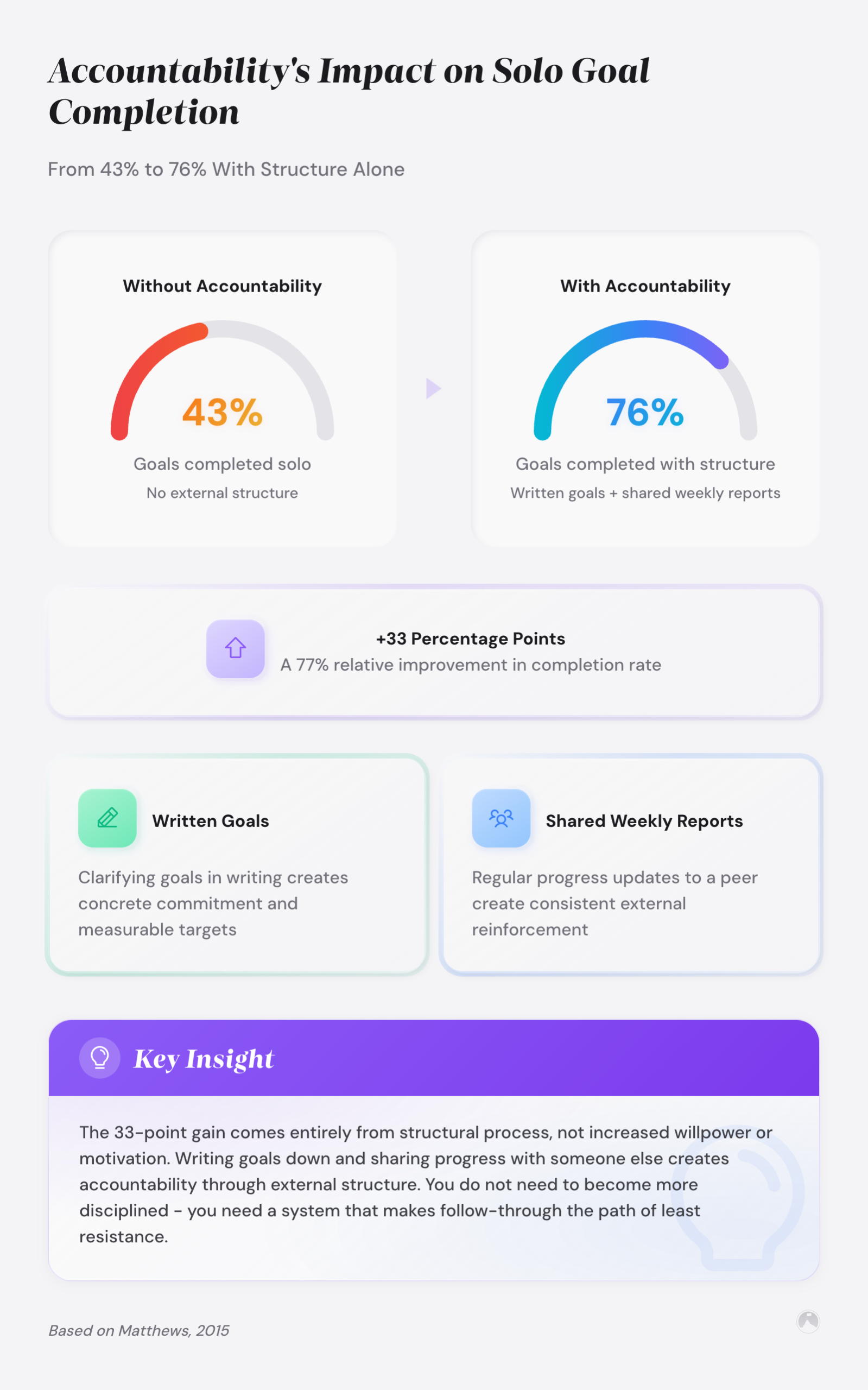
Here’s what the research says about that gap. Gail Matthews at Dominican University studied business professionals in 2015 and found that participants who wrote down goals, shared them with an accountability partner, and sent weekly progress reports achieved 76% of their goals. Those who only thought about their goals hit 43% [1]. That’s a 33-percentage-point difference from adding structure alone.
The real problem isn’t laziness or lack of vision. It’s that solo work removes the external pressure most people relied on for years without realizing it. This guide gives you a concrete system for rebuilding that pressure on your own terms.
Accountability for solo entrepreneurs A structured set of practices, tools, and human connections that replace the built-in oversight of traditional workplaces, enabling one-person business owners to maintain consistent follow-through on goals without external management.
What you will learn
- Why standard accountability advice fails for solo entrepreneurs
- How accountability partners, coaches, masterminds, and apps compare for different business stages
- How to build a hybrid accountability system using the Solo Accountability Loop
- How to measure whether your accountability system is producing results
- What to do when your accountability system stops working
Key takeaways
- Writing goals down and sharing weekly reports raises completion from 43% to 76% — a 33-point gain from structure alone [1].
- Structured, scheduled accountability monitoring produces significantly larger effects on goal attainment than casual self-monitoring [2].
- The Solo Accountability Loop combines daily self-tracking, weekly human check-ins, and monthly reviews into a three-layer system.
- Technology tools work best as a tracking layer under human accountability, not as a replacement for external commitment.
- Public commitment and external monitoring strengthen goal-setting effects beyond private self-tracking [2].
- Accountability systems fail most often from vague commitments and tracking burnout, not from weak willpower.
- Long-term accountability requires quarterly recalibration as solo businesses evolve through different growth stages.
- Specific, difficult goals outperform vague intentions across 40,000+ participants in goal-setting research [3].
Why does accountability break for solo entrepreneurs?
In a traditional workplace, accountability is baked into the environment. Meetings create deadlines. Colleagues create social pressure. Managers create consequences. When you work alone, all three vanish overnight.
The standard advice says “find an accountability partner” or “set deadlines for yourself.” But that misses the deeper issue. Locke and Latham’s foundational 2002 research synthesis, drawing from studies across 88 different tasks involving over 40,000 participants, shows that goal commitment is the critical variable for difficult goals [3]. A self-imposed deadline without a real commitment mechanism behind it is just a suggestion you’ll ignore by Thursday.
And that’s the core structural problem. Solo entrepreneurs who rely on self-discipline alone are fighting a system designed for team environments with tools built for individuals. The mismatch explains why talented founders stall on projects they genuinely care about.
Hmieleski and Baron’s 2009 research on 159 new ventures adds another layer: entrepreneurs tend to score high on dispositional optimism, and that optimism actually predicted worse venture performance when unchecked by external feedback [4]. Solo founders without accountability structures are especially vulnerable to this optimism bias — overestimating what they’ll accomplish and underestimating the time required.
So where does real accountability come from? Matthews’ 2015 study found that participants who shared goals with a friend and sent weekly updates achieved significantly more than those who merely thought about goals [1]. Harkin and colleagues’ 2016 meta-analysis of 138 studies involving nearly 20,000 participants confirmed and expanded this finding: goal monitoring interventions promoted goal attainment, and the effect grew stronger when goals were reported publicly and monitored by someone else [2]. The research points in one direction: accountability for solo entrepreneurs needs to come from outside your own head. For a deeper look at the science behind these findings, our guide on accountability psychology research breaks down the mechanisms in detail.
Types of accountability for solo entrepreneurs: partners, coaches, masterminds, and apps
Before building a system, you need to understand the options. Each accountability method works differently, costs differently, and fits a different stage of the solo business path. Here’s how the four main approaches compare.
| Method | Best for | Time investment | Cost | Key limitation |
|---|---|---|---|---|
| Accountability partner | Early-stage solopreneurs needing consistent check-ins. Start here if you’ve never had external accountability. | 30-60 min/week | Free | Quality depends entirely on partner match |
| Business coach | Founders facing strategic decisions alongside execution gaps. Coaching meta-analyses show positive effects on goal-directed self-regulation (practical judgment: most valuable past $50K revenue) [5]. | 1-2 hours/month | $200-500/month | Expensive and hard to vet quality |
| Mastermind group | Established solopreneurs wanting peer-level strategic feedback. The strongest option once you find the right group. | 2-4 hours/month | Free to $200/month | Group dynamics can drift; requires facilitation |
| Technology/apps | Daily habit and metric tracking between human check-ins. Tracking layer, never the whole system. | 5-10 min/day | Free to $20/month | No emotional stakes; easy to ignore |
The gap between casual and structured accountability is where most solopreneurs lose. Matthews’ 2015 study demonstrated this directly: participants who wrote goals, formulated action commitments, shared both with a friend, and sent weekly progress reports outperformed every other group [1]. The difference between “I told someone” and “I scheduled a structured check-in” is not small. It’s enormous.
Scheduling one recurring check-in with another person is the single most impactful accountability decision a solopreneur can make.
Adapted from Harkin et al., Psychological Bulletin, 2016 [2]
If you read nothing else in this article, do that this week.
How to build a hybrid solo business accountability system
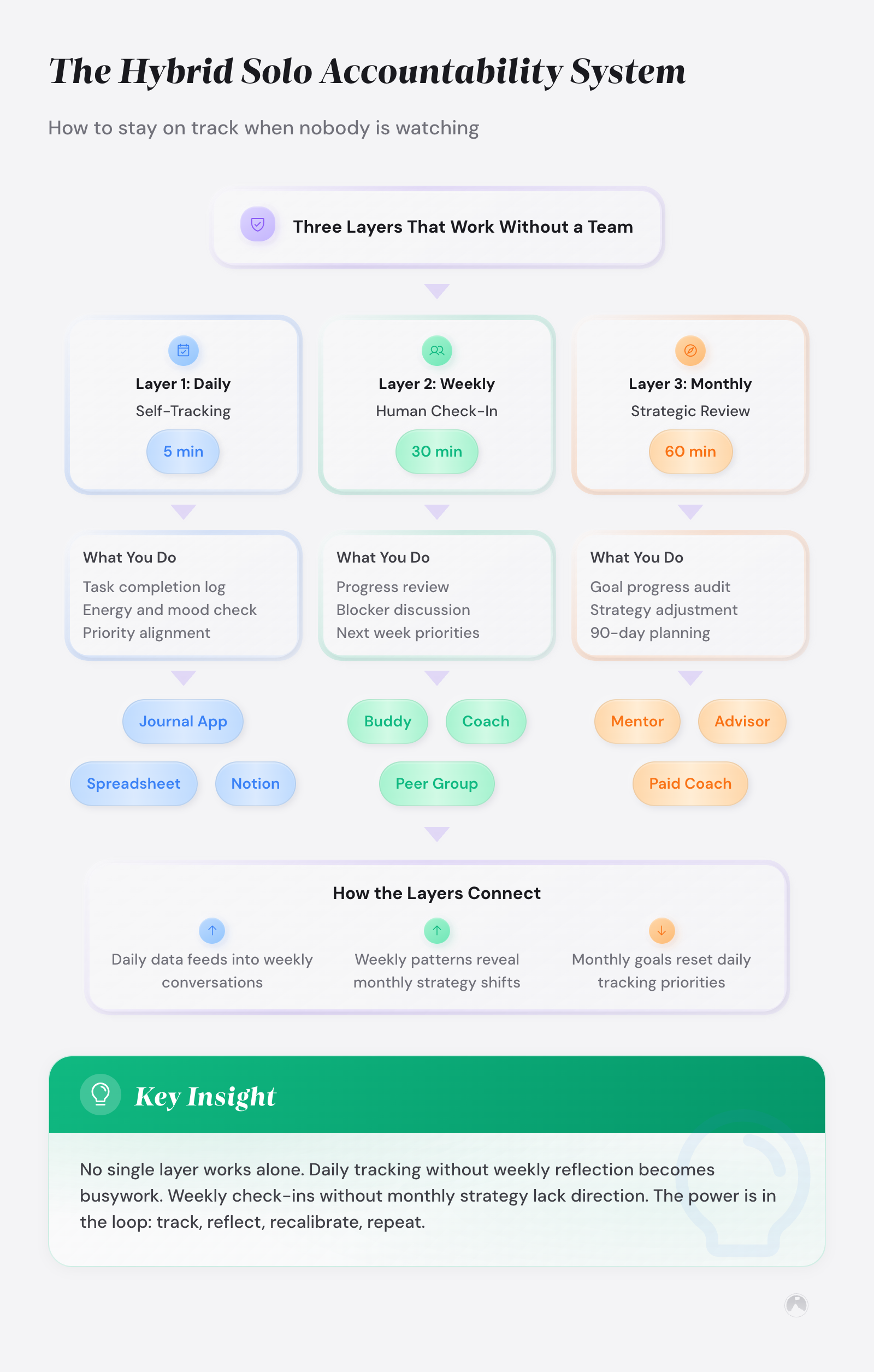
No single method handles everything. The best solo business accountability systems combine automated tracking for daily execution with human connection for weekly and monthly reflection. Staying accountable as a solopreneur requires all three time horizons working together. Here’s a framework (we call it the Solo Accountability Loop) that pulls the strongest elements from each accountability type into a three-layer system.
The Solo Accountability Loop A three-layer accountability framework for one-person businesses, combining daily self-tracking, weekly human check-ins, and monthly strategic reviews into a single repeating cycle.
Layer 1: daily self-tracking (5 minutes)
Each morning, write down three outcomes you’ll complete today. Not tasks – outcomes. “Draft pricing page copy” is an outcome; “work on website” is a task.
At the end of the day, mark which outcomes you hit and which you didn’t. A basic spreadsheet or notes app works. The tool matters far less than the consistency.
Wood and Neal’s research on habit formation explains why this daily repetition matters: habits form through repeated associations between a behavior and a stable context [6]. Writing outcomes each morning in the same place at the same time builds an automatic routine that survives motivation dips. The goal is to make daily tracking a context-triggered habit, not a willpower-dependent decision.
This layer creates a daily record that feeds your weekly check-in. Without it, weekly conversations turn into vague recollections of what you think you did.
Layer 2: weekly human check-in (30 minutes)
Meet with an accountability partner, coach, or mastermind group once per week. Share your daily tracking record. Report what you committed to, what you delivered, and where you fell short.
The structure matters more than the format. A 15-minute video call beats a 90-minute unstructured coffee chat. Keep the agenda tight: three wins, one miss, three commitments for next week.
But here’s what actually separates a good check-in from a useless one. Locke and Latham’s research identifies specificity as the mechanism driving goal achievement [3]. Accountability check-ins that follow a consistent structure outperform casual conversations because structure forces specificity. Weekly human check-ins produce significantly larger goal attainment effects than daily self-monitoring alone, because reporting progress to another person adds a social commitment layer that self-tracking cannot replicate [2]. If you need a repeatable framework for these sessions, our weekly goal review process guide walks through a step-by-step agenda.
Layer 3: monthly strategic review (60 minutes)
Once a month, step back from execution and review the bigger picture. Are your weekly outcomes moving your quarterly goals forward? Are you spending time on revenue-generating work or getting pulled into low-impact busywork?
This review can happen with a coach, a mastermind group, or solo with a written template. The monthly review prevents the slow drift that kills solopreneur momentum. You might hit every daily target for a month and still move nowhere if those targets aren’t connected to your business strategy. For a framework on conducting these reviews, see our guide on goal achievement reviews for course correction.
Putting the solo accountability loop into action
Here’s what the Loop looks like for a freelance web designer. Daily: write three client deliverables to finish today, track completion. Weekly: 20-minute call with an accountability partner, sharing the tracking sheet and discussing one stuck point. Monthly: 60-minute solo review comparing monthly revenue against quarterly target, adjusting next month’s focus areas.
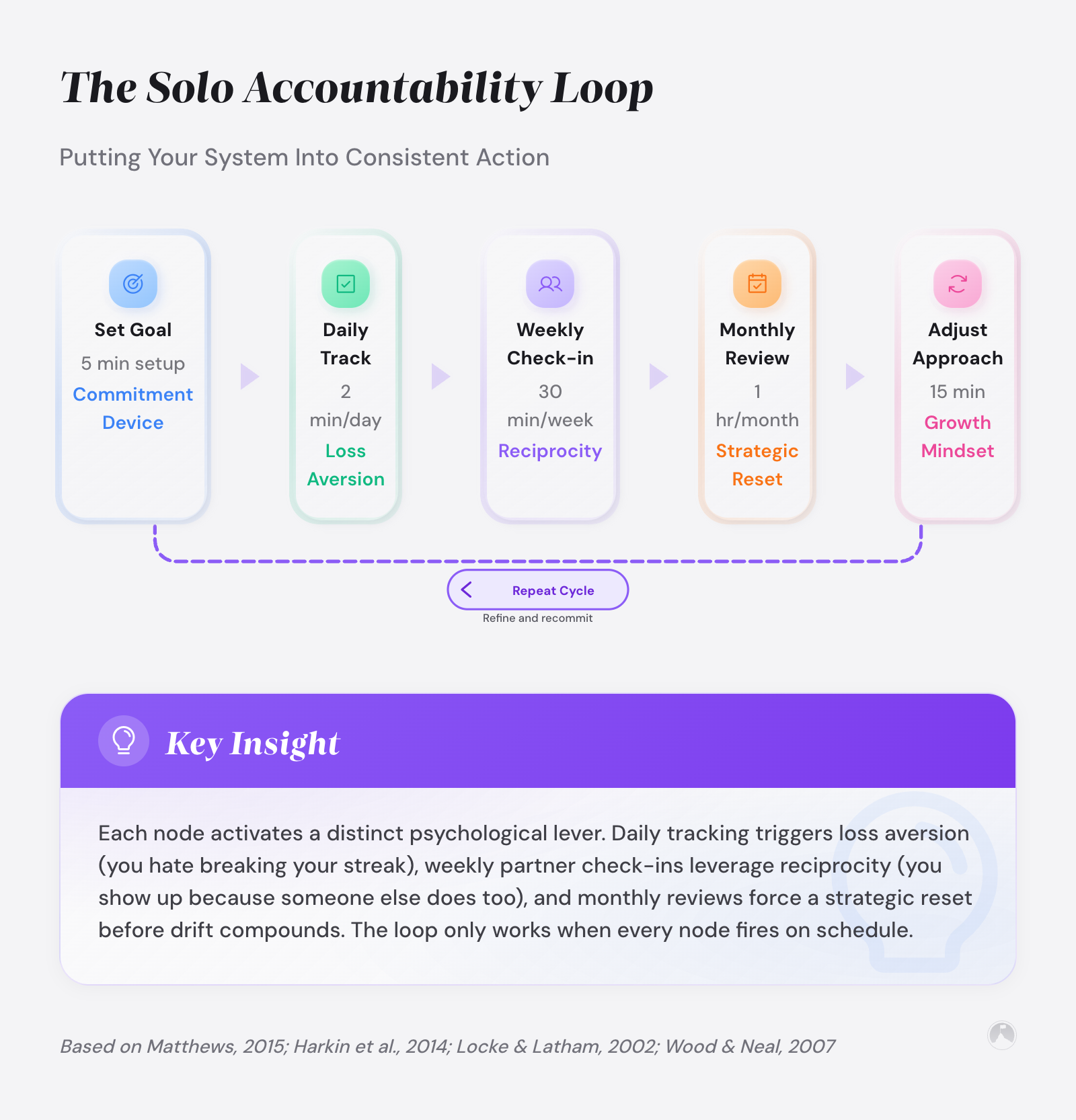
Here’s how it adapts for a solo business coach. Daily: log three outcomes — one client-facing (prepare session materials), one marketing (write newsletter draft), one operations (update CRM). Weekly: 30-minute mastermind call with two other coaches, sharing client pipeline numbers and one growth experiment result. Monthly: review client retention rate against quarterly revenue goal, decide whether to adjust pricing or marketing focus for the next cycle.
The Loop works because each layer feeds the next. Daily tracking gives the weekly check-in real data. Weekly check-ins surface patterns the monthly review can address. And monthly reviews reset priorities that shape the next round of daily outcomes.
Self-accountability strategies for solopreneurs fail when they operate on a single time horizon; the Solo Accountability Loop succeeds by operating on three simultaneously.
How do you measure if your accountability system is working?
An accountability system that feels good but doesn’t produce results is a social ritual, not a business tool. You need metrics to know whether your system is earning its time investment.
The Solo Accountability Metrics are three monthly measurements that distinguish a functioning accountability system from one in name only: commitment completion rate, goal velocity, and drift detection.
Track these three numbers monthly:
- Commitment completion rate measures the percentage of weekly commitments completed. A rate below 60% signals that commitments are too vague or too ambitious.
- Goal velocity measures whether quarterly goals are progressing at the pace required to meet the target deadline. If monthly milestones keep slipping, accountability is pointing forward without enough force.
- Drift detection measures how many days per week planned outcomes are displaced by unplanned work. More than two days signals a priority problem, not an accountability one.
These three metrics align with the structured goal measurement principles found in OKR (Objectives and Key Results) frameworks, where measurable key results replace vague objectives to create clear progress signals. The same principle applies to solo accountability: what gets measured with specificity gets managed.
So why not just track these yourself and skip the check-in? Because self-tracking alone lacks the psychological weight of reporting to another person.
Goal monitoring interventions promote goal attainment, with effects stronger when outcomes are reported publicly and monitored by someone else.
Harkin et al., Psychological Bulletin, 2016 [2]
Measuring accountability means tracking commitment completion rate, goal velocity, and drift frequency monthly (and sharing those numbers with someone who will ask about them). If all three trend in the right direction for 90 days, your system is working. If they stagnate or decline, the troubleshooting section below shows how to fix it.
What to do when your accountability system stops working
Every accountability system decays. Partners get busy. Check-ins become performative. The daily tracking habit fades after a strong first month. Here are the three most common failure modes and what to do about each.
Accountability decay The gradual loss of effectiveness in an accountability system caused by routine fatigue, vague commitments, or deteriorating partner engagement.
Solo accountability systems most commonly fail through three named patterns: vague commitments, partner mismatch, and tracking burnout — each with a specific and distinct fix.
Failure mode 1: Vague commitments. You tell your partner “I’ll work on marketing this week.” That’s not a commitment – that’s a direction. Fix it by switching to outcome-based language: “I’ll publish two LinkedIn posts and send 10 outreach emails by Friday.”
Locke and Latham’s research is clear on this point: specific, difficult goals outperform vague intentions across thousands of participants [3]. Vagueness is the most common way accountability systems die.
Failure mode 2: Partner mismatch. Your accountability partner runs a product business; you run a service business. Your challenges don’t overlap enough for the feedback to be useful.
The fix: find accountability partners for entrepreneurs in a similar business model, or switch to a mastermind group where you get multiple perspectives. Accountability groups for solo business owners work best when members share similar revenue stages (not necessarily similar industries).
Failure mode 3: Tracking burnout. You tracked daily outcomes for six weeks, then stopped. The fix is counterintuitive: track less, not more. Drop from daily to three times per week and lower the friction. If tracking starts feeling pointless, our guide on when goal tracking hurts explains when to simplify and when to stop entirely.
A lighter tracking habit that survives is worth more than a rigorous one that dies in month two.
Accountability systems don’t fail from a lack of motivation – they fail from vague commitments and too much complexity. The fix is almost always more specificity and less friction.
If you’re exploring goal tracking apps, choose tools that make daily logging fast (under two minutes) rather than tools that offer elaborate dashboards you’ll never maintain.
Ramon’s take
My read on this: skip the partner search until you’ve run the daily self-tracking for two weeks straight. Most people drop accountability systems before the human layer even matters. Get the solo habit working first.
I’ve seen the pattern over and over in the studies: solo founders with nothing but a spreadsheet and a weekly self-review outperform peers who had accountability partners but still missed targets repeatedly. The variable isn’t who’s watching – it’s whether you’ve built a feedback loop honest enough to show you the gap between what you planned and what you delivered.
That said, the human element matters for a different reason: a good accountability conversation surfaces the things you’re avoiding, not just the tasks you’re missing. The best accountability system is the one that makes lying to yourself harder than doing the work.
Conclusion
Accountability for solo entrepreneurs isn’t about finding one perfect tool or the right partner. It’s about building a layered system that matches the real structure of solo work: daily execution, weekly reflection, monthly strategic adjustment.
Matthews’ research shows that writing goals down and sharing them produces dramatically higher completion rates [1]. And Harkin and colleagues’ meta-analysis confirms that structured monitoring with an external partner amplifies those effects further [2]. The Solo Accountability Loop gives you a framework for putting that research into practice without overcomplicating your already-full schedule.
For a broader view of how accountability fits into your overall goal tracking system, start there and branch into the specific approaches that match your current business stage. And if you’re an ADHD entrepreneur looking for adapted systems, our guide on accountability systems for ADHD creatives covers strategies for neurodivergent founders. If you want a structured workbook to map your goals before building accountability around them, the Life Goals Workbook pairs well with the Solo Accountability Loop.
The most effective accountability system is the one that makes self-deception harder than execution.
In the next 10 minutes
- Write down three specific outcomes you’ll complete tomorrow morning (outcomes, not tasks).
- Text one person you trust and propose a 20-minute weekly accountability call.
- Open a new note or spreadsheet and label it “Daily Outcomes Tracker.”
This week
- Hold your first weekly check-in with your accountability partner or group.
- Track daily outcomes for five consecutive days and review your completion rate on Friday.
- Decide which accountability type (partner, coach, mastermind, or hybrid) fits your current stage.
There is more to explore
For more strategies on building accountability into your workflow, explore the related guides linked in the conclusion above — including accountability for ADHD creatives, the full goal tracking system overview, and the Life Goals Workbook.
Related articles in this guide
- accountability-strategies-for-working-parents
- accountability-systems-for-adhd-creatives
- best-goal-setting-methods-compared
Frequently asked questions
How do I stay accountable without employees or a team?
Build a three-layer system: daily self-tracking of outcomes, a weekly check-in with one trusted person, and a monthly strategic solo review. Matthews’ Dominican University research shows writing goals down and reporting weekly raises completion rates from 43% to 76% [1]. The key is replacing team-based oversight with structured self-reporting that includes at least one external touchpoint per week.
Should I join an accountability group or find a one-on-one partner?
Start with a one-on-one partner if you’ve never used external accountability before. The lower coordination cost makes it easier to build the habit. Move to a mastermind group once you need strategic feedback from multiple perspectives, typically after your first year in business or once revenue exceeds $30K annually.
What are the most common accountability mistakes solo entrepreneurs make?
The three biggest mistakes are vague commitments, partner mismatch, and tracking burnout. A quick diagnostic for each: Can your accountability partner repeat your weekly commitment in one sentence? If not, the commitment is too vague. Does your partner understand the business model challenges you face? If not, the match needs adjustment. Have you tracked outcomes for more than four consecutive weeks? If not, reduce tracking frequency before the habit breaks entirely.
Can accountability apps replace human accountability partners?
Apps handle tracking and reminders well but cannot replace the psychological effect of committing to another person. Harkin and colleagues’ meta-analysis of 138 studies found that goal monitoring effects were significantly larger when progress was reported to and monitored by an external partner rather than tracked privately [2]. Use apps as your daily tracking layer and humans for weekly reflection and strategic feedback.
How much time should I invest in accountability each week?
Budget 30-45 minutes per week for human accountability: a 20-minute partner call plus 10-15 minutes of prep reviewing your weekly tracking data. Add 5 minutes daily for outcome logging. Total weekly investment is roughly 75 minutes. Any system requiring more than two hours weekly is likely too complex for a solo operation.
How do I know if my accountability system is working?
Track three metrics monthly: commitment completion rate (percentage of weekly commitments finished), goal velocity (whether quarterly milestones are on pace), and drift frequency (how many days per week you deviate from planned outcomes). If all three trend positively over 90 days, the system is working. If they stagnate, use the troubleshooting framework in the article.
References
[1] Matthews, G. (2015). “The Impact of Commitment, Accountability, and Written Goals on Goal Achievement.” Presentation at Ninth Annual International Conference of ATINER, Dominican University of California. https://scholar.dominican.edu/psychology-faculty-conference-presentations/3/
[2] Harkin, B., Webb, T. L., Chang, B. P. I., Prestwich, A., Conner, M., Kellar, I., Benn, Y., and Sheeran, P. (2016). “Does Monitoring Goal Progress Promote Goal Attainment? A Meta-Analysis of the Experimental Evidence.” Psychological Bulletin, 142(2), 198-229. https://doi.org/10.1037/bul0000025
[3] Locke, E. A. and Latham, G. P. (2002). “Building a Practically Useful Theory of Goal Setting and Task Motivation: A 35-Year Odyssey.” American Psychologist, 57(9), 705-717. https://doi.org/10.1037/0003-066X.57.9.705
[4] Hmieleski, K. M. and Baron, R. A. (2009). “Entrepreneurs’ Optimism and New Venture Performance: A Social Cognitive Perspective.” Academy of Management Journal, 52(3), 473-488. https://doi.org/10.5465/amj.2009.41330755
[5] Theeboom, T., Beersma, B., and van Vianen, A. E. (2014). “Does Coaching Work? A Meta-Analysis on the Effects of Coaching on Individual Level Outcomes in an Organizational Context.” Journal of Positive Psychology, 9(1), 1-18. https://doi.org/10.1080/17439760.2013.837499
[6] Wood, W. and Neal, D. T. (2007). “A New Look at Habits and the Habit-Goal Interface.” Psychological Review, 114(4), 843-863. https://doi.org/10.1037/0033-295X.114.4.843