
What does accountability psychology actually explain about behavior change?
The standard accountability pitch goes like this: find a buddy, make a promise, check in weekly (and somehow everything works out). And it sounds reasonable. But accountability psychology tells a more complicated story than “get someone to watch you.”
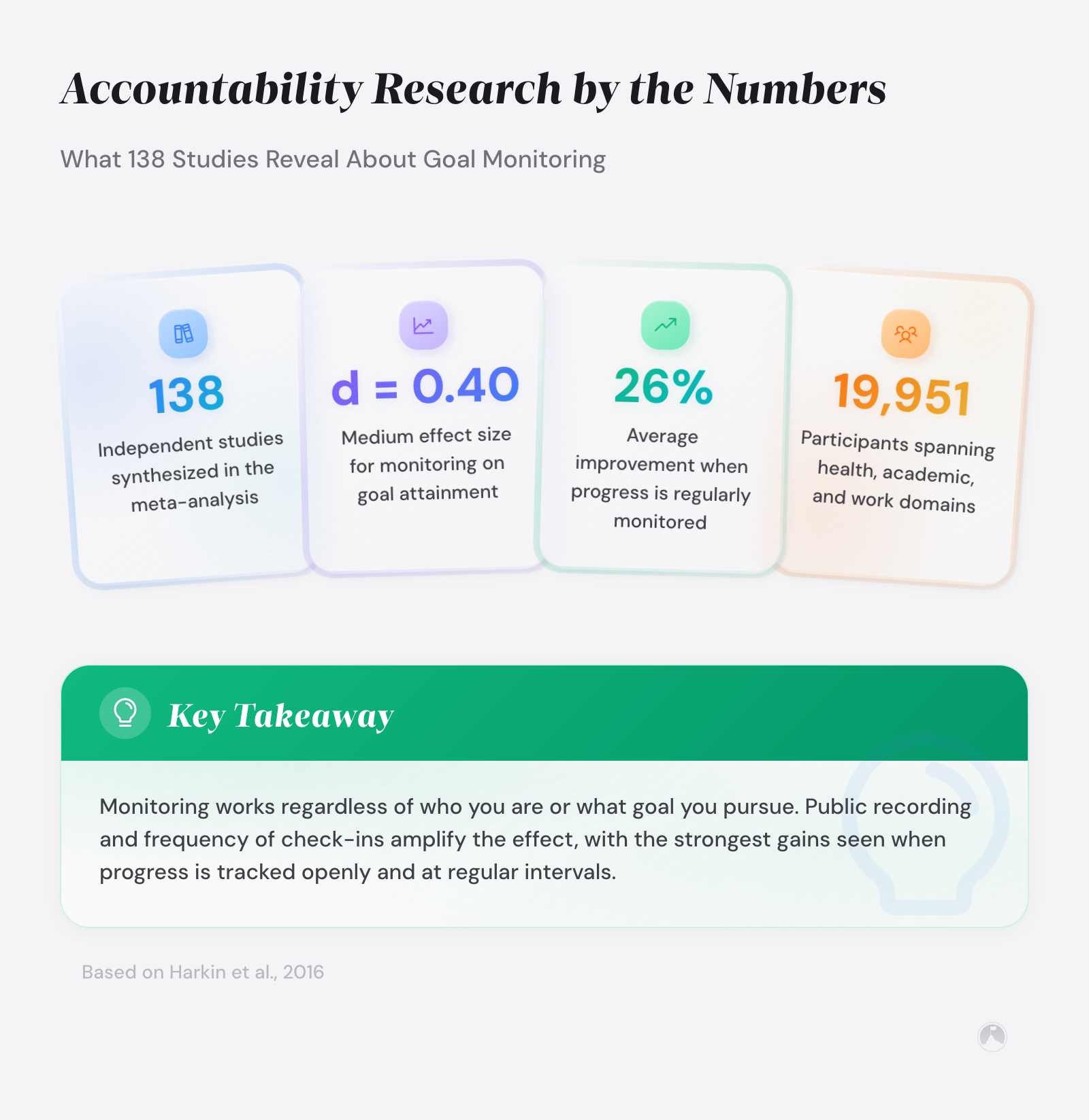
Dr. Gail Matthews at Dominican University conducted one of the most cited studies on goal achievement, finding that participants who wrote down their goals and sent weekly progress reports to a friend achieved significantly more than those who simply thought about their goals [1]. A large-scale meta-analysis by Harkin et al. (2016), covering 138 studies and nearly 19,951 participants, confirmed that monitoring goal progress has a significant positive effect on goal attainment [2]. That gap between unmonitored and monitored goals is one of the most consistent patterns in accountability research.
Accountability psychology is the study of why people follow through on goals when external observers are watching or expecting progress. The field draws on consistency bias, social contracts, loss aversion, and the Hawthorne effect to explain how external structures change behavior – and under what conditions they backfire.
So why do most accountability setups still fail?
But most advice about accountability stops at “find a buddy.” It doesn’t explain why being watched changes behavior, what psychological mechanisms drive the accountability effect, or when accountability quietly does more harm than good. This article covers the science, the mechanisms, and the honest tradeoffs of building accountability for goals into your goal tracking systems.
Key takeaways
- A meta-analysis of 138 studies found that monitoring goal progress significantly improves goal attainment across diverse populations and goal types [2].
- Four psychological mechanisms drive accountability: consistency principle, social contracts, loss aversion, and the Hawthorne effect.
- Writing goals down and sharing progress with a friend increases achievement by 33% compared to unwritten goals [1].
- The Accountability Spectrum ranges from self-monitoring to financial stakes, each activating different psychological triggers.
- Accountability backfires when it undermines autonomy, triggers shame, or replaces intrinsic motivation with external pressure.
- Self-Determination Theory explains why controlling accountability kills motivation, yet supportive accountability fuels it [6].
- Effective accountability systems match the mechanism to the person and the goal type.
What does accountability research actually show?
The science of accountability isn’t built on a single study. It’s a pattern that keeps showing up across social psychology, behavioral economics, and organizational research.
Dr. Gail Matthews at Dominican University conducted one of the most cited studies on goal achievement in 2015. Matthews found that participants who wrote down their goals and sent weekly progress reports to a friend achieved 33% more than those who simply thought about their goals [1]. Matthews’ study was presented at a conference and published through Dominican Scholar; it has not been published in a peer-reviewed journal, though its findings align with the larger meta-analytic evidence from Harkin et al. (2016). Writing goals down matters, but sharing them with someone who checks in is what moves the needle.
The Harkin et al. (2016) meta-analysis provides the most comprehensive evidence base for accountability psychology. Across 138 experimental studies and nearly 19,951 participants, they found that monitoring goal progress promotes goal attainment with a small-to-medium effect size [2]. The effect was strongest when monitoring was physically recorded rather than kept in memory, and when progress was reported to others. Building a weekly goal review process creates exactly this kind of structured accountability checkpoint.
Participants who wrote down their goals, shared them with a friend, and sent weekly progress reports achieved 33% more than those who merely thought about their goals. — Matthews, G., Dominican University of California, 2015 [1]
This finding has been widely cited as evidence that accountability structures, not intentions, drive goal completion.
The structure matters as much as the social pressure. Informal “I’ll let you know how it goes” arrangements produce weaker results than scheduled appointments with a specific time and format. So what exactly is happening in your brain when someone else knows about your goals?
Why does accountability psychology actually work?
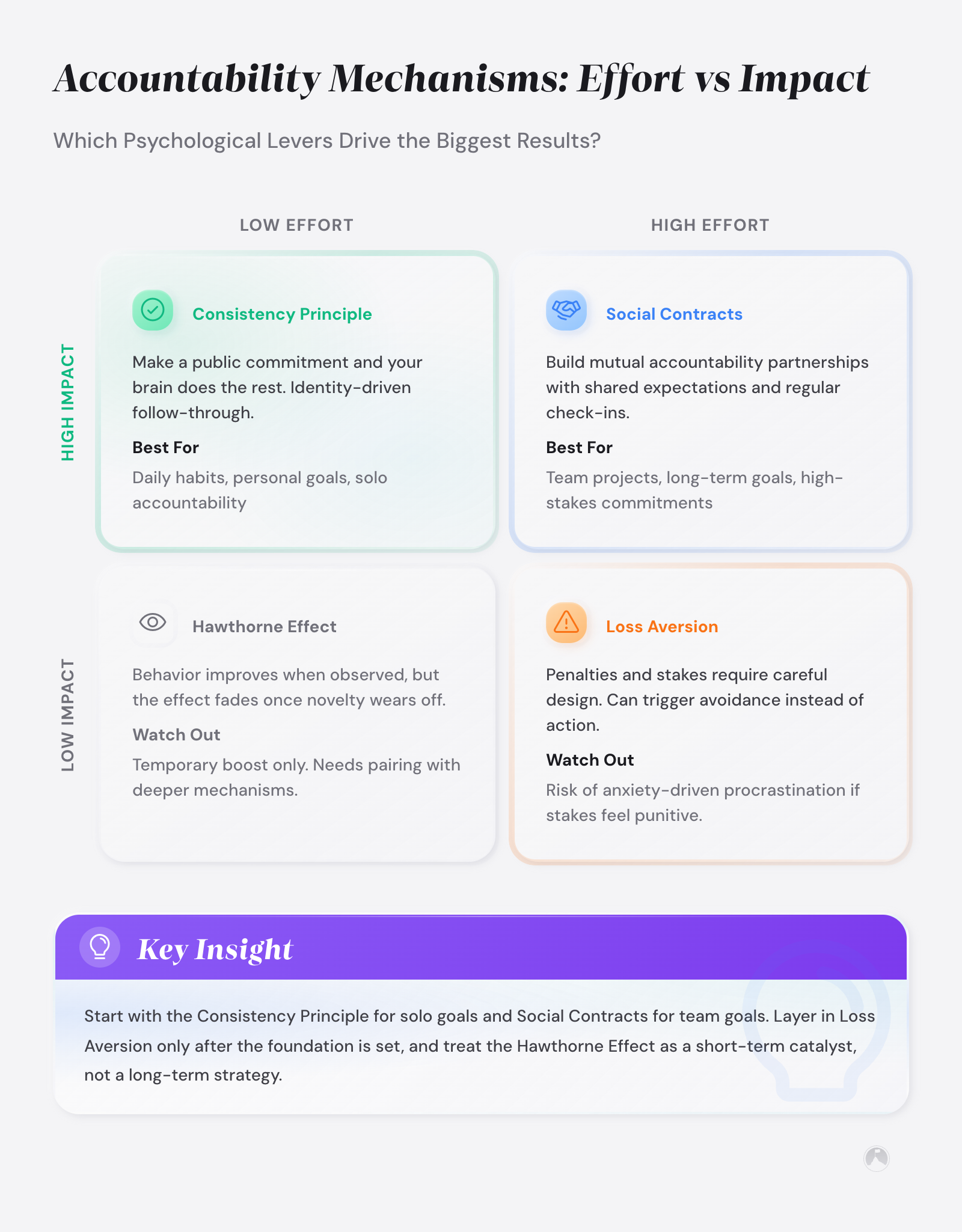
Four psychological mechanisms explain why accountability works for changing behavior. Each one operates independently, but they’re most powerful in combination.
How does the consistency principle explain accountability’s effect on behavior?
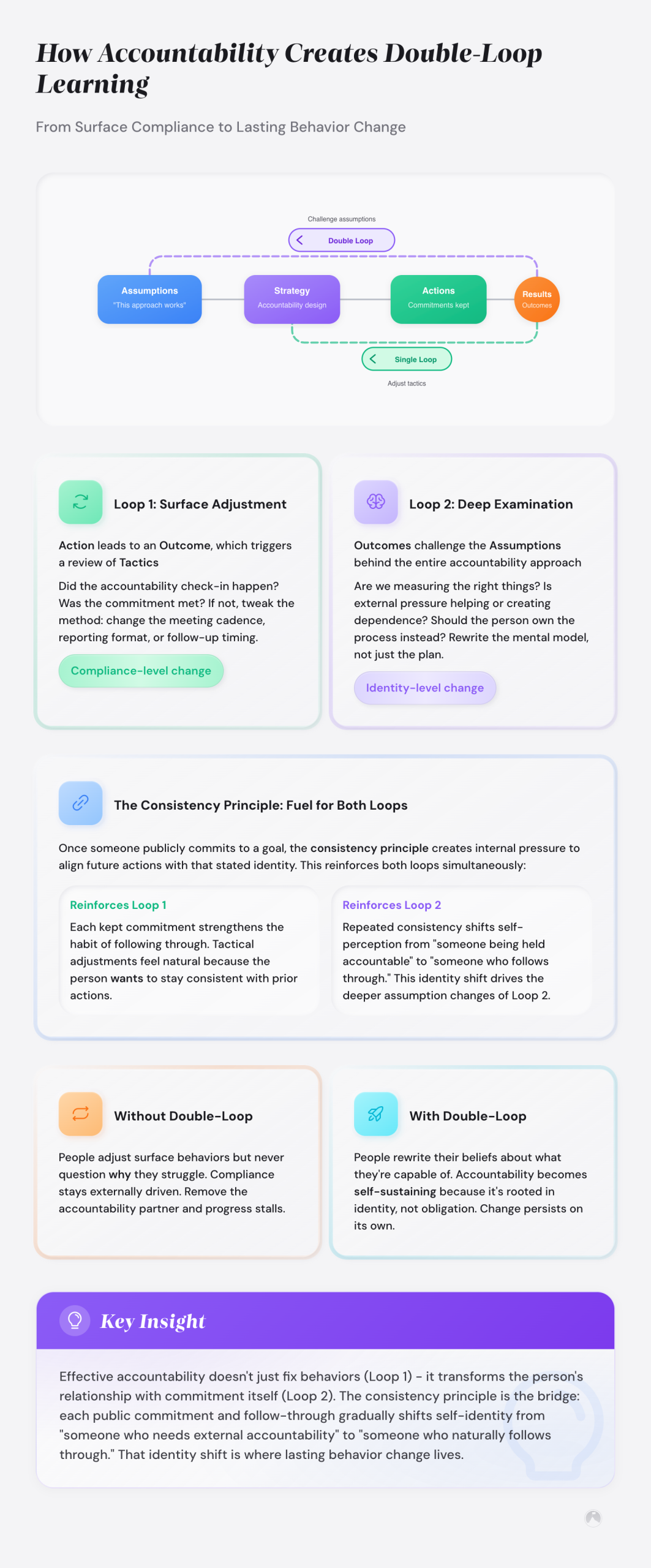
Robert Cialdini’s research on influence identified consistency as one of the most powerful drivers of human behavior [3]. Once you make a public commitment to a goal (what researchers call goal commitment) your brain creates internal pressure to act in ways that match that commitment. It’s not about willpower. It’s about identity.
Here’s what this looks like in practice. You tell your running partner “I’m training three days a week.” Two weeks later, your alarm goes off at 6 a.m. and you don’t feel like getting up. But you get up anyway, not because you’re disciplined, but because skipping creates a gap between what you said and what you did.
That gap feels genuinely uncomfortable. Public commitments create a psychological debt that only action can repay [3].
This connects directly to how different goal setting methods use commitment, where researchers have found that stated intentions shape subsequent behavior.
Why do social contracts and reciprocity drive accountability compliance?
Accountability creates an implicit social contract. When someone agrees to check on your progress, you’ve entered a reciprocal arrangement. Breaking that contract carries social costs (even small ones). You don’t want to disappoint someone who invested time in tracking your progress.
This is why structured accountability partnerships work better than solo goal tracking. The social contract adds a layer of motivation that doesn’t exist when you’re only answerable to yourself. Solo professionals face a unique version of this challenge, which is why accountability strategies designed for solo entrepreneurs require different approaches than partner-based systems.
How does loss aversion make accountability more powerful than intrinsic motivation alone?
Behavioral economics shows that people feel losses roughly twice as strongly as equivalent gains. Daniel Kahneman and Amos Tversky’s prospect theory established this asymmetry as one of the most reliable findings in decision science [4]. Accountability frames potential failure as a social loss: the loss of credibility, someone’s respect, your self-image as reliable.
Failing publicly feels roughly twice as painful as succeeding feels rewarding – Kahneman and Tversky’s prospect theory applied to social reputation [4]. And this mechanism explains why commitment devices that involve real stakes, like financial penalties, produce higher follow-through rates than verbal agreements alone.
What is the Hawthorne effect and why does it matter for accountability?
The original Hawthorne studies from the 1920s, conducted by Elton Mayo and later documented by Roethlisberger and Dickson, found something that reshaped workplace psychology: workers at a Western Electric factory became more productive simply from knowing researchers were observing them [5]. The effect wasn’t about the specific changes made to working conditions. It was about being watched.
Later analyses by Levitt and List (2011) questioned whether the original Hawthorne data fully supports the claimed effect, though the broader principle – that observation influences behavior – has been replicated in numerous other settings [9].
Mayo’s Hawthorne studies showed that worker productivity increased regardless of what environmental changes were made, simply because participants knew they were being observed [5]. — Mayo, E., The Human Problems of an Industrial Civilization, 1933 [5]
This finding, while debated in its original form, remains a cornerstone of accountability psychology in its broader principle.
Observation changes behavior before feedback ever arrives. This is the most basic mechanism of accountability. Knowing that someone will see your progress, or your lack of it, is often enough to change what you do. But which type of accountability activates which mechanism?
Accountability psychology across different types: from self to social
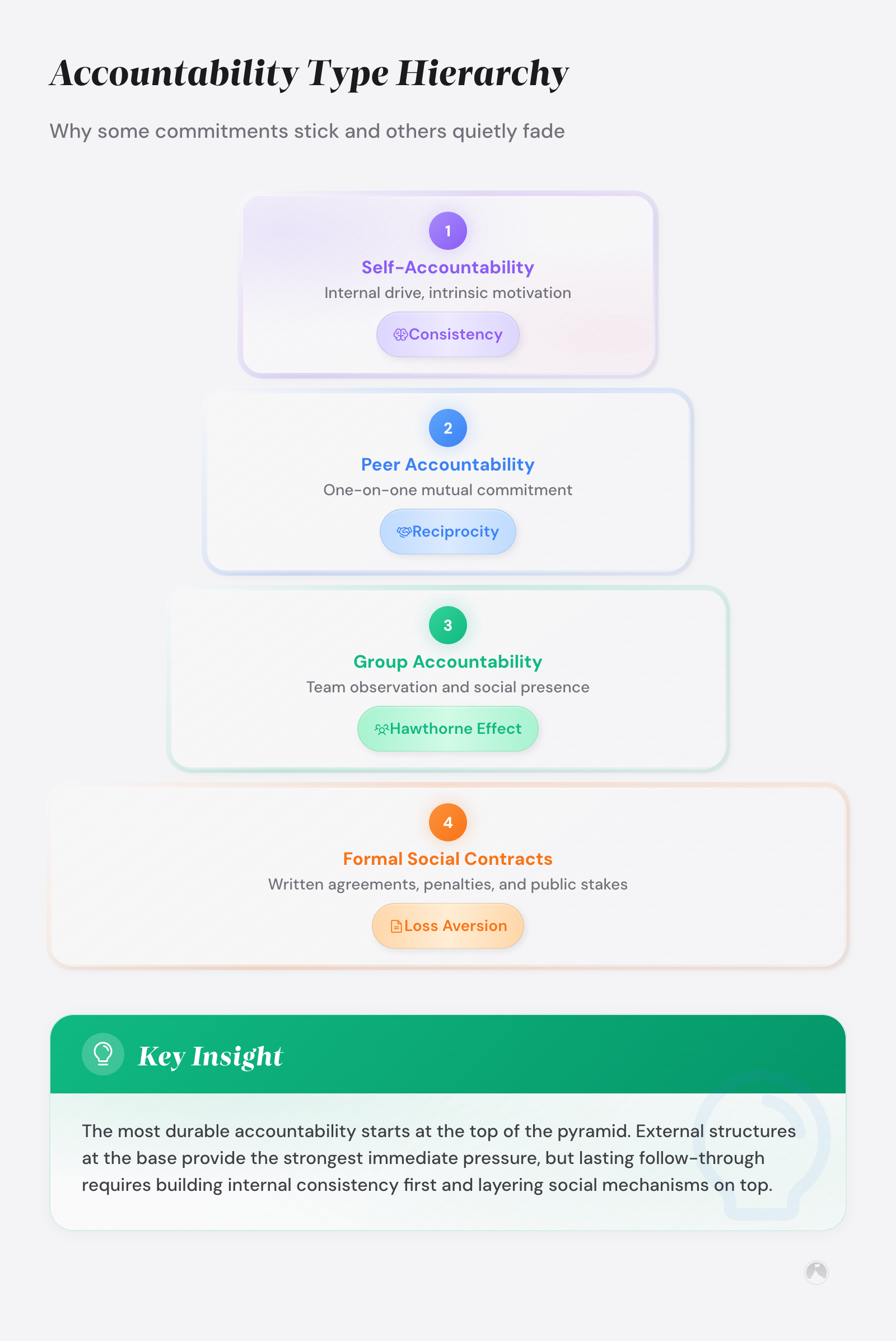
Not all accountability is the same. Different types activate different psychological mechanisms, and what works for one person or goal might fail for another. Understanding accountability and goal achievement means matching the right mechanism to the right context.
| Type | Mechanism Activated | Best For | Risk Level |
|---|---|---|---|
| Self-monitoring | Awareness, consistency | Daily habits, ongoing tracking | Low intensity |
| Partner accountability | Social contract, reciprocity | Medium-term goals, skill building | Medium – depends on partner quality |
| Group accountability | Social facilitation, norms | Behavior change, fitness, learning | Medium – group dynamics can distort |
| Public accountability | Hawthorne effect, identity | Bold commitments, creative output | High – shame risk if poorly managed |
| Financial accountability | Loss aversion, commitment | Specific measurable targets | High – can feel punitive |
Self-monitoring is the gentlest form. Tracking your own behavior through journaling, apps, or simple checklists activates awareness without social pressure. It’s a starting point, not an endpoint. The best goal tracking apps can create a lightweight self-accountability loop that builds consistency over time.
Partner accountability adds social weight. Matthews’ study showed this is where the biggest jump in effectiveness occurs [1]. But partner quality matters: a partner who nags triggers resistance, and a partner who asks genuine questions creates support. Choosing the right partner is half the strategy.
Group accountability uses what psychologist Robert Zajonc identified as social facilitation, the phenomenon where people perform better in the presence of others doing similar work [10]. The group establishes a norm of progress that members absorb. People with ADHD or creative temperaments often find group settings particularly effective, which is why accountability systems designed for ADHD creatives lean heavily on community-based structures.
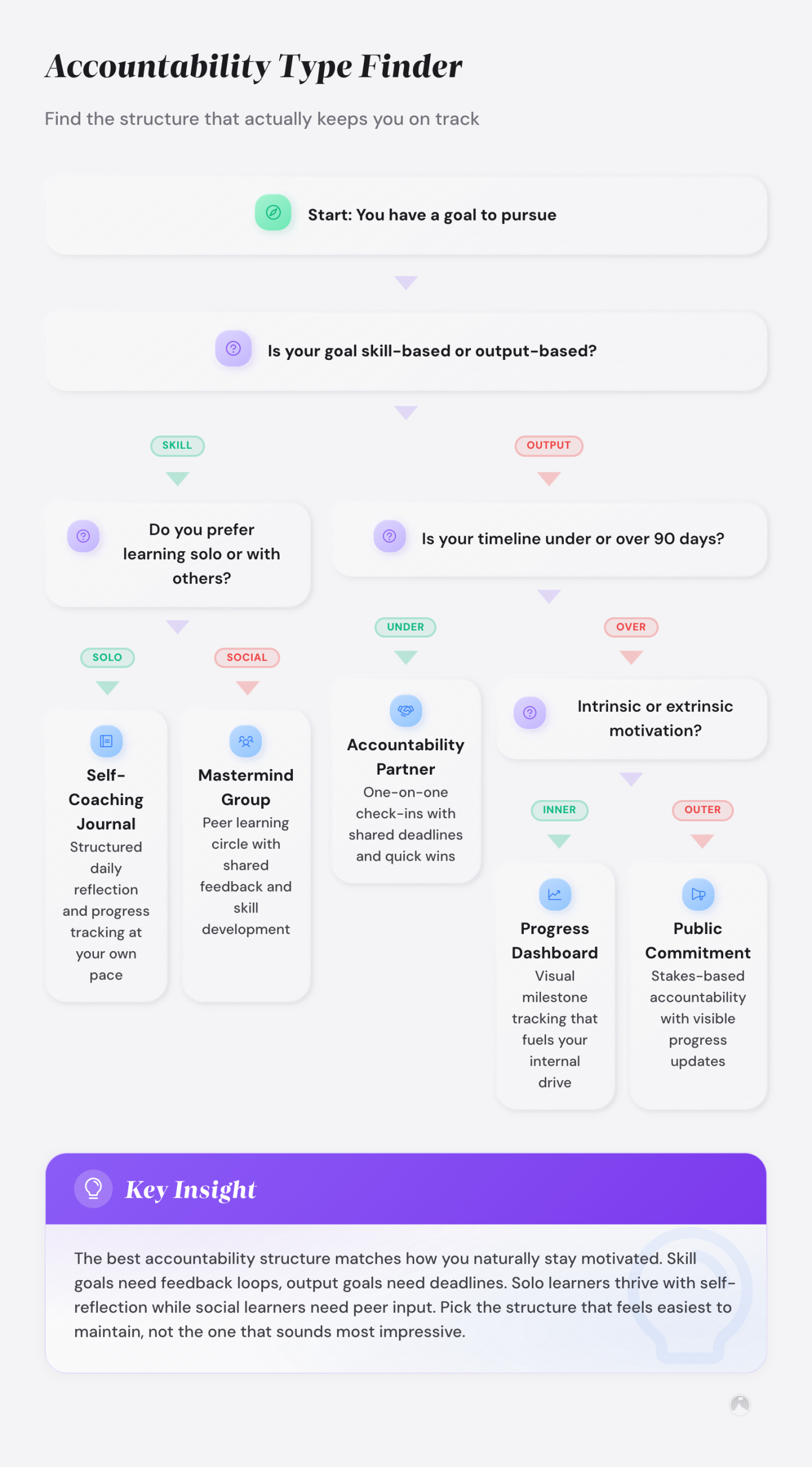
Accountability Type Finder
Match your goal type to the right accountability mechanism:
Start with: Self-monitoring (streak tracker)
Level up to: Group (fitness class, book club)
Start with: Partner (weekly check-in)
Level up to: Public (blog, portfolio updates)
Start with: Partner (deadline buddy)
Level up to: Financial (deposit at stake)
Start with: Group (support community)
Level up to: Partner + financial hybrid
Financial accountability is the heaviest tool (and the most polarizing). Services like StickK and Beeminder lock you into consequences through commitment contracts. Research by Kaur, Kremer, and Mullainathan found that adding financial consequences significantly increased goal completion rates [8]. Put money on the line, and loss aversion kicks into high gear.
The right accountability type isn’t the strongest one. It’s the one that matches the goal.
When does accountability psychology backfire?
Here’s the part most articles leave out. Accountability doesn’t always help. Sometimes it actively sabotages the goals you’re trying to reach. Understanding when goal tracking hurts rather than helps is important for designing accountability that actually works.
The autonomy problem
Edward Deci and Richard Ryan’s Self-Determination Theory identifies three basic psychological needs: autonomy, competence, and relatedness [6]. When accountability feels controlling rather than supportive, it directly undermines autonomy, and motivation collapses. This tension between intrinsic and extrinsic motivation in goal pursuit is central to understanding why accountability sometimes fails.
Here’s a concrete example. A manager who sends a daily “did you finish the report?” email gets worse results than a manager who asks “how’s the project going – anything blocking you?” Both are accountability. But the first feels like surveillance and the second feels like support.
Same frequency, same intent, radically different outcome.
Deci and Ryan’s research shows that controlling accountability that threatens a person’s sense of autonomy reduces intrinsic motivation, even when the person originally wanted to pursue the goal [6]. This is why a nagging accountability partner often produces worse results than no partner at all. Accountability that removes choice kills the motivation it was supposed to protect.
The shame spiral
There’s a meaningful difference between guilt and shame in accountability contexts. Guilt says “I didn’t do what I said I would.” Shame says “I am a failure.” When accountability triggers shame rather than guilt, people withdraw rather than course-correct.
This happens most often with public accountability (which is most of social media, if we’re being honest). Announcing a goal online and then failing publicly doesn’t just hurt. It can create an association between goal-setting itself and emotional pain. The next goal feels more threatening, not less.
The performance trap
Peter Gollwitzer and Gabriele Oettingen’s research on goal publicity found that publicly announcing identity-based goals (“I’m going to become a writer”) can actually reduce follow-through [7]. The social recognition received from the announcement can substitute for the actual work, creating a premature sense of completion. This is particularly true for goals tied to identity transformation rather than specific measurable outcomes. If you’re tracking goals with digital spreadsheets or using goal achievement reviews for course correction, keep the tracking private until you’ve built momentum.
So accountability can undermine autonomy, trigger shame, or give you credit you haven’t earned. That doesn’t mean it’s broken. It means you need to match the mechanism to the situation.
The Accountability Spectrum: matching mechanisms to goals
Rather than treating accountability as one thing, think of it as a spectrum of mechanisms you can dial up or down based on the goal, the person, and the context.
The Accountability Spectrum is a framework for matching accountability intensity to goal type, where self-monitoring anchors the low end and financial commitment devices anchor the high end. The right position on the spectrum depends on goal measurability, timeline, and the person’s relationship with external pressure.
The Accountability Spectrum operates on the principle that accountability effectiveness depends on matching mechanism intensity to goal difficulty – self-monitoring for habits, partner accountability for projects, financial stakes for high-importance commitments.
The Accountability Spectrum works because different goals activate different psychological needs. A daily meditation habit needs gentle self-monitoring, not a financial penalty for missing a day. But a commitment to finish a manuscript by June might need the heavier mechanisms: a partner with scheduled check-ins and real consequences for missed deadlines.
Here’s a practical example. Someone training for a marathon might start with self-monitoring (tracking runs in an app), add partner accountability at month two (joining a running group), and layer in public accountability closer to race day (sharing training progress). Each mechanism enters when the psychological need shifts from awareness to social pressure to identity commitment.
The mistake most people make is choosing one accountability mechanism and applying it to everything. That’s like using a hammer for every repair job. Effective accountability matches the intensity of the mechanism to the difficulty of the goal. Different stages of the same goal might need different positions on the spectrum.
To build your own accountability approach into a broader system, explore our complete guide to goal tracking systems, which covers how accountability fits alongside tracking methods, review processes, and goal setting frameworks. You can also compare different goal tracking methods to find the system that pairs best with your preferred accountability style.
The question isn’t whether accountability works. It’s which kind of accountability works for a specific goal, in a specific context, right now.
Ramon’s take
Before you build a whole accountability system, just pick one type that fits your goal. Public stakes for habits you want to build. Private tracking for personal stuff. Mixing everything at once is probably why the last system didn’t stick.
Conclusion
Accountability psychology isn’t a single trick. It’s a set of mechanisms (consistency, social contracts, loss aversion, observation) that you can combine based on what your specific goal demands. The research is clear that structured accountability dramatically improves goal completion [1][2]. But the research is equally clear that the wrong kind of accountability undermines motivation and triggers withdrawal [6].
The goal isn’t maximum accountability. It’s the right accountability, matched to the right goal, at the right intensity.
Match the mechanism to the moment, and accountability becomes invisible until the day you try to walk away.
To build accountability into a complete goal tracking approach, start with our goal tracking systems guide.
In the next 10 minutes
- Pick one current goal and identify where it falls on the Accountability Spectrum (self-monitoring through financial commitment).
- Write the goal down and share it with one person who will ask about it, not nag about it.
- Schedule a single 15-minute check-in with that person for next week.
This week
- Set up a basic self-monitoring system for one goal (a simple spreadsheet, app, or journal entry works).
- Have a conversation with your accountability partner about what kind of check-ins feel supportive vs. controlling.
- Review your goal tracking system and identify which goals lack any accountability mechanism.
Related articles in this guide
- accountability-solo-entrepreneurs
- accountability-strategies-for-working-parents
- accountability-systems-for-adhd-creatives
Frequently asked questions
Why does accountability work for goals according to psychology?
Accountability activates four psychological mechanisms simultaneously. Robert Cialdini’s consistency principle means public commitments create internal pressure to follow through [3]. Social contracts mean not wanting to let down someone who invested time in checking progress. Kahneman and Tversky’s loss aversion means failing publicly feels worse than succeeding feels good [4]. The Hawthorne effect means being observed changes behavior [5]. These mechanisms operate independently of willpower, which is why accountability works even when motivation fades.
Does having an accountability partner actually increase goal completion rates?
Research from Dr. Gail Matthews at Dominican University found that sharing weekly progress with a friend increased goal achievement by 33% compared to keeping goals private [1]. A meta-analysis by Harkin et al. covering 138 studies confirmed that monitoring progress – especially when reported to others – significantly improves goal attainment [2]. Partner quality matters as much as partner presence. A partner who asks curious questions outperforms one who tracks compliance.
What is the difference between accountability and shame in goal pursuit?
Accountability produces guilt (I did not do what I said I would), which motivates corrective action. Shame produces identity threat (I am a failure), which motivates withdrawal and avoidance. The difference depends on framing. Supportive accountability focuses on behavior and progress. Punitive accountability focuses on the person and their worth. If accountability consistently triggers shame rather than constructive guilt, the accountability structure needs changing, not the effort level.
Can accountability actually harm motivation for certain goals?
Yes. Deci and Ryan’s Self-Determination Theory research shows that controlling accountability undermines intrinsic motivation by threatening autonomy [6]. This is most common with externally imposed accountability (a boss tracking hours) versus self-chosen accountability (asking a friend to check in). Gollwitzer’s research also found that identity-based goals are particularly vulnerable, as public announcements can create premature satisfaction before the work is done [7].
How do I hold myself accountable without an accountability partner?
Self-accountability works through environmental design rather than willpower. Use visible tracking (a wall calendar with X marks, a streak counter) to activate the observation effect on yourself. Create implementation intentions that specify when, where, and how to act on a goal. Build commitment devices that make quitting costly, like prepaying for a class or deleting distracting apps. Self-monitoring apps and goal tracking spreadsheets create a lightweight accountability loop that Harkin et al.’s meta-analysis confirmed as effective [2].
What is the Hawthorne effect and how does it relate to accountability?
The Hawthorne effect describes how people change their behavior when they know they are being observed, first documented in Elton Mayo’s 1920s factory studies [5]. Later analyses by Levitt and List (2011) questioned whether the original data fully supports the claimed effect, though the broader principle has been replicated in other settings [9]. For accountability, this means that self-observation tools (visible trackers, journaling, app dashboards) can partially replicate the effect without requiring a partner.
References
- Matthews, G. (2015). “The Impact of Commitment, Accountability, and Written Goals on Goal Achievement.” Dominican University of California Psychology Faculty Publications. https://scholar.dominican.edu/cgi/viewcontent.cgi?article=1265&context=news-releases
- Harkin, B., Webb, T. L., Chang, B. P. I., Prestwich, A., Conner, M., Kellar, I., Benn, Y., & Sheeran, P. (2016). “Does Monitoring Goal Progress Promote Goal Attainment? A Meta-Analysis of the Experimental Evidence.” Psychological Bulletin, 142(2), 198-229. https://doi.org/10.1037/bul0000025
- Cialdini, R. B. (2006). Influence: The Psychology of Persuasion (Rev. Ed.). HarperBusiness. ISBN: 978-0-06-124189-5. https://www.amazon.com/Influence-Psychology-Persuasion-Robert-Cialdini/dp/006124189X
- Kahneman, D., & Tversky, A. (1979). “Prospect Theory: An Analysis of Decision under Risk.” Econometrica, 47(2), 263-291. https://doi.org/10.2307/1914185
- Mayo, E. (1933). The Human Problems of an Industrial Civilization. Macmillan. https://archive.org/details/humanproblems. See also: Roethlisberger, F. J., & Dickson, W. J. (1939). Management and the Worker. Harvard University Press. Modern evaluation: Wickstrom, G., & Bendix, T. (2000). “The Hawthorne Effect.” Scandinavian Journal of Work, Environment & Health, 26(4), 363-367. https://doi.org/10.5271/sjweh.555
- Deci, E. L., & Ryan, R. M. (2000). “The ‘What’ and ‘Why’ of Goal Pursuits: Human Needs and the Self-Determination of Behavior.” Psychological Inquiry, 11(4), 227-268. https://doi.org/10.1207/S15327965PLI1104_01
- Gollwitzer, P. M., & Oettingen, G. (2012). “Goal Pursuit.” In R. M. Ryan (Ed.), Oxford Handbook of Motivation (pp. 208-231). Oxford University Press. https://doi.org/10.1093/oxfordhb/9780195399820.013.0013
- Kaur, S., Kremer, M., & Mullainathan, S. (2015). “Self-Control at Work.” Journal of Political Economy, 123(6), 1227-1277. https://doi.org/10.1086/682679
- Levitt, S. D., & List, J. A. (2011). “Was There Really a Hawthorne Effect at the Hawthorne Plant? An Analysis of the Original Illumination Experiments.” American Economic Journal: Applied Economics, 3(1), 224-238. https://doi.org/10.1257/app.3.1.224
- Zajonc, R. B. (1965). “Social Facilitation.” Science, 149(3681), 269-274. https://doi.org/10.1126/science.149.3681.269